The Titaness
"Thanks for the kind thoughts. Water was fine and swimming good. Neptune was exceedingly kind to me and I am now high and dry." ~Margaret Tobin Brown in a letter to her attorney after the Titanic tragedy
.jpg) “I don’t care what the newspapers say about me, as long as they say something.” ~Margaret Tobin Brown
“I don’t care what the newspapers say about me, as long as they say something.” ~Margaret Tobin Brown
If one were to shake the snow globe of the Gilded Age heiresses, the flakes would reveal nights at the Metropolitan Opera House, dancing the quadrille at Newport balls, shopping at Macy’s. A discordant image would be of millionaire Margaret Tobin Brown rowing a lifeboat along the frigid waves of the North Atlantic Ocean as the White Star Line’s crown jewel performed its swan song.
Of all the storied individuals who went down on the RMS (Royal Mail Ship) Titanic, the women featured in several theatrical productions was wealthy Margaret Tobin Brown-mostly remembered by a different name. In 1960, Richard Morris’s hit musical, The Unsinkable Molly Brown, centered on Margaret-called Molly as two syllables were more lyrical than three. Kathy Bates portrayed Margaret in James Cameron’s epic film, Titanic, that centered on a love-triangle: Rose, her millionaire fiancée, and her indigent lover. In the movie, Margaret lent Jack her son’s tuxedo so he could make an impression on Rose.
The ”unsinkable Molly Brown” was born near the Mississippi River in a home that is currently the Molly Brown Birthplace & Museum. Her Missouri hometown, Hanibal, also produced Samuel Clemens, pen name Mark Twain, the author of Tom Sawyer and Huckleberry Finn. Her parents, John and Johanna Tobin, were Irish immigrants who had fled the Potato Famine. Both had been widowed, the parents of one child when they remarried, and together they had four more. The children attended their Aunt Mary O’Leary’s grammar school where Margaret studied until the eighth grade- three years more than the average for girls from the lower-class. A more valuable education came from John, an abolitionist who had participated in the raid on Harper’s Ferry. He instilled in his children a social conscience and explained it was their duty to help the marginalized: the Irish- Catholics and the recently freed blacks.
At age thirteen, Elizabeth worked at the Garth Tobacco Factory where she endured grueling conditions. Perhaps inspired by the Mark Twin tales, the eighteen-year-old Elizabeth followed her sister Mary Ann and her brother-in-law Jack Landrigan to Leadville, Colorado, a magnet for those seeking the Pied Piper of its mines. On time off from her position in a dry goods store, Elizabeth attended a picnic sponsored by the Church of the Anunciation where she met James Joseph, (J.J.), Brown, thirteen years her senior. They shared the commonality of Irish immigrant parentage, straitened circumstances, and passion for the Tabor Opera House. After a six-month courtship, in 1886, nineteen-year-old Margaret married J.J. in the Church of the Anunciation. They moved to Stumpftown, a town close to the mines, where they welcomed son Lawrence Palmer, nicknamed Larry, and Catherine Ellen, (known as Helen.) Despite the demands of her home and family, Margaret organized soup kitchens for miners and their families.
J.J.’s geological genius led to his discovery of vast quantities of high-grade copper and gold in The Little Jonny Mine that left the Brown’s hard-scrabble life in the rear-view mirror. The windfall afforded the family a month-long stay in Chicago where they visited the Columbian Exposition of 1893 that introduced Aunt Jemima Pancake Mix, Juicy Fruit Gum, and Shredded Wheat. A later vacation was a trip to England and Italy. The Browns relocated from their modest Stumpftown house to rapidly developing Denver -known as the Queen City of the Plains-where they purchased a stately three-story residence. The steps in front displayed sphinx statues from Egypt, and the two stone lions in its entrance led to the name The House of Lions. The eclectic décor held reminders of life in Leadville such as mounted antelope heads and a white polar bear rug as well as treasures from their travels. The Browns welcomed relatives from Hannibal and eminent names such as Countess de la Castlemardno of Rome. Currently designated as a home museum, the plaque states: ROAD TO THE 19TH AMENDMENT. VOTES FOR WOMEN. HOME OF MARGARET BROWN. ‘TITANIC SURVIVOR’ & NATIONAL ADVOCATE FOR SUFFRAGE & LABOR RIGHTS. PROPOSED AS CANDIDATE FOR THE U. S. SENATE 1914. A secondary property was a four-hundred-acre country retreat in Bear Creek, nine miles from Denver. They christened their estate Avoca, an allusion to the Thomas Moore poem “The Meetings of the Waters.” Along with the Denver snow, rain fell when rumors spread that J. J. had sidestepped his marital vows. Due to their Catholicism, children, and pricey real estate, the Browns swept the gossip under their Polar bear rug.
As was the case in Manhattan, new money did not buy entry into old monied cliques-especially as the Browns were of Irish descent, Catholic, and came from the lower class. The doyenne of Denver society, Louise Hill, and her “Sacred Thirty-Six-” so-named after the number of guests required to fill her bridge tables-closed ranks against the couple. Margaret pronounced the Queen Bee “the snobbiest woman in Denver.” Rather than claw into the ranks of the elite, Margaret transformed into a social reformer and philanthropist. She founded the Denver’s Women’s Club, that, rather than play bridge, advocated for education, suffrage, and human rights. In 1911, Margaret raised enough funds for the creation of the Cathedral of Immaculate Conception, St. Joseph’s Hospital, and several Catholic schools. Along with Judge Ben Lindsey, Mrs. J. J. Brown (the name she went by) established the first juvenile court in the country, a model adopted nation-wide. Lapping up publicity, Margaret stated, “I don’t care what the newspapers say about me, as long as they say something.” J.J. scorned his wife’s press coverage as he felt a woman should only have her name in the papers four times: at her birth, engagement, marriage, and death. Ultimately, through the auspices of Mary Matteson Grant, the wife of former governor James Benton Grant, proved an open sesame to Denver society. Mary included the Browns in her box at the theater unto the couple bought their own. Others who embraced the newly minted millionaires were Senator Edward Wolcott and his wife. Newspapers reported on Margaret’s Parisienne gowns and striking string of emeralds that were “worth a king’s ransom.” Due to J.J.’s stroke, husband and wife spent a year in Ireland while their children attended boarding school in Paris.
Several of the Gilded Age millionaires had founded universities that bore their names such as Cornell, John Hopkins, Stanford, Vanderbilt, Duke, and the University of Rochester. To improve her truncated education, Margaret became one of the first students in New York’s Carnegie Institute where she studied foreign languages. Although J.J. and Margaret were often apart, she was still devastated when Harry D. Call sued her husband for $50,000, for the alienation of Mrs. Call’s affections-an event lapped up by the press. In a last-ditch effort to save their union, the Browns rented their Denver home to Governor James Orman, and the couple embarked on an around-the-world tour. With a flair for the theatrical, Margaret returned to Denver where she wore kimonos from Japan, showcased her yodeling skills picked up in Switzerland, and performed on a ukelele from Honolulu. She also took in her three nieces after the passing of her sister-in-law. With time, there was “the parting of the waters”: J.J. spent time in Arizona in the hope the dry climate would improve his health, while Margaret shone in Newport where Countess Leary introduced her to its elite society. In the exclusive Rhode Island enclave, Margaret befriended America’s crown prince, John Jacob Astor IV, and his then fiancée, Madeleine. The Astors welcomed Margaret as she did not look down her nose at the teenaged Madeleine who had bagged a billionaire.
After the demise of her marital relationship, Helen became her mother’s travel companion. Margaret took her daughter to the Schweizerhof in Lucerne, Switzerland, where they made the acquaintance of William Waldorf Astor. In London, Margaret and Helen attended the coronation of King George V in Westminster Abbey. Helen’s1910 Denver debut-covered in the society pages- also had coming-out ceremonies in New York, Newport, and Paris. She shared her mother’s academic aspirations and enrolled in the Sorbonne.
In 1913, Margaret rented a twenty-six-room Newport cottage she named Mon Etui, French for “my little box.” In the luxurious enclave she befriended fellow outspoken socialite Mamie Stuyvesant Fish. When John Astor asked Margaret to join him and Madeleine on a tour of northern Africa and Egypt to escape the fallout from his remarriage, Margaret agreed. In Egypt, a photographer snapped a picture of Margaret and Helen astride their camels, the pyramid and Sphinx of Gaza as backdrop. During a stopover in Rome, Margaret purchased casts of ancient cities that she earmarked for the Denver Museum.
Her stay at the Ritz Hotel in Paris ended when Margaret received a telegram from Larry that his five-month-old baby, Lawrence Palmer Brown, Jr. was ill. Frantic over the news concerning the grandson she had never met, Margaret booked a passage on the newest and reputedly fastest ship, the Titanic-christened after the Titans of Greek mythology. At the last minute, Helen decided to remain in France. Margaret boarded the luxury liner at Cherbourg, France, taking along trunks that held twenty-five gowns and thirteen pairs of shoe she had purchased in Paris. along with the Astor who wanted to return to America as Madeleine was pregnant. They took along a nurse, a footman, and their Airedale, Kitty. Other first-class passengers were Benjamin Guggenheim, heir to a mining fortune- who was traveling with his mistress, the French singer Leontine Pauline, (Ninette) Aubart, Isidor Strauss, (the co-owner of Macy’s,) and Philadelphia millionaires, George, Eleonor and Henry Widener.
On April 10, 1912, a date that will forever live on in maritime history, The Titanic set sail from Southampton, England, en route to New York City. The ship was a Gilded Age floating pleasure dome on which first class passengers descended the grand staircase in white ties and Worth gowns. Dinners consisted of delicacies such as Oysters à la Russe, Chocolate Painted Eclairs, and champagne. Squeezed into unforgiving corsets, the women had to exercise restraint during eleven-course meals.
At 11:40 P.M. the unthinkable came to pass: the “unsinkable” ship collided with an iceberg. At the time of the impact, Margaret was in bed reading a book. When the alarm sounded, she retrieved her small turquoise tomb figure she had bought in Egypt to use as a good luck talisman. According to maritime code, the crew placed women and children in the lifeboats. A suffragist to the core, Margaret exclaimed, “Women demand equal rights on land-why not at sea?” Her onus was the families needed their fathers. Rather than save herself, Margaret corralled hysterical passengers into lifeboats. Because the White Star line had believed the ship unsinkable, they had not made adequate provisions for a disaster, and there were not enough lifeboats for the 2,00 plus passengers. Eventually, a crewman took hold of Margaret and forcibly dropped her into lifeboat # 6. Livid that only twenty-five people were on her craft when there was space for sixty-five, Margaret threatened the quartermaster (male crew members were on each lifeboat to help with navigation,) that she would throw him overboard if he did not return for shipmates succumbing to hypothermia. He refused, arguing those fleeing the sinking ship would capsize their craft as they scrambled onboard. In her accounts of the disaster, Margaret referred to him as “the most craven of cowards.” Margaret and other women “manned” the oars until rescue by the RMS Carpathia. Rather than succumb to exhaustion and trauma, while sailing to New York Margaret organized a committee of the survivors to assist the steerage survivors, many of whom were immigrants, who would arrive in a new country with nothing) and no one waiting for their arrival. Her efforts helped raise $10,000 before the rescue ship reached shore. In a letter to her frantic daughter, Helen wrote, “After being brined, salted, and pickled in mid ocean I am now high and dry... I have had flowers, letters, telegrams-people until I am befuddled. They are petitioning Congress to give me a medal... If I must call a specialist to examine my head it is due to the title of Heroine of the Titanic." Refusing to let her horrific experience to curtail her love of travel, in 1912, Margaret accepted an invitation from Princess Stephanie Dolgoruky she took a trip to Russia, followed by a stay in India until she united with Helen in France.
For the remainder of her life, Margaret chaired the Titanic Survivors’ Committee. In 1920, Margaret laid floral wreaths on all the Titanic graves in Halifax, Canada, the final resting place of those who had perished. She also raised funds for the Women’s Titanic Memorial in Washington, D.C When asked to what she contributed her luck at making through the tragedy, Margaret responded that she was the possessor of typical Brown luck, “We’re unsinkable.” One not in Camp Margaret was J.J. who quipped to his friend, “She’s too mean to sink.”
Those not “unsinkable” was Benjamin Guggenheim, though his mistress made it to safety. After a second officer had refused John Jacob Astor’s request to accompany his pregnant wife as she was in “a delicate condition” onto lifeboat 4, the world’s wealthiest man perished. Ida Strauss chose to remain with her husband on the sinking ship, where she told him, “Where you go, I go.” Rescue workers recovered Isador’s gold pocket watch that had stopped ticking at 2:20 on that fateful morning; it sold for $2.3 million in a British auction. Eleanor Widener, who lost her husband and son, instituted in her child’s memory Harvard University’s Harry Elkins Widener Memorial Library.
For her altruism during “the night to remember,” Margaret Brown was the logical candidate to present a silver cup to Captain Rostron of The Carpathia, as well as a medal to each crew member, a ceremony enacted on his ship. Newspapers throughout the world carried the photograph. In Denver, Louise threw a luncheon for the woman she had ostracized. Feeling she had been spared for a reason, Margaret advocated for striking miners following the 1914 Ludlow Massacre and walked picket lines with the United Garment Workers. Margaret joined forces with Alva Vanderbilt Belmont, the President of the National Woman’s Suffrage Association, with whom she organized an international women’s rights convention in Newport’s magnificent Marble House. A segment of feminists decried their efforts and referred to the rich women as the Mink Brigade. In 1914, eight years before women could vote, Margaret became one of the first women in the United States to rally for a seat in the Senate.
The outbreak of World War hit Margaret on a personal level as her sister Helen, whose marriage had made her the Baroness Von Reitzenstein, was living in Berlin. To help with the war effort, Margaret opened Mon Etui for the Red Cross that used it as a veteran’s hospital. She engendered controversy when she argued that if women were to have equal rights in times of peace, they should have equal responsibilities in times of war. Many argued against the idea of women fighting alongside men on battlefields. Along with Anne Morgan, (daughter of millionaire J. P. Morgan), Margaret aligned with the American Committee for Devastated France that helped rebuild devastated landscapes behind the Front Line. She also aided wounded French and American soldiers; the Chateau of Blerancourt Museum, situated outside Paris, has a commemorative plaque engraved with her name. Further appreciation: she received the French Legion of Honor.
The Grim Reaper caught up with Margaret in 1932 when she was staying at the Barbizon Hotel in New York City, where she succumbed to a brain tumor at age sixty-five. After a restless life, Margaret’s final resting place was in Long Island's Holy Rood Cemetery, next to her husband. While history remembers Margaret as the unsinkable Molly Brown, another way to commemorate her indomitable spirt: Titanic’s Titaness.

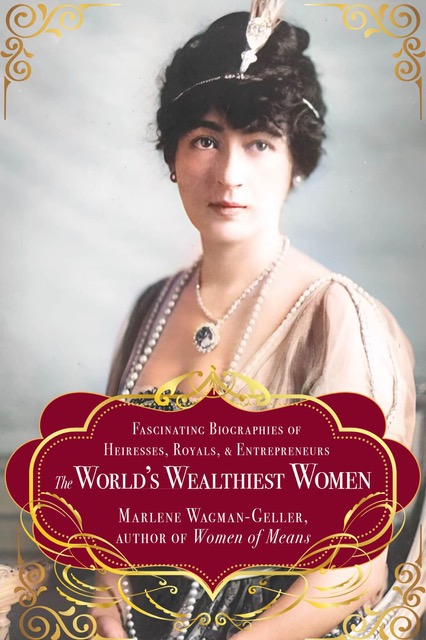
To pre-order my newest book, The World's Wealthiest Women: Fascinating Biographies of Heiresses, Royals, Entrepreneurs, and Entertainers, please click one of the links below.
- Amazon.com: amazon.com
- IndiePubs: indiepubs.com
- Bookshop: bookshop.org
- Amazon.co.uk
- Amazon.ca
- B&N: b&n.com
- Chapters Indigo (CA): indigo.com
- Books That Save Lives