A Heart is Not Judged
“I’m going to have a wonderful season this summer.”—Florence Griswold
Florence Griswold Museum (opened 1947)
In Frank L. Baum’s The Wonderful Wizard of Oz, Dorothy shared her insight: “If I ever go looking for my heart’s desire again, I won’t look any further than my own back yard.” Unlike the girl from Kansas, the woman from Connecticut always understood “there’s no place like home.” To visit the Florence Griswold Museum is to connect with a special time, a special place, a special woman.
In the first decades of the twentieth century, Gertrude Stein, along with her partner, fellow Jewish American expat Alice B. Toklas, presided over their atelier on 27 Rue de Fleurus in Paris. Through their doors passed the legends Pablo Picasso, Henri Matisse, Georges Braque. At the same time, though worlds away, Miss Florence presided over her New England salon.
The artist’s colony had its genesis with Florence, the daughter of Helen and Captain Robert Harper Griswold. Helen wrote to her husband, who was aboard his ship the Ocean Queen, to announce Florence’s birth on Christmas Day, 1850. Her parents dearly loved Florence and her siblings, Robert Jr., Helen Adele, and Louisa.
The Griswolds had an impressive heritage; Matthew Griswold had been a founding settler of Old Lyme, and the eastern shore of the Connecticut River bears the name Griswold Point. The family’s ancestors included two governors of Connecticut, including Florence’s grandfather, who was a U.S. congressman and a Connecticut Supreme Court judge.
Robert was a captain on his family’s Black X Line; on one voyage, he bonded with his passenger Herman Melville and rewarded the author with a private stateroom. As a captain, Robert was away from his family for long periods of time; in compensation, his substantial income allowed him to purchase a grand home on tony Lyme Avenue. His daughters attended the private Perkins School in New London, run by their aunts. Florence became fluent in French and learned to play the harp and piano. Though the finishing school was supposed to enable the Griswold sisters to find eligible husbands, none of them married.
By 1855, as the age of sail had evolved into the age of steam, Robert retired, at age forty-nine. Unfortunately, he invested heavily in the South Lyme nail factory, which floundered; he sold off land and assumed three mortgages. Relatives paid the debt, but with Robert’s 1882 death, his wife and four children were in dire financial straits. Their large house and several acres on the banks of the Lieutenant River was their only safety net. A further tragedy for the family was Robert Jr.’s death from diphtheria at age sixteen.
To earn a desperately needed income, in 1878 Helen and her daughters opened a girls’ school in their home that offered classes in subjects including “the rich and elegant styles of French embroidery, ancient and modern, not elsewhere taught in this country.” After fourteen years, due to competition from the Boxwood School, the Lyme Street School closed its doors. Further sorrow shadowed the Griswolds when Louise, an organist for the Congregational Church, died in an 1896 carriage accident. Three years later, Helen passed away from Bright’s disease. In 1900 Helen Adele, the family artist, entered the Hartford Retreat for the Insane, where she died in 1913.
In 1900, destitute and with most jobs closed to women, in a bid to keep her beloved home, Florence opened it to boarders. Her idea proved prescient, as people were happy to take the train to flee from overcrowded New York and Boston for bucolic Old Lyme. Their hostess greeted them with a bottle of wine followed by a tour of her garden.
The first tenant was artist Henry Ward Ranger who was enchanted by the residence and felt its grounds would provide the perfect backdrop for his paintings. He viewed the Griswold home as the venue to start his own “American Barbizon Colony.” The term alluded to the town of Barbizon located at the edge of the Forest of Fontainebleau, France, where painters specialized in rural themes. Ranger stated of his paradise found, “It looks like Barbizon, the land of Millet.”
Word spread to his fellow artists, who in turn became boarders of—as they called her—
Miss Florence. These core members instituted one of America’s most famous Impressionist art colonies. The arrival of Childe Hassam in 1903 introduced Impressionism, a relatively new style in America. A resident artist, Edward Charles Voelkert, was famous for his paintings of cattle which he patterned after those on Old Lyme farms. While he painted the bovine, the house carried dozens of felines, the colony’s mascots. Ellen Axson Wilson (the first wife of Woodrow Wilson), an avid painter, along with the future president, spent time in the colony where she befriended Florence. Heeding the advice of the Wilsons, Florence created a gallery in the front of her home to exhibit and sell her boarders’ canvases. When the Old Lyme Art Association opened a galley next door on property she had donated, the chatelaine became its manager, and received commissions. Her boarders dubbed their home-away-from-home the Holy House, as it produced a font of inspiration. The moniker was also a play on the Bush Holley House in Greenwich, another artist boarding house.
In downtown Rome, the Villa Aurora’s crown jewel is a ceiling on which the sixteenth-century painter Caravaggio painted a canvas, a work valued at $310 million. While the home in Old Lyme does not have the imprint of an Old Master, it does have souvenirs from its Impressionist boarders. To thank Miss Florence, her boarders showed their appreciation by using the dining room as their canvas, thus making the house itself a piece of art. 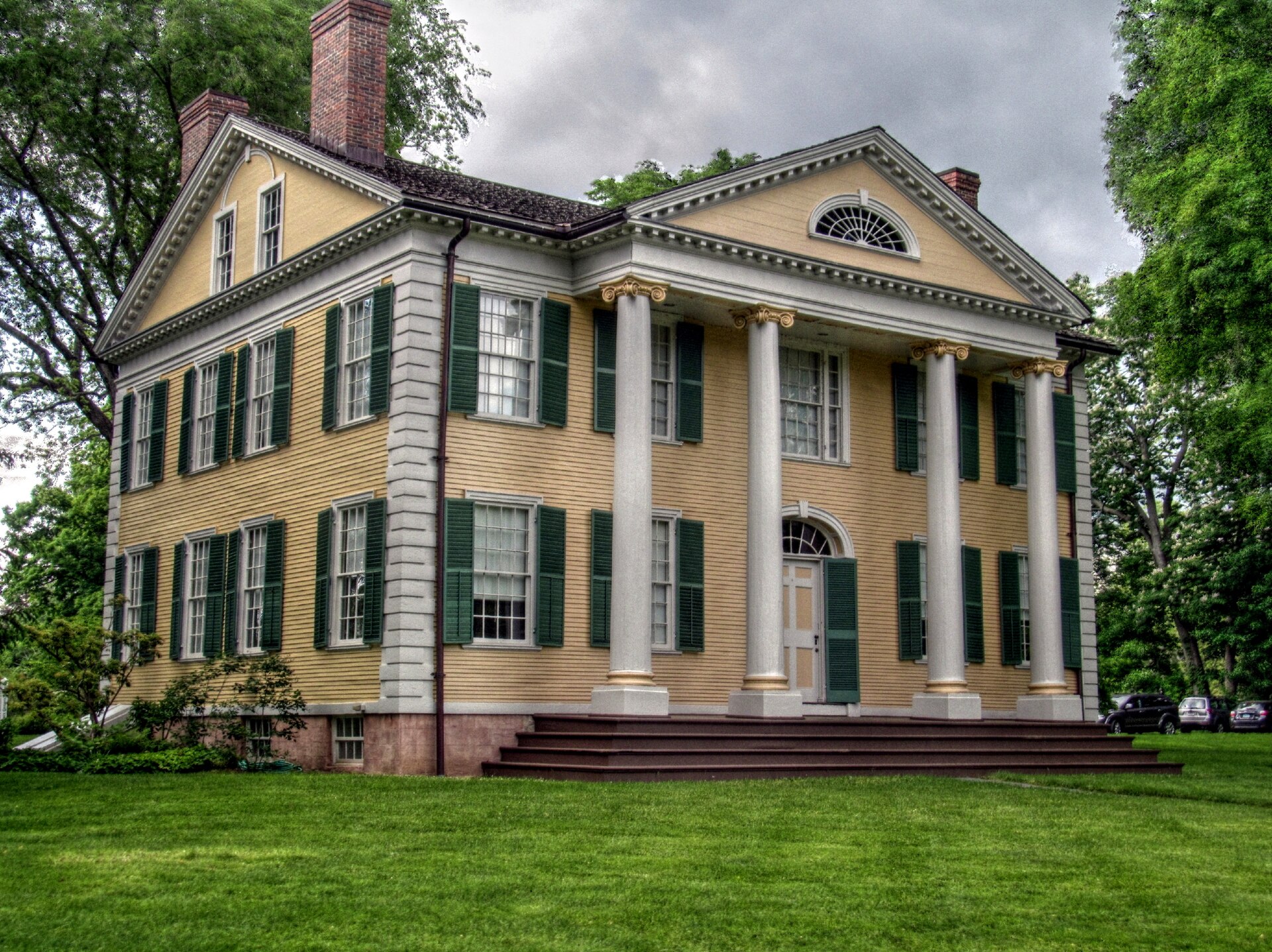
Despite the harmony between Florence and her “boys” as she called her tenants, economic worry hovered over the colony. Because she viewed her artists as family, Florence had only raised her modest seven-dollar weekly rent once. By trying to improve their accommodations, Florence had spiraled into debt. Along with artists, creditors began arriving at her doorstep. The threat of losing her house, where she had been born and which held the memories of her family, took a physical and psychological toll.
Discovering her plight, a boarder sent letters to everyone who would be willing to help, and they formed The Florence Griswold Association. A friend invited Florence to stay with them in New York for two weeks. In her absence, donations accumulated—some from the Wilsons—
and her “boys” exchanged their paintbrushes for tools. The artisan Property Brothers repaired dilapidated furniture, mended torn carpet, and plastered cracking ceilings. For other tasks, they employed a mason, an electrician, and a plumber who installed hot and cold water. When Miss Florence returned and saw the renovation she was overcome with emotion. The self-described Keeper of the Artist Colony remained in her home until her 1937 passing.
Florence Griswold Museum
For those looking to conjure a slice of New England’s past and who want to tour a historic house that in itself is an art gallery, the white-pillared Florence Griswold Museum beckons. Samuel Belcher, the architect of the First Congregational Church of Old Lyme, planned the estate for William Noyes in 1817. The Georgian-style mansion is representative of the affluence of Old Lyme’s maritime era.
While the Sistine Chapel is famous for its ceiling, the Florence Griswold Museum is renowned for its murals. There are thirty-eight individual panels and eight double panels (on the doors that complete one scene) in the former boardinghouse. Highlights of the museum are the canvases of former members of the art colony. Willard L. Metcalf’s Kalmia, 1905, depicts the mountain laurel that blooms along the banks of the Lieutenant River. Childe Hassam painted Summer Evening which captures a woman whose body leans to the shadows while a potted plant leans toward the sun. William Chadwick’s Impressionist paintings convey the pastoral setting of the Griswold estate: grapevines cover its porch, along with a profusion of roses and perennials.
As a reminder the museum was once a home, there are toys and dolls, remnants from the Griswold children, and period furniture. The Griswold Garden is a delight and displays the flowers Florence cultivated. The thirteen-acre grounds overlook the lovely Lieutenant River, where one can envision the artists setting up their easels. The Georgian-style guesthouse retains its original furniture, art, and games. Visitors can also tour the Krieble Gallery, which hosts temporary exhibitions, a small cinema, bookshop, and quaint restaurant.
The Wizard of Oz might have been a charlatan, but he shared wisdom that applied to Miss Florence with his pronouncement, “A Heart is not judged by how much you love; but by how much you are loved by others.”
A View from Her Window
From her window, Florence could see the Lieutenant River, salt marshes, white-spired churches, sheep and cows, cats and dogs. What also brought joy were the artists who shared her home and were her surrogate family.

To pre-order my newest book, The World's Wealthiest Women: Fascinating Biographies of Heiresses, Royals, Entrepreneurs, and Entertainers, please click one of the links below.
- Amazon.com: amazon.com
- IndiePubs: indiepubs.com
- Bookshop: bookshop.org
- Amazon.co.uk
- Amazon.ca
- B&N: b&n.com
- Chapters Indigo (CA): indigo.com
- Books That Save Lives