It Was Beauty
“No woman should try to bring up a child without first bringing up a great ape.” ~Gertrude Lintz
In 1933, Hollywood introduced a new leading man: he was tall, dark, and bore a royal name. He was the eighteen-foot King Kong, abducted from the jungle of Skull Island to the jungle of Manhattan. Kong’s contemporary was an African ape, raised by animal- mad Gertrude Ada Davies Lintz.
 Real estate gains cache when associated with a celebrity which was the case with a 2019 listing in Bay Ridge, Brooklyn. The property, on the market for $2.8 million and offered an 1,800-square-foot backyard with a heart-shaped swimming pool, gazebo, and outdoor shower. The residence had belonged to the eccentric Gertrude, her physician husband, and enough animals to rival Prospect Park’s Brooklyn Zoo.
Gertrude was one of thirteen children of Welsh-born John Henry Davies, an opera singer, and his French English pianist wife. While music was her parents’ passion, Gertrude’s was all things animal. She adored her family’s St. Bernard and hated sharing him with her siblings. At age three, her favorite uncle took her from her home in Islington to visit London’s Regent Park. On the carriage ride home, she cried because the animals were in captivity. The London Zoo was where Christopher Robin Milne encountered the Canadian bear, Winnipeg, who he called Winnie-the-Pooh.
A poor stewardship of his finances, when John inherited an American farm, the family left for life across the pond. Aboard the steamship, the Davies children studied the captain’s atlas, but confused America with Africa. They expected when they came ashore to see lions, elephants, and gorillas. To Gertrude’s great disappointment, the farm only had cows, horses, and chickens, though she grew fond of them. Unable to make it in the world of opera, John became an itinerant Presbyterian minister, and the family lived in Tennessee, Texas, and Oklahoma. Unable to put down roots, Gertrude nurtured a dog, goat, and mule. Eight-year-old Gertrude was bereft at her mother’s passing, and further heartache followed when John sent his children to live in various homes. Miserable, Gertrude often ran away, taking along Rex, her black-and-tan terrier mix. Two years later, John remarried and reunited with his children; however, in Humpy Dumpty fashion, the Davies could not be put together again.
In her early twenties, Gertrude opened a kennel for Saint Bernards in Red Bank, New Jersey, and magazines dubbed the red-haired Brit the “Joan of Arc of the American St. Bernard.” After a rival poisoned her puppies, Gertrude suffered a nervous breakdown that required hospitalization. She fell in love with her physician, Doctor William (Bill) Lintz, who she wed in 1914. During their Vienna honeymoon, the newlyweds visited its zoo.
Bill and Gertude purchased a home on Shore Road, Brooklyn, with a view of the Narrows of New York Harbor. What the home also possessed was a harrowing past. The former owner, Judge Charles Van Brunt, son had shot two men as they attempted to burglarize their residence. (The victims had also been the perpetrators of a kidnapping.) As the longed-for children never arrived, and with her husband spending his days at work, Gertrude acquired rare pigeons, rabbits, dogs, geese, doves, parrot, badger, and tortoise. However, she longed for more exotic animals, and their Brooklyn home welcomed Purser, the leopard, Jack and Jill, two horned owls, and an eight-foot Chinese dragon lizard encased in scales. Unfortunately, the leopard turned on the Lintzs, the owls were “tigers on wings,” which led Gertrude to remark, “There is nothing wickeder than the giant horned owl,” and the lizard proved problematic.
A family friend, the sea captain Arthur Phillips, was responsible for adding a unique addition to Shore Road. He made regular runs to Africa on his ship, the West Key Bar, and often returned with exotic animals. In 1928, Arthur sold Gertrude a chimpanzee she named Maggie Klein who she dressed in outfits from Bergdorf and Goodman’s department store. To provide Maggie Klein with a playmate, Gertrude adopted chimpanzee Joe Mendi-the latter’s name a nod to an African tribe. To purchase Joe Mendi his first pair of shoes, Gertrude dressed him in a sailor suit and cap, and they left on a shopping excursion. When the Lintz chauffeur dropped them off at a Fifth Avenue store, the doorman did a double take.
After the media revealed that the Brooklyn housewife had trained a chimpanzee to communicate, Sanka Coffee executives invited Gertrude and her chimpanzee, Susan, as guests on their radio program. During the broadcast, Susan, dressed in a man’s business suit and wearing basketball sneakers, sat in a chair munching grapes. Gertrude communicated with Susan with the words, “Who-who?” Taking a break from her grapes, Susan replied “Who-who,” then continued eating. After Susan’s passing, the Harvard Peabody museum acquired her skeleton.
Three years later, the captain returned to the States with a sickly gorilla, who Gertrude added to her menagerie. She named the new addition Massa-an African word for “big boss” and nursed her back to health from her bout of pneumonia. Massa had the run of the billiard table and performed housekeeping duties such as dusting and sweeping. In 1933, Bill and Gertrude took Massa to the Chicago’s World Fair that featured the modern marvel of a Ferris Wheel, and products such as Juicy Fruit gum, Cracker Jacks, and Shredded Wheat. And one of the greatest attractions was Massa who lodged at the Gorilla Villa.
Trouble arrived on Shore Road when Gertrude slipped on the recently mopped kitchen floor that caused the mop’s handle to smack into Mansa’s face. The five-year-old, five-hundred-and-forty-pound gorilla reverted to his atavistic nature and sank her teeth into Gertrude’s arm and legs. Her injury required hundreds of stiches and months of recovery. Fearful of another act of violence, in 1935, Gertude sold Massa for $6,000 to the Philadelphia Zoo who had been searching for a mate for their gorilla, Bamboo. The zookeepers realized Massa was a male, and the pair lived in their own dwellings. Massa, who lived to age fifty-four, set a record for longevity for apes in captivity.
To combat the ills of the Great Depression, Americans witnessed fads such as flagpole sitting, swallowing live goldfish, and cramming as many people as possible into a telephone booth. Yet a well-dressed woman with a British accent provided Brooklyn with some of its strangest sighs. While filmmaker Carl Dunhan had abducted King Kong from his Skull Island in the Indian Ocean, a nonfictional gorilla suffered the same fate in the swamplands of the Belgian Congo. When he was a month old, poachers killed his mother. Missionaries took over his care until they released him to Captain Philips. The crew treated the young ape with affection, and he roamed the ship untethered. After the captain fired a sailor, in retaliation he aimed a fire extinguisher filled with nitric acid at the slumbering ape that left him grossly disfigured.
Upon arrival in the States, the captain contacted the St. Francis Assisi of Brooklyn to inquire if she would take in a physically and psychologically traumatized ape. She rushed to the ship and brought her new family member home. While looking after an ape was daunting enough, it was even more challenging to nurse one who could not close his eyes or move his facial muscles. She was fortunate to have her assistant, Richard Kroener, who had been a butcher in Germany before he came to the United States where he found work helping Gertrude where she had owned the New Jersey kennels, and had been in her employment since that time. They painstakingly wrestled the infant ape from the Grim Reaper.
Gertrude named her new pet Buddha, nicknamed Buddy. His eyelids healed, but the left side of his mouth remained in a permanent grimace that exposed his teeth and made him look even more ferocious. Ironically, Buddy was sweet-tempered and interacted well with Mansa, though his special caregivers were Gertrude and Richard. The ape’s appetite was enormous, and he gained one hundred pounds during his first year. To her neighbors’ astonishment and alarm, Getrude took her two pet gorillas for outings where onlookers gave them a wide berth.
Buddy was in his basement cage when an evening thunderstorm left the four-hundred-pound ape quaking in terror. As someone had forgot to lock his cage, seeking comfort, he went in search of his adored surrogate mother. He climbed the stairs and joined her in bed. Remaining level-headed despite the danger, using a pear as bait, she lured Buddy back into his cage. Up to this point, the adjective “uxorious” described the devoted husband. Bill allowed his wife to turn him into the 1930s Noah, he spent a fortune on feeding the animals, and knew his colleagues viewed him with ridicule. The Lintz home was the largest private zoo in the country and housed thirty St. Bernards, 200 rabbits, 300 pigeons, 400 tropical fish, a pair of owls, nine chimpanzees, and a gorilla. While it is not known if Buddy broke the bed frame, his action proved the straw that broke the camel’s back. His ultimatum: either she get rid of the elephant in the room or he would file for divorce. The bed incident led to Gertude’s variation of a Sophie’s Choice: Bill or Buddy?
With heavy heart, Gertude contacted Henry Ringling North, the cigar-chomping vice president of the Ringling Brothers and Barnum Circus. He hurried to her Brooklyn home and Gertrude sold Buddy for $10.000($180,000 in contemporary dollars)-her biblical thirty pieces of silver.
The Orange Blossom Special transported Buddy to the circus’s winter headquarters in Sarasota. In the vein of “there’s no business-like show business” press agents embarked on transforming a lowlands gorilla-with a stopover in Brooklyn” into the world’s most frightening animal. Accordingly, they promoted him as “the most fiendishly ferocious brute that breathes.” One of the press agents, Roland Butler, felt the ape with the disfigured face needed a more ferocious sounding name than Buddy. Roland rechristened him Gargantua after the giant protagonist from the Françoise Rabelais novel. What helped with the transition was Richard Kroener had agreed to work as Buddy’s caregiver. The circus circulated posters of Gargantua snarling (his permanent expression due to the injury) holding in his fist the rendition of an African native. The caption read: THE WORLD’S MOST TERRIFYING LIVING CREATURE! GARGANTUA THE GREAT. Guides shared with visitors the vital statistics of the ape in the air-conditioned-, glassed in enclosure that replicated the climate of the Congo. They explained the ape was five foot seven and a half inches tall with an arm reach of nine feet. He would have needed a size-eleven glove, and his shoes would have been size 12-DDDD. The hirsute celebrity appeared in The Saturday Evening Post, the New Yorker, and Ladies Home Journal. (The 1997 fim Buddy was a fictionalized adaptation of Brooklyn’s simian brush with history.)
Just as the horse, Sea Biscuit, provided hope during the Great Depression, Buddy became the era’s star attraction of “the greatest show on earth.” In 1938, Buddy arrived in New York City, Kong’s old stomping ground. He was at Madison Square Gardens, along with thirteen other acts including Terrell Jacobs single-handedly controlling eighteen lions, the Paroff Trio acrobats, and the Gibsons who threw knives at a showgirl strapped to a revolving wheel. When a wagon pulled by six white horses entered the arena with a glass cage that held Gargantua, the legendary ape was the focus of attention. His notoriety saved the Ringley’s financial neck.
To capitalize on their leading man, they devised a publicity stunt: to find a bride for Gargantua. They felt their leading man needed a female to pass the time when the crowd went home. Accordingly, contact was made with A. Maria Hoyt of Havanna, Cuba, the owner of an ape named M’Toto. She had not called him after the Cairn Terrier from The Wizard of Oz; rather, it was Swahili for “Little One.” Mrs. Hoyt agreed to participate in the simian love affair and sold Toto to John Ringling North, the president of the Ringley Brothers. She added the stipulation that M’Toto would enjoy the same luxurious surrounding that they had given Buddy. While the circus announced the impending union, Mrs. Hoyt prepared her beloved ape a trousseau that she said saved her from “many a spell of weeping” as she prepared for the painful separation. The trousseau consisted of sweaters, shirts, socks, blankets, sheets, and mattress covers that she embroidered with the name of endearment: Totito. She also sent along special cooking utensils and care packages of her favorite food such as Cuban black beans. The Cuban Gertrude, to ensure a sage transition, followed M’Toto. She said she was annoyed that the newspapers carried stories about “the future Mrs. Gargantua. Mrs. Hoyt groused, “It was all a little silly when the baby was actually still a nine-year-old child and Gargantua himself, after all, only an eleven-or twelve-year old boy.”
The 1941 Sarasota meeting of the non-cinematic King Kong and Ann Darrow proved a media circus. The Ringleys supplied a profusion of flowers, a wedding cake from Schrafft’s Bakery in New York, and the air echoed with strains from the “Processional.” Workers painted the bride’s cage white and designed a sign: Mrs. Gargantua the Great. Mrs. Hoyt wore a dress of flowing chiffon and a huge hat. When the anticipated moment arrived, the doors that backed onto one another opened. There was no Kong- Ann Darrow love connection. Buddy hurtled a cabbage at his intended’s face; there was no consummation. Mrs. Gargantuan tried to become affectionate, but her feelings were not reciprocated. Despite his ferocious mien, he was at heart an adolescent who longed for the woman who had left her imprint on his heart. The helicopter ape mama, Mrs. Hoyt, was a constant presence in the jilted M’Toto’s cage. Eventually, Mrs. Hoyt moved from Havana to Sarasota. Buddy did not fare as well: in 1942, Richard passed away.
Unlike her Cuban counterpart, Gertrude felt emotional salvation lay with keeping her distance from Buddy. In her autobiography, Animals Are My Hobby, published in 1942, Gertrude wrote of one of the few times she went to visit, and the last time she ever saw Buddy. She paid him a visit, and when Buddy awoke, he rose and beat his breast in delight. Then he took his finger and pulled up his scarred lip and pointed to an infected tooth. She wrote, “He knew I wouldn’t let him have an ache in his mouth, or anywhere in his great body. She knew his care was out of her hands; all she could not was to report the problem and leave.
Brooklyn derived its name from the old Dutch settlement, Breuckelen that translates to “”Broken land.” And broken described Gertrude at Buddy’s 1949 passing in Miami. Henry Ringley North, in his book, wrote, “He was a wonderful animal.” Henry donated his prize ape’s remains to his alma mater, Yale, who placed him in their Peabody Museum of Natural History. His skeleton is mounted in a hunched pose with a glass enclosure. Above the displace case is the framed circus advertisement. His widow, M’Toto, passed away in 1968, and Mrs. Hoyt arranged her burial in the Sandy Lane Pet Cemetery. Her marker bears the words, “Sleep well my darling companion. You will always be remembered.”
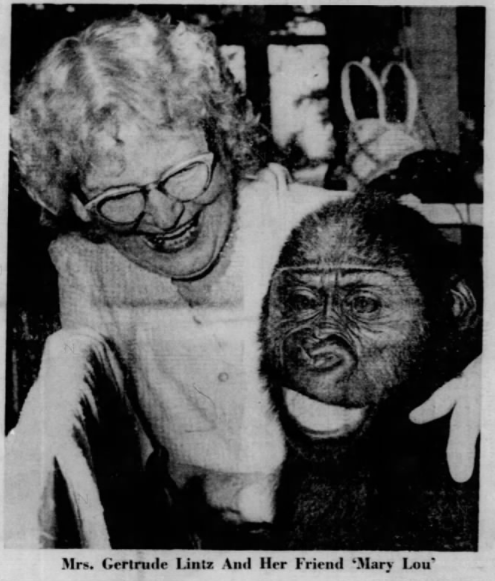
When Will retired, the couple moved to North Miami Beach. A reporter for the North Miami Beach wrote a 1961 article on Gertrude and Mary Lou, her two-and-a half-year old, fifty-five- pound chimp. A year later, during a tornado, Mary Lou sustained an injury that left her paralyzed. Gertrude relinquished her to Florida University. In 1968, Gertrude passed away- her grave site is unknown.
In the closing scene of King Kong, the ape dubbed “the eighth wonder of the world,” climbed to the top of the Empire State Building protectively clutching Ann Darrow. Under attack by navy biplanes, he fell to his death. Carl Denham spoke the film’s final words that applied to his non-cinematic counterpart, “It was Beauty killed the Beast.”

To pre-order my newest book, The World's Wealthiest Women: Fascinating Biographies of Heiresses, Royals, Entrepreneurs, and Entertainers, please click one of the links below.
- Amazon.com: amazon.com
- IndiePubs: indiepubs.com
- Bookshop: bookshop.org
- Amazon.co.uk
- Amazon.ca
- B&N: b&n.com
- Chapters Indigo (CA): indigo.com
- Books That Save Lives