It's a Wrap
“I created the dress, but really the dress created me.” –Diane von Furstenberg
If we could eavesdrop on Cinderella, we would overhear her tell her granddaughters about her hardscrabble youth: named after cinders, dressed by anthropomorphic mice, a gourd as transportation. She would likely end by explaining how a pair of shoes can alter their destiny. A Belgium-born billionaire, Diane von Furstenberg, life changed, not through footwear, but through an item of clothing.
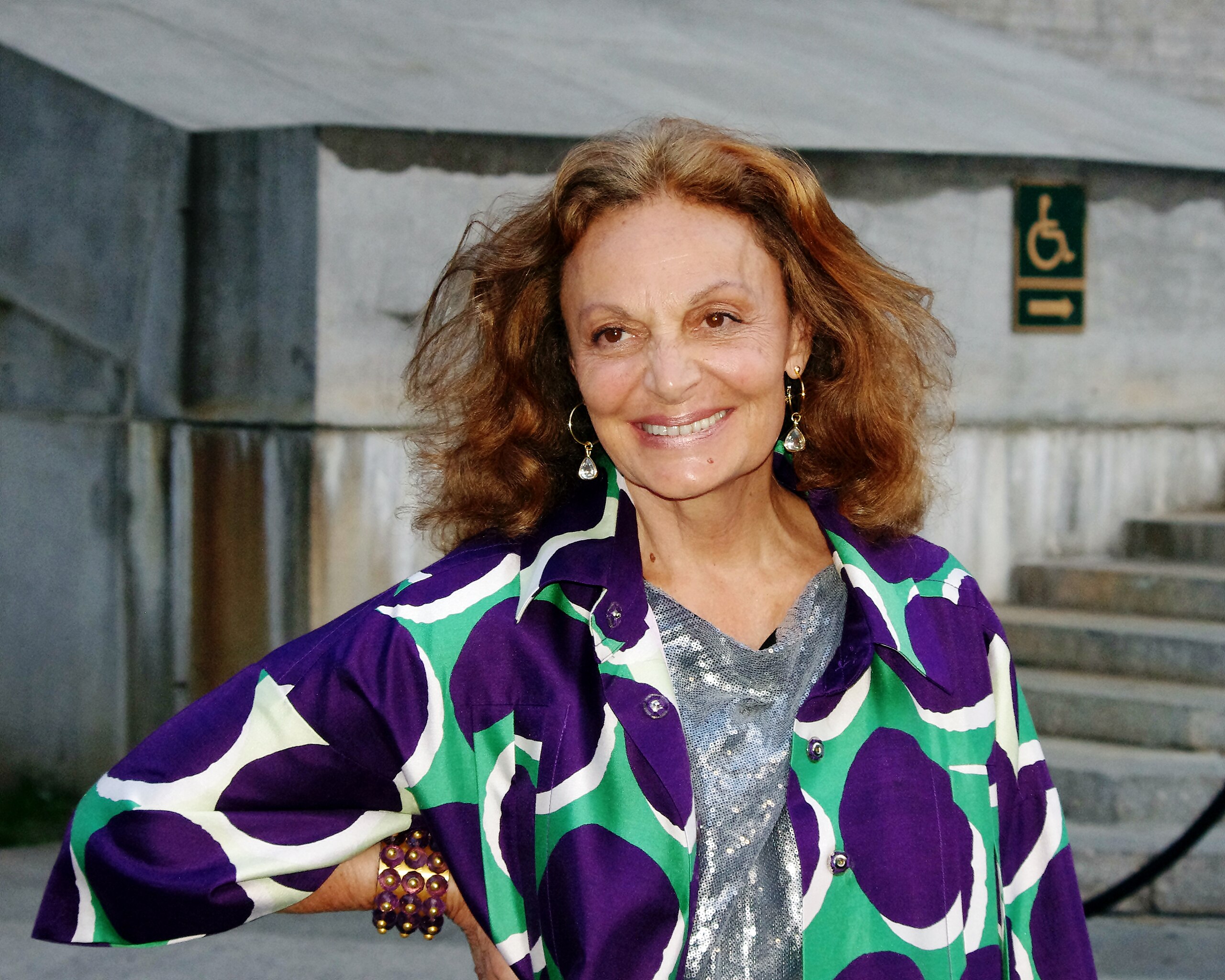
France’s Coco Chanel found fame and fortune through her little black dress, and Diane von Furstenberg found hers through the wrap dress. Diane Simone Michelle Halfin was born in Brussels, Belgium, the daughter of Jewish immigrants Leon, from Russia, and Lily, from Greece. Their hope for a better life ended when the Nazis goosestepped into their adopted country. With gold coins hidden in his socks, Leon fled to Switzerland. To protect their youngest daughter, Lily’s parents sent her to live with a Christian family, unaware they were members of the Resistance. While riding her bicycle throughout Brussels to deliver false identity papers to Jews, police arrested the saboteur. Lily spent eighteen months in Auschwitz,and Ravensbrück.
The twenty-one-year-old Lily Nahmias returned to Belgium. Ill, weighing forty-nine pounds, she wed Leon, her fiancé prior to internment. Eighteen months post liberation, on New Year’s Eve, Lily welcomed her daughter. In 1952, her brother, Philippe competed the family.
Although the Halfins enjoyed an upper middle-class lifestyle, tensions ricocheted throughout their home as Leon could not grasp Lily’s psychological fragility stemming from her Holocaust horror. As a child, Diane did not understand why her mother had two lines of blue tattooed numbers on her left arm. Another source of distress was, with her dark, frizzy hair and brown eyes, Diane felt like the ugly duckling compared to the Belgium girls who had blonde straight hair and blue eyes. In her teens, Diane transformed to a swan.
Over Leon’s objections, Lily sent Diane to Pensionnat Cuche, a private boarding school by Lake Sauvabelin in Lausanne, Switzerland. Upon her father’s insistence, two years later she returned home. Her parents argued nonstop, fights that ended with their divorce. The following year, at age sixteen, Diane left for Stroud Court, a girls’ boarding school in Oxfordshire, England. Excursions to swinging London of the sixties introduced the teen to mod fashion; she felt wearing go-go boots and miniskirts was a step away from dating Paul McCartney. Stroud Court was where she surrendered her virginity: first to the Iranian Sohrab and then to her French friend, Deanna. After graduation, Diane and Deanna enrolled in the University of Madrid; anti-Franco protests resulted in sporadic classes.
In Lausanne, a friend from her Swiss boarding-school days introduced Diane to the blonde Prince Eduard Egon von und zu Fürstenberg, also an adherent of sexually fluidity. What they did not have in common was their backgrounds: while Diane was the daughter of a Jewish Holocaust survivor mother, Egon’s mother, Clara Agnelli, was the heiress to the Fiat fortune. While her father had been a Russian refugee, his father, Prince Tassilo Egon Maximillan Furstenberg hailed from the Austro-German nobility whose family tree held Charlemagne, the king of the Holy Roman Empire. Egon whisked her away to the Far East where they toured Hong Kong, Cambodia, India, and Thailand. In the south of France, she sailed on Egon’s Uncle Gianni Agnelli’s yacht and watched the Grand Prix in Monaco. Her prince took her to a costume ball in Venice where she moved in the firmament of Elizabeth Taylor and Richard Burton.
At age twenty-two, draped in a Christian Dior wedding gown, Diane married her Prince Disarming in the medieval city of Montfort-l’Amaury, France in front of 500 guests. The reception was at Auberge, owned by Maxim’s of Paris. The cloud on the occasion was Prince Tassilo expressed his horror that his son, who Pope John XXIII had baptized, was marrying “this dark little Jewish girl.” One reason–although she had not shared the news–was because she was three months pregnant. Displeased with his new daughter-in-law, he attended the ceremony but bowed out of the reception. The newlyweds spent their honeymoon sailing the fjords of Norway, followed by a month with friends on Sardinia’s Costa Smeralda.
The couple’s Manhattan base was 1250 Park Avenue that they shared with their children, Alexandre and Tatiana Desirée, as well as their retinue. Other places to hang their hats were an apartment in Paris and a beach house in Sardinia, the latter a wedding present from Egon’s mother. Known as the European Park Avenue prince and princess, they threw cocktail parties whose guests included Andy Warhol, Yves St. Laurent, and Paloma Picasso. Egon and Diane dined with Jackie Kennedy Onassis and Aristotle, her shipping tycoon husband, at Manhattan’s El Morocco. Jackie and Diane shared a hairdresser, Edgar Montalvo; the designer called him “the best blower in town.” In those days, Diane ironed her hair, as she hated her natural wild locks. As Egon was related to Monaco’s royals, they received invitations to parties hosted by Prince Rainier III and Princess Grace.
While most women would have felt their plates were full enough with an active night life, international travel, and two children, Diane explained her desire for a career, “I had to be someone of my own, and not just a plain little girl who got married beyond her deserts.” In 1972, she opened a store on Seventh Avenue. Vogue editor, Dianna Vreeland, helped boost sales, as did her royal title. Egon shared her love of fashion and said he saw his first couture collection at the age of two while in his mother’s arms.
The Belgium bombshell’s eureka moment arrived when she saw Julie Nixon Eisenhower on television, defending her father, President Richard M. Nixon, during Watergate. Flattered that the First Daughter was wearing a Diane von Furstenberg top, the designing woman created a one-piece wrap dress. The garment, crafted without hooks, buttons, and zippers appealed to the feminist zeitgeist of the era and proved a welcome contrast to the unisex suits of women in the workforce. The garment, that wedded feminism and femininity, consisted of a soft fabric adorned with patterns that ran the gamut from the world of nature to geometric prints, thereby providing customers an array of visual themes. The $86.00 dress became an iconic fashion statement and owns a niche in the Costume Institute of the Metropolitan Museum of Art and the Smithsonian. The garment catapulted the twenty-eight-year-old to fashion superstardom. Within the first year of the dress’ debut, DVF was producing 25,000 per week. Four years later, she had sold a million and appeared on the cover of Newsweek. The accompanying article stated that Diane von Furstenberg was “the most marketable woman since Coco Chanel.” (Although Diane kept her married name, she dropped the umlaut over the U. Gloria Steinem convinced her to forego the title Princess for Ms.). At a White House dinner, seated next to President Ford, the first lady of fashion and the chief executive exchanged light-hearted banter regarding how she had supplanted the president for that month’s issue. Secretary of State Henry Kissinger eagerly made her acquaintance. On a 1976 flight to Cleveland, a man seated next to her asked, “What’s a pretty girl like you doing reading the Wall Street Journal?” She refrained from showing him her picture on the front page.
DVF, begun with a $30,000 investment, transformed to a $100 million dollar enterprise. free. The garment became so intricately bound with its designer that Diane joked, “It will probably be on my tombstone: Here Lies the Woman Who Designed the Wrap Dress.”
In contrast to her thriving business, the Furstenberg marriage was faltering. A strong believer that promiscuity did not end in marriage, Egon slept with anything-man, woman, or mineral and was open to threesomes with various anatomical combinations. Due to his promiscuity, he received the epithet, “Egon von First-in—bed.” Unhappy with her relationship, she stated, “ I was in charge of my children, I was in charge of my life, I was in charge of my business, I was a woman in charge.” In a variation of wearing her heart on her sleeve, Diane wears a gold and diamond necklace with the words: In charge; her New York office displays the exhortation on numerous signs. Egon and Diane separated and finalized their divorce in 1983. Diane kept her title and custody of their two children. They continued to deeply care for one another, and Diane was with Egon in Rome when he passed away, purportedly from AIDS.
As her sanctuary from Manhattan, at age twenty-six Diane purchased her room of her own, Cloudwalk, a 75-acre eighteenth century farm in Litchfield County, Connecticut. The estate’s former owner, Jonson & Johnson heiress Evangeline Johnson, had christened the property. The estate holds an apple orchard, gardens, a stream, swimming pool, waterfall, and five ancillary structures. As she is always working, Diane converted a barn into a studio with soaring ceilings. The most interesting outdoor touch is a giant lipstick sculpture carved from a tree trunk. Neighbor Henry Kissinger and his wife often came for dinner. She purchased a second room of her own as her thirtieth birthday gift to herself: a Fifth Avenue apartment whose former owner was Rodman Rockefeller. Her friend, Oscar de la Renta’s wife, Françoise, decorated it in an expensive bohemia theme. Egon summered in Italy and wintered in Miami.
The Merrie Divorcée had a long list of lovers and felt free to bed and not wed. Of her custom-made neo-deco bed, (a present from her mother for her thirtieth birthday), Diane reminisced, “In my wild days…that bed can tell all the stories.” In between designing clothes, caring for her son and daughter, nights were mainly spent partying at Studio 54 with the likes of Bianca Jagger, Mick Jager, David Bowie, Richard Gere, Warren Beatty, Ryan O’Neal. Another habitué was Andy Warhol who immortalized her on canvass. The Belgian Diane, like the Greek Diana, was a huntress whose catches were Richard Gere, (she described as “cute”). She pronounced Omar Sharif “the worst lay she ever had.” A proponent of living with the same sexual laissez-faire attitude as men, Diane recalls how she was intimate with both Ryan O’Neal and Warren Beatty in a single weekend. Who else can claim the same? In contrast, she turned down David Bowie and Mick Jagger after they approached her with the offer of a ménage à trois.
While Diane had any number of men in her life, she only loved two of them: Egon and Barry Diller. At age twenty-eight, when she first met Barry, she had no idea what a significant role the prince of Paramount Studio would play in her life. Some of the director’s blockbusters movies would include Marathon Man, Saturday Night Fever, Grease, and Urban Cowboy. His friends were astounded when he started seeing Diane, as he had always been open about his homosexuality. Andy Warhol’s observation was, “I guess the reason why Diller and Diane are a couple is because she gives him straightness and he gives her powerfulness.” An irate Barry countered the pop artist’s pronouncement saying, “Diane and I were actually motiveless when we came together. It was a coup defoudre.” The designer brought out the soft side of the man who had the moniker “killer Diller.” In the seventies, when they first started seeing each other, for For Mother’s Day he bought her a speedboat so Alexandre and Tatiana could waterski in the lake near Cloudwalk. For their Fourth of July party, they had a get together with actress Candice Bergen, writer Jerzy Kosinski, and socialite, Slim Keith who brought along film star Claudette Colbert. New Year’s Eve was spent at Woody Allen’s party where Barry gave Diane twenty-nine loose diamonds in a Band-Aid Box. For her forty-ninth birthday, he gifted her forty-nine diamonds. With his $4.2 billion fortune, he could afford grand gifts.
At this point, Diane was living on Cloud Nine until a series of events upended her life. In 1980, after a Caribbean cruise where Barry was the captain, she received a phone call informing her that Lily was in dire distress. Her mother and her partner had gone to Germany on a business trip. In the hotel, hearing men conversing loudly in German sent her into a panic; terror-stricken, she hid under the concierge’s desk. Diane immediately flew to Switzerland to spend time with her mother in an asylum. Deeply shaken, along with her children, Diane took off for Bali where she fell in love with Brazilian Paulo, with whom she shared his bamboo house. Even during the idyl, she could not turn off her entrepreneurial button and created a perfume borne from her exotic/erotic locale: Volcan d'Amour. The relationship lasted four years, as did her wardrobe of sarongs.
When Diane bid farewell to her version of Eat, Love, Pray, she turned to Barry,with whom she had weathered many storms–the crash of her first business, tongue cancer, her mother’s nervous breakdown, a car and skiing accident. After years of turning down his proposals, for his birthday she offered to at last tie the knot. The venue for the ceremony was New York’s City Hall where the only guests were her brother, Tatiana and Alexandre. Celebrity photographer and friend of the bride, Annie Leibovitz, captured the memory. In tribute to her recently deceased mother, her bouquet held lilies. The delighted groom gave his wife twenty-six wedding bands to symbolize the twenty-six fallow years when they had not been an official couple. A party, with 350 guests, took place later that evening in Diane’s Greenwich Village loft.
The couple own several places to hang their hats, wrap dresses, and Warhol paintings. Diane’s European refuge is her Parisian apartment in the suburb of Saint-Germaine-des-Prés, redolent of former residents Josephine Baker and Ernest Hemingway. Her self-described “tree house” in Manhattan’s Meatpacking District is a glass structure overlooking the Empire State building. A romantic getaway is their $45 million oceanfront property in Miami Beach on Biscayne Bay, (where a neighbor is Bee Gees’ star Barry Gibb). For West Coast living, there is the Beverly Hills home where Diane and Barry threw an engagement party for Jeff Bezos and Lauren Sanchez. The hosts welcomed guests Oprah Winfrey, Selma Hayek Pinault, Barbra Streisand, and Kris Jenner. Her Connecticut first home will be her final resting place, specifically near a bridge over a stream. As Diane pointed out, “At Cloudwalk I will become a mushroom.” Their floating palace is their yacht, Eros, (Greek for goddess of the dawn), whose prow is a nine-foot figurehead of Diane. Until Jeff Bezos’ $500 million yacht, the Eros was the world’s most expensive.
Due to multiple addresses and one a floating one, it is as difficult to locate Diane as it is Waldo. However, a journalist tracked her down to Italy. The interview took place in a palazzo overlooking the Grand Canal, a palace owned by Egon’s aunt, the ninety-seven-year-old Christiana Brandolini d’Adda. She remarked of her new residence, “Venice is a nice stage for the winter of my life.” However, for the woman who has rivaled cats in the number of lives they purportedly possess, no one is likely to hear Diane pronounce, “It’s a wrap.

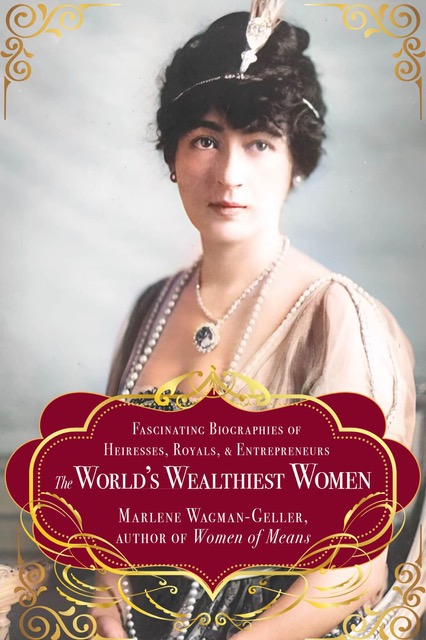
To pre-order my newest book, The World's Wealthiest Women: Fascinating Biographies of Heiresses, Royals, Entrepreneurs, and Entertainers, please click one of the links below.
- Amazon.com: amazon.com
- IndiePubs: indiepubs.com
- Bookshop: bookshop.org
- Amazon.co.uk
- Amazon.ca
- B&N: b&n.com
- Chapters Indigo (CA): indigo.com
- Books That Save Lives