Fear to Tread
“I was the daughter of an enormously popular President, and the first girl in the White House since Nellie Grant, and I looked upon the world as my oyster,” ~Alice Roosevelt
Dubbed Princess Alice, President Roosevelt’s eldest child was the capital’s wittiest woman. As a force with which to be reckoned, she bore the appellation “Washington’s other monument.” Whatever one’s opinion of the Gilded Age’s wild child, she was far from a retiring First Daughter.
While Alice was in Wonderland, she observed of the strange goings-on, “Curious and curiouser.” When the other Alice was in Washington, she used more acerbic language. Born in New York City, her lineage held extreme wealth and knickerbocker roots; the family name, of Dutch origin, was originally Rosenveldt-the field of roses. Her father, Theodore, was in Albany, New York, while at the state assembly, was ecstatically announcing Alice’s February 12th arrival-a birthday she shared with President Lincoln. On Valentine’s Day, Theodore hurried to his mother’s grand house, two blocks from Central Park. The twenty-five- year-old suffered a dual tragedy: within hours, his wife, Alice Lee, had died from Bright’s Disease and his mother, Margaret, “Mittie,” had passed from typhoid fever. In his diary, Theodore placed a large letter X on February 14, 1884, and wrote a one-line ode to the woman he loved, “The light has gone out of my life.” Two thousand mourners attended the double funerals at the Fifth Avenue Presbyterian church. Two horse drawn hearses, covered with roses, departed for Greenwood Cemetery. At her christening, the baby wore a locket that held her mother’s hair. A shell-shocked Theodore headed to the Dakota Badlands, leaving two-day-old Alice Lee with his sister Anna, nicknamed Bambie. Overwhelmed with grief, he only referred to his daughter as Baby Lee, as it was too painful to utter his wife’s name. Eleanor Roosevelt, her first cousin, was Alice’s childhood playmate. Later in life, their rivalry rendered them hissing cousins. 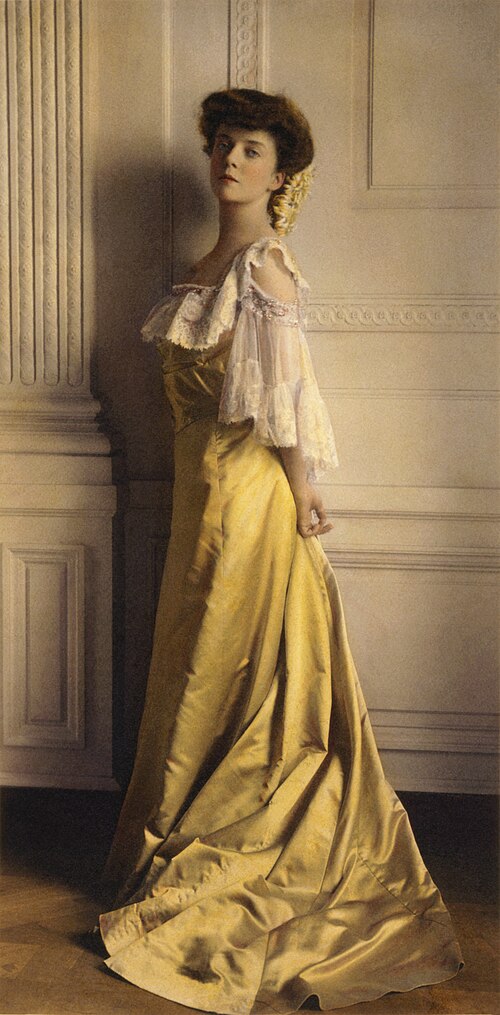
Theodore married Edith Kermit Carow-once the romantic rival of his first wife- and reclaimed his three-year-old-daughter. Alice was traumatized over the separation from Aunt Byne- what her niece called her surrogate mother. The Roosevelts moved to Sagamore Hill, in Oyster Bay, Long Island, to their twenty-two-room estate. The family grew to include four half-brothers and a half-sister: Ethel, Archibald, Theodore Jr., Kermit, and Quentin. Her stepbrothers ridiculed Alice from coming from another mother. Further pain derived as her father never spoke of his deceased wife. Edith shared her view that her predecessor had been stupid and boring.
For two years, Alice wore braces on both legs, from knee to ankle, to correct an orthopedic issue. Unable to keep up with her rambunctious siblings and sixteen cousins, Alice recalled she “could spend hours of time pretending that I was a fiery horse, preferably cream-colored, like Cinderella’s horses, able at a bound to cover vast regions of the earth, and also able at will to turn into something quite different, such as a princess with very long hair, or an extremely martial prince.” Her physical limitation did not dampen her spirit: at a reception, she fired dynamite caps from her toy pistol at unsuspecting guests. Although she attended a private school, her education mainly derived from private tutors and the Roosevelt circle. At age six, Alice had her first meeting with a president-Benjamin Harris- who she described as “a solemn, bearded gnome.”
Theodore made a rapid rise on the political hierarchy: from New York City police commissioner to governor to vice-president. When the country reeled over Leon Czolgosz’s 1901 assassination of President McKinley in Buffalo, the seventeen-year-old Alice viewed the event with “pure rapture.” She recalled, “I was never so pleased about anything. I didn’t give a damn. Father wanted the White House Hurrah. Father must have the White House. I danced a little dance of happiness.”
In terms of media magnets, after the First Ladies come the First Daughters. President Franklin D. Roosevelt’s daughter, Anna, helped persuade him to pick Harry Truman as his running mate. Life magazine noted, “Daddy’s girl is running Daddy.” Anna accompanied FDR to the Yalta Conference where they met with Winston Churchill and Joseph Stalin. Ronald Regan’s daughter, Patti Davis, posed topless in the 1994 issue of Playboy. Ivanka Trump was the first First Daughter to score a West Wing office. But Alice made her predecessors rank amateurs in the what-will-she-do next-arena.
Theodore’s 1902 inauguration provided a spectacle where the president and his family rode to the White House in a carriage escorted by Rough Riders. Alice wore a white dress, and white hat accented with black satin ostrich feathers. Her father wore a ring that held a lock of Lincoln’s hair. During the Inaugural Ball, as her father greeted guests, Princess Alice (as the press dubbed her) imitated his speech and mannerisms until he yelled, “Sit down!” The following year, President and First Lady Edith Roosevelt hosted Alice’s White House coming out party. The invitation requested the pleasure of guests at a “small dance:” small involved 700. The President, First Lady, and Alice received attendees in the Blue Room where eight Italian marble mantels, carved a century before and surrounded by oversized mirrors framed in Venetian gilt, reflected the gala. More than two thousand roses, carnations, and narcissus adorned the White House. Guests included the Misses Pauncefote, (the daughters of the British ambassador,) the Countess Marguerite Cassini, (her son, Oleg, became First Lady Jackie Kennedy’s favorite designer,) and representatives of the German, French, Russian, and Italian embassies. Franklin Delano Roosevelt danced with Alice several times, as well as with their cousin Eleanor. The Manhattan socialites were arrayed in full plumage. Of the over top Gilded Age fashions, Alice stated, “Oh, those Edwardian beauties! They rise before me with their large bosoms compressed in strange ways. They were flattened out with straight corsets in front and then their backsides were pushed out into great big tails behind. Extraordinary! The hats could be outrageous-great cartwheels loaded down with fruit, flowers, feathers, and dead birds….”
At a White House dinner, the First Daughter attended events with her pet snake, Emily Spinach-Emily after her step-aunt, green due to its color. When Emily Spinach died, Alice attributed it to snakeicide. Alice accessorized with flasks of whiskey, ran up poker debts, and lobbied verbal grenades. Her blue macaw, Eli Yale, had its own room. In response to her father’s no-women-smoking-under- my- roof rule, she lit her cigarettes on the White House roof. Along with a friend, Alice drove from Newport, Rhode Island, to Boston- sans escort. The novelist Owen Wister asked, “Theodore, isn’t there anything you can do to control Alice?” The First Father responded, “I can be president of the United States, or I can attend to Alice. I cannot possibly do both.” Theodore took the easier route; he ran the country.
In contrast to the president who was displeased with his daughter’s hijinks, the press feasted on her hijinks. Alicemania took over the country. Due to the color of her eyes, “Alice blue” became fashion’s most sought-after hue. Bands blared, “Alice, Where Art Thou?” Her face appeared on cards in candy bars, on sheet music, and a stream of magazine covers. Kaiser Wilhelm II asked Alice to christen his yacht, the Meteor, built by an American company, wherein she smashed a bottle of French champagne that met with wild cheers. A group who declined to cheer were the members of the Women’s Christian Temperance Movement. (Theodore’s presence did not prove as popular.) The prince presented Alice with a diamond bracelet, a gift from Wilhelm.
Following the baptism of the Meteor, Alice received an invitation to attend the coronation of Britain’s Edward VII. The royal family offered the American princess to stay in Westminster Abbey in the company of the world’s crowned heads. To her chagrin, Alice declined as Theodore felt her appearance would not coalesce with his image as a man of the people. The following year, Alice was in Newport, Rhode Island, to attend the debut of Constance Livermore, the daughter of Baroness Selliere. John Jacob Astor taught the socialite to drive. A crush of fans greeted her at the 1904 St. Louis World’s Fair. In Havana the Cubans gave her a celebrity welcome due to her father’s role in the Spanish-American War. John McCutcheon sketched a cartoon of onlookers gawking at Alice at a Chicago horse show. When her father wrote to berate her for attracting untoward notice, Alice burned his letter at a New London boating party. In answer to her father’s tirade she was an attention seeker, Alice countered, “My father always wanted to be the corpse at every funeral, the bride at every wedding, and the baby at every christening.”
In 1905, Alice left for the Far East with a diplomatic delegation that included seven senators, twenty congressmen, and Secretary of War/ future president-William Howard Taft. Empress Dowager Cixi of China gifted Manchu, a black Pekingese, to the animal lover. In deference to her inclusion on the diplomatic mission, the only prank Alice pulled was jumping into a pool fully clothed. The incident became such a part of lore that fifty years later Bobby Kennedy mentioned it, to which Alice responded that at least she had not done so naked. In her Baker car, wearing a Merry-Widow hat, Alice watched the aerial experimentations of the Wright brothers Military Flyer.
The public thirst for Alice news reached a frenzy when, at age twenty-two, she announced her engagement to Representative Nicholas Longwork of Cincinnati. She decided to forego bridesmaids-so the attention would be on the bride. He was fifteen years her senior, whose Pied Piper was women and whiskey. Her stepmother’s words to her before her 1905 White House wedding, “I want you to know I’m glad to see you leave. You have never been anything else but trouble.” The prickly relationship with her mother continued with her mother-in-law who Alice nicknamed Bromide.
The atmosphere surrounding the American royal’s wedding was so frenzied that the Wahington Times likened it to “celebrating a national holiday.” The satin bridal gown trim included her mother’s wedding dress. Among the thousand wedding guests were Nellie Grant, (President Grant’s daughter who had also had a White house wedding,) and Franklin D. Roosevelt, (a pregnant Elanor stayed home.) The Episcopal bishop of Washington performed the ceremony. Gifts, displayed in the Blue Room, befitted the nuptials of Princess Alice: the government of Cuba- a $25,000 pearl necklace, Edward VII, a blue and gold snuff box that bore his likeness, the Dowager Empress of China jewelry, an ermine coat, Kaiser Wilhelm II a diamond bracelet bearing his likeness, the King of Italy a mosaic table. The Longworths honeymooned in Cuba. A wedding gift of which Alice did not wax eloquent: in Havanna she awoke to an inebriated husband passed out on the floor.
Upon her return from Cuba, Nick and Alice went to Columbus, Ohio, to unveil a statue of President McKinley. Her presence drew a crowd of 50,000 who became so unruly that the Longworths climbed through a window of the governor’s office until the police escorted them to their car.
In 1912, Alice underwent a trauma when her father was in Milwaukee campaigning for a third term for the presidency. A deranged New York saloon owner, John Schrank, fired a bullet into his chest. The fifty-three-year-old survived because of his fifty-page speech kept in his shirt pocket. He spoke for one-and-a-half-hours while blood seeped through his shirt. He improvised, “I don’t know whether you fully understand that I have just been shot. But it takes more than that to kill a Bull Moose!” In 1918, Alice’s stepbrother, Quentin, died in aerial combat in World War I; a week later, her father passed away. Alice wore a ring that held her father’s hair.
While the Longworth’s union was not the stuff of wedded bliss, a further fissure occurred in 1912 with Alice’s variation of Sophie’s Choice. Alice worked on behalf of her father’s Bull Moose Presidential ticket that pitted her against her Republican husband. Nicholas felt Alice was a Judas. When her father left the White House, Alice buried a “bad little idol” in its garden in the hope it would bring bad luck to the Taft administration. Of the 350-pound Taft, Alice stated he was “great in girth…but great in nothing else.” When Woodrow Wilson returned from the Paris Peace Conference, she muttered a curse “A murrain on him!” and made the sign of the evil eye. Her take on Harding, “Saying that Harding is second-rate is one of the biggest compliments anyone can pay him.”
In 1925, Nicholas became the Speaker of the House, but her marriage to a high-profile man did nothing to curb her wild ways. She played poker with men, made gin in her cellar during Prohibition, and wore pantalettes in public. In her self-appointed role as a boredom buster, her dinner seating arrangements placed enemies next to one another. A font of political gossip, she approved of Franklin D. Rosevelt’s long-time mistress, Lucy Mercer, “Every man in Washington has a summer wife and Franklin deserves one because he is married to Elanor.”
After nineteen years of marriage, the forty-year-old Alice became pregnant. Nick, along with many others, knew that the baby’s father was the married Idaho Senator William Borah. Alice wanted to name her daughter Deborah after Borah; Nick balked, and they settled on Paulina, after the apostle Paul. She gave birth on February 14th-the date of her mother and grandmother’s death. Of motherhood Alice pronounced, “I’m always glad to try anything once.” The public was as fascinated with Theodore’s granddaughter as they had been with his daughter. In 1925, when Alice appeared with her baby, troops had to control the crowds that lined the streets. On the night before Paulina’s wedding, Alice shared the truth about her biological father. There was something in the fact Alice rhymes with malice. Paulina died at age thirty-one from downing fifty-eight tranquilizers and twelve barbiturate capsules, washed down with liquor. In a letter, Alice described the depth of her grief, “For months after Paulina died, whenever I tried to write, I simply crumbled.” Although a failure as a mother, Alice was devoted to her granddaughter, Joanna, who she raised.
The grand dame of Washington spent her final years in her magnificent four-story Dupont Circle estate on Massachusetts Avenue where she reigned as the Duchess of Dupont Circle. In her salon she entertained politicians and presidents John F. Kennedy, Lyndon Johnson, and Richard Nixon. A pillow’s needlepoint instructed guests, “If you can’t say something good about someone, sit right here by me.” The words were ones she took to heart. When President Lyndon Baines Johnson displayed his gall bladder scar, she quipped, “Thank God it wasn’t his prostrate.”
The home held a Siberian tiger skin from her father’s African hunting expedition, a Sargent watercolor of the White House, and a tapestry that once hung in the White House dining room. She shared her home with Joanna and Robin Hood, her Siamese cat- “it owns me.” Age did not wither Alice’s legendary barbs, even those she aimed at herself. After undergoing her second mastectomy, she remarked she was the “only topless octogenarian in Georgetown Hospital.” In a nod to arrested development might be a Fountain of Youth, and columnist Tom Braden’s dinner party, she sat in a lotus position with a boa conscript or around her neck. In answer to the shocked stares, she explained, “I’m one of those show-off Roosevelts.
At age ninety-six, the Dowager Empress of Washington, D. C. passed away at her Dupont home with Paulina at her side. For the first time in nine decades, Alice Roosevelt Longworth did not want to be the center of attention: she had stated there was to be no public funeral. No doubt, in heaven she holds her trademark pillow, and in her celestial niche even the angels must fear to tread.

To pre-order my newest book, The World's Wealthiest Women: Fascinating Biographies of Heiresses, Royals, Entrepreneurs, and Entertainers, please click one of the links below.
- Amazon.com: amazon.com
- IndiePubs: indiepubs.com
- Bookshop: bookshop.org
- Amazon.co.uk
- Amazon.ca
- B&N: b&n.com
- Chapters Indigo (CA): indigo.com
- Books That Save Lives