A Lovely Light
“I do not think there is a woman in whom the roots of passion shoot deeper than me.”
—Edna St. Vincent Millay
Steepletop (opened 2010)
Dorothy Parker, at her self-deprecating best, wrote, “I was following in the exquisite footsteps of Miss Edna St. Vincent Millay, unhappily in my own horrible sneakers.” When Ms. Parker, the mistress of acerbic wit, paid a fellow poet a compliment, it was high praise indeed. To walk in Ms. Millay’s “exquisite footsteps,” take a trip to Steepletop.
The expansive grounds of Steepletop was world’s away from Edna’s modest roots in Rockland, a rocky-coast town in Maine, where she was born in 1892. Her middle name came from New York’s St. Vincent Hospital where her uncle had received life-saving care.
Her father, Henry, gambled away his meager income, and when Edna was eight, her mother, Cora, obtained a divorce. Henry and Edna did not meet again for eleven years. To support her daughters, Edna, Norma, and Kathleen, Cora worked as an itinerant nurse. The Millays likened themselves to the struggling March family in Louisa May Alcott’s Little Women.
The Millays moved around New England until they settled in Camden, Maine, where they rented a small house in, as Edna described it, “the bad section of town.” While Cora was away, Edna’s life centered on chores and siblings. She entered poetry contests under the name E. Vincent Millay, in the belief publishers would take a man’s work more seriously. With the prize money from St. Nicholas, she purchased a collection of the poetry of Robert Browning. In her diary, she wrote that for her eighteenth birthday, her mother bought her a book on the poetry of Omar Khayyam’s Rubaiyat.
In 1912 her poem “Renascence” appeared in The Lyric Year, an eminent anthology. Further laurels arrived when the editors discovered the poet was a twenty-year-old whose education ended after high school. After Edna recited “Renascence” at the Whitehall Inn in Camden, guest, Caroline Dow was so impressed she arranged the financing of Edna’s college education.
Vassar’s Vincent was the party-girl poet around which the campus’s literary lights revolved. The college also assuaged her isolation as she embarked on relationships with two female classmates. Regarding the school’s women-only policy, Edna groused, “A man is forbidden as if he were an apple.” Her behavior almost led to her banishment from commencement.
Upon graduation, Edna migrated to Greenwich Village; the embodiment of the starving artist, she lived hand-to-mouth, bed-to-bed. Critic Edmund Wilson thought he was Edna’s one and only; he was one of four-or more. In addition to writing, she acted with the Provincetown Players in their converted stable on MacDougal Street. Her hungry years led to her poem in which she wrote of a couple in love, “We looked into a fire, we leaned across a table.” The poignancy, the pain was only apparent in its title, “Recuerdo”—Spanish for “I Remember.”
Part of the roar of the Roaring Twenties emanated from the poet-flapper who drank, partied, and had affairs. In contrast to the romanticism of nineteenth-century poetry such as Elizabeth Barrett Browning’s sonnet, “And, if God choose /I shall but love thee better after death,” Edna’s pen dripped with the transience of romance, “And if I loved you Wednesday / Well, what is that to you? / I do not love you Thursday— / So much is true.”
Desirous of “new grass to feed on,” Edna was thrilled to set sail for Europe as Vanity Fair’s first female foreign correspondent. Her love of travel was evident in her words, “But there isn’t a train I wouldn’t take / No matter where it’s going.” She was part of the American colony in Paris where she posed for Man Ray, dined with Brancusi, and caroused with F. Scott Fitzgerald. She shared she was not impressed with the author of The Great Gatsby. In 1923, after two years abroad, Edna returned to New York.
Six years earlier, Hungarian-born publisher Joseph Pulitzer had established the Pulitzer Prize; Edna St. Vincent Millay was the first woman to win his award for poetry. Harriet Monroe of Poetry magazine referred to her as “the greatest woman poet since Sappho.” The public lionized the literary light, and crowds gathered to hear the words of the woman with the flame-colored hair. British author Thomas Hardy remarked that Millay’s poetry, along with the skyscraper, was America’s greatest contribution to the 1920s. Inspired by her affair with much younger George Dillon, despite the Great Depression, her book Fatal Interview sold more than 50,000 copies. despite the Great Depression. Dorothy Parker wrote, “We all wandered in after Miss Millay. We were all being dashing and gallant, declaring that we weren’t virgins, whether we were or not. Beautiful as she was, Miss Millay did a great deal of harm with her double burning candles . . . made poetry seem so easy that we could all do it. But of course, we couldn’t.”
The year she won the Pulitzer Prize she met the Dutch-born entrepreneur Eugen Jan Boissevain at a house party in Croton-on-Hudson, New York. He was the widow of Inez Mulholland who shared similarities with Edna: Vassar graduate, fierce feminist, and proponent of free love. Yet Inez had done something Edna had not. The day before President Woodrow Wilson’s inauguration, wearing a crown and a white cape, she rode a horse at the head of a suffrage procession in Washington, D.C. In her poem, “Passer Mortuus Est,” Edna expressed she also had a sentimental streak concerning affairs of the heart, “After all, my erstwhile dear / My no longer cherished / Need we say it was not love / Now that love is perished?” Their wedding elicited national headlines and three New York papers placed it on their front page. Suffering from intestinal pain, the bride went from the ceremony to the hospital for emergency surgery. Referring to her Pulitzer Prize, she told Eugen, “If I die now, at least I’ll be immortal.” An onslaught of health and other problems led to her observance, “It’s not true that life is one damn thing after another-it’s the same damn thing over and over.”
To find a forever home after her nomadic existence, Edna and Eugen purchased an abandoned berry farm on a hilltop overlooking the Berkshire Hills. A proud homeowner, Edna christened it Steepletop after the pink-flowered steeplebush that grew wild in its meadow. The couple enjoyed wonderful years, but Steepletop’s gate could not keep out evil spirits. In 1936 Edna fell through the door of a car, an accident that left her with chronic pain and segued to her morphine addiction. When Eugen died after surgery for lung cancer, Edna suffered a nervous breakdown and had to be institutionalized. Her elegy for Eugen can be expressed in her poem she had written years before, “Dirge Without Music,” in which she mourned, “Quietly they go, the intelligent, the witty, the brave. I know. But I do not approve. And I am not resigned.” The following year, while at the top of her stairs, Edna suffered a heart attack and tumbled to her death. Later in the day, caretaker James Pinnie discovered her body at the foot of the landing.
Steepletop
Edna wrote, “Safe upon the solid rock the ugly houses stand: / Come and see my shining palace built upon the sand!” Visitors to Millay’s shining palace, perched on a hill overlooking hundreds of acres of pastures and woods, sense the high priestesses of poetry’s bohemian ghost.
The home is a fossil that remains the same as on the date of the poet’s 1950 passing. In the foyer are walking sticks and hunting rifles. A jar of witch hazel sits on the shelf above her bathroom sink, next to her bottle of pills with a 1945 label. In her bedroom, the dresser drawer holds her purse; inside is a tube of lipstick etched—as were her hand towels and notepad—with the initials E. St. V. M. Wrapped in tissue is a lock of her red hair. The clothes from her reading tours, silk scarves, and monogrammed purse lie in readiness. Beside the four-poster bed is a nightstand on which rests Melachrino cigarettes, assorted lacquer and rhino-horn trinkets, souvenirs from her honeymoon across Asia.
Steepletop’s sanctuary is Edna’s second-floor library which holds three thousand books, along with faded newspapers. One is tempted to curl up in her chair. Hung from the ceiling is a hand-lettered sign demanding “Silence,” which is tongue-in-cheek, as she did not permit anyone to enter this domain. In the kitchen, stuffing spills from the salmon-colored Naugahyde cushions. The wine glasses in the cupboard once touched Edna’s lips. In what Edna referred to as her “withdrawing room” rests her Remington typewriter, two pianos, and a life-size marble bust of Sappho. 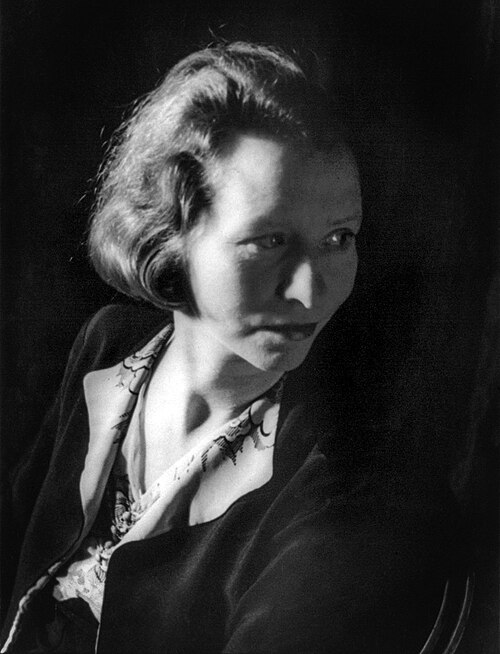
Although Steepletop was a retreat from Hardy’s “madding crowd”, Edna and Eugen often invited guests to their home. At the outdoor bar, gin watered the flowers; in the spring-fed pool, one swam au naturel. The she-shack was where Edna wrote, accompanied by her German shepherd, Altair; after Cora’s passing, Edna surrounded the cabin with thirty-one white pines in memory of her mother and Maine. A missing museum item: a candle with wicks on both ends.
A heart-rending sight is the railing’s broken baluster: as Edna tumbled down the stairs, she grabbed hold of it to break her fall. The Steepletop Cemetery holds the graves of Cora, Edna, Eugen, her sister, Norma, and her brother-in-law, Charles Ellis. Edna’s epitaph could have been the words from “First Fig”: “My candle burns at both ends; / It will not last the night; / But ah, my foes, and oh, my friends— / It gives a lovely light!”
A View from Her Window
Looking from the window, Edna saw endless rows of pink-flowered steeplebush.

To pre-order my newest book, The World's Wealthiest Women: Fascinating Biographies of Heiresses, Royals, Entrepreneurs, and Entertainers, please click one of the links below.
- Amazon.com: amazon.com
- IndiePubs: indiepubs.com
- Bookshop: bookshop.org
- Amazon.co.uk
- Amazon.ca
- B&N: b&n.com
- Chapters Indigo (CA): indigo.com
- Books That Save Lives