Belle da Costa Greene
Author Rudyard Kipling wrote, “East is East and West is West and never the twain shall meet.” And yet, in the Gilded Age, there was a meeting of the twain when the wolf of Wall Street, J. P. Morgan, joined forces with librarian Belle da Costa Greene.
Where can one find treasures such as Rembrandt’s “The Hundred Gilder Print,” an autographed Charles Dickens’ A Christmas Carole, the Declaration of Independence, under one roof? Answer: Manhattan’s Morgan Library & Museum. Many of these artifacts were the result of a woman who guarded her past as assiduously as she did the priceless relics.
In E. L. Doctorow’s novel, Ragtime, vigilantes occupied Manhattan’s Morgan Library; they threatened to blow it up to protest racial injustice. They had targeted the library in the belief its founder, J. Pierpont Morgan, represented the white- is- right- mindset. Ironically, the diminutive dragon who guarded the gate of the Morgan was black. .jpg)
A most unusual Gilded Age story began in Washington, D.C., with the birth of Belle Marion, the third of seven children (two passed away in infancy) of Genevieve, a music teacher, and Richard Greener, the first black graduate of Harvard College, later its dean. To mark his position as the first black professor at the University of South Carolina, in 2018 the school erected a nine-foot bronze statue of Richard holding a book satchel, dressed in a tailored waistcoat. Frederick Douglas and Richard had collaborated on the Reconstruction newspaper New National Era. While her father did not imbibe Belle with his social conscience, he did share with her his passion for rare books and manuscripts. In 1916, she told The Evening Sun, “I knew definitely by the time I was twelve years old that I wanted to work with rare books. I loved them even then, the sight of them, the wonderful feel of them, the romance and the thrill of them.”
The Greeners relocated to New York for Richard’s appointment as secretary of an association to raise funds for a monument to Ulysses S. Grant who Richard had met at Harvard. The result was New York City’s Grant’s Tomb. As the couple were light-skinned, a result of their mixed parents, Genevieve wanted the family to pass as white in their new city to escape Jim Crow. Her plan engendered marital trouble as Richard refused, arguing he could not fight for Civil Rights while living as a white man. With the family estrangement, Richard accepted President McKinley’s diplomatic post in Vladivostok, Russia, where he had three children with the Japanese Mishi Kawashima. There never was a reunion between Belle and Richard. To substantiate the charade, Genevieve abbreviated Greener to Greene and changed her maiden name from Fleet to Van Vliet for its association with the old Dutch aristocracy. Belle and her brother, Russell, darker skinned than their siblings, added da Costa due to its association of a Portuguese lineage. The New York census designated the Greens as white, Genevive as a widow. Belle identified her father as deceased.
With the Greens in dire financial straits after Richard’s departure, Belle dropped out of Horace Mann High School to work for Grace Hoadley Dodge at Teacher’s College. Aware of her assistant’s librarian aspiration, Grace penned a letter to the Northfield Seminary for Young Ladies in Massachusetts, “The family has a sad history. The Mother was a Mt Holyoke Graduate, a teacher—She married a man, with Spanish Cuban & Negro blood a lawyer who graduated the head of his class at Harvard! He turned out clever but bad and after terrible experiences she left him & has been supporting her five children with terrible struggle. . . . While the trace of Negro blood is noticeable, Belle has always associated intimately with the best class of white girls. The Mother wants to make the girl a true noble woman & she has qualities for such if under such influence as Northfield. The Mother, of course, is white.”
Despite the misrepresentation of Genevieve’s ethnicity and attendance at Mt. Holyoke, Northfield granted her admission. The Northfield years were challenging: tuition derived from Grace’s charity, her father had vanished, she was fearful the truth would out. After graduation, Belle spent a summer internship at Amherst College, followed by an apprenticeship at Pyne, Princeton University’s library where she had a $480 annual salary. ($18,000 today) Had Belle not hidden her ethnicity, she would not have received the post. The all-male Princeton, known as the Southern Ivy, had students from the former Confederacy. The university’s president, Woodrow Wilson, maintained an all-white policy even though other Ivy League schools admitted blacks.
In Princeton, Belle met Junius Morgan II who introduced her to his stratospherically wealthy uncle, J. P. Morgan. The financier was seeking a personal librarian to transform his haphazard collection (that included 10,000 books) into The Pierpont Morgan Library-that he was constructing adjacent to his Manhattan mansion. The 1905 meeting with the tycoon amidst a palazzo of baronial splendor must have left Belle feeling like a twirling ballerina inside a massive jewelry box. Either because the money man was drawn to the connotation of her last name, or because of her chutzpah which she shared with her vision for the future library, “I hope to be able to say some day that there is neither rival nor equal” Morgan hired Belle despite her gender and lack of university diploma. She was ecstatic to work with priceless objects, and with her salary that doubled what she had earned at Princeton. Although her position entailed forsaking her roots, her extended family, and her father, she knew Belle da Costa Greene had accomplished what would have been impossible for Belle Marion Greener.
The initial task was to pack hundreds of treasures to the new venue-the building adjacent to Morgan’s mansion. Her vision and organization skills were so exemplary Morgan soon had her assisting with his personal affairs that entailed compiling guests lists to his dinners and choose gifts for his circle. On one occasion, Belle went out on a limb and smuggled objects from Europe, an escapade that bonded the captain of industry and his personal librarian. Due to Morgan’s reputation that he pursued mistresses as relentlessly as he did art, journalists asked the librarian if she were in a romantic relationship with her billionaire boss. Well versed in keeping her secrets close, she responded, “We tried.” If Morgan harbored suspicions regarding her past, he was too invested in his librarian -“the cleverest girl I know-” to consider her dismissal. He may have also been empathetic to her secret as he harbored his own: his daughter Anne was in a Boston marriage, (euphemism for lesbian relationship.)
As Belle learned the ropes and garnered further trust, Morgan allowed his apprentice to acquire priceless finds on his behalf. As a high-profile figure in the auction houses-in America and England,-and with her association with the titan she called “the Big Chief” provided an open sesame to Gilded Age galas and nights at the opera in her employer’s box. At night, in the minuscule room she shared with her sister Teddy, Belle related the can-such-things-be antics of Mrs. Astor’s 400.
The era’s leading librarian’s greatest coup was the 1911 successful bid for the 1485 Thomas Malory’s Caxton Morte d’Arthur that she purchased for $50,000 (several million today.) The New York Tims reported, “Miss Belle Greene can spend more money in an afternoon than any other young woman of 26.” Select visitors such as actress Ellen Terry, opera singer Enrico Caruso, and novelist Henry James had visiting privileges to the rarified enclave that included a Guttenberg bible, Rembrandt etchings, and Shakespeare folio.
In gratitude to his right-hand woman, Morgan increased her salary to $10,00- $300,000 today. With her newfound wealth, Belle drove a Pierce-Arrow convertible, and moved, along with her mother, to adjoining apartments at 535 Park Avenue apartment, blocks from the Morgan. With her padded bank afford, she furnished her apartment with Lavina Fontana’s Renaissance “Marriage Portrait of a Borghese Noblewoman” and calligraphy from an Indian Quran. A dedicated clotheshorse, Belle sported fur collars, plumed hats, and Fortuny gowns. As she remarked, “Just because I am a librarian doesn’t mean I have to dress like one.” Her lavish lifestyle distanced herself from the daughter of the single mother. In a desire to further distance herself from her ethnicity, Belle displayed the prejudices of the white elite. In 1910, Belle wrote about the passing of her maid, “poor little black thing who had been more than a mother to me.” Then added that she had proved “my faithful and adoring slave.” After attending Eugene O’Neils’ The Emperor Jones that starred the black actor Charles Sidnet Gilpin, she stated, “A real New York dandy darky-and amazingly well done.” A hint as to her inner conflict at hiding her truth, she mentioned that she had started a diary in which “I write things I hardly dare think.”
When the journalists questioned Belle as to why she had never married, Belle responded, “As far as interest goes, I have found nothing thus far to equal my position as librarian of the Morgan Library.” Her statement held true until 1909 when the twenty-nine-year-old Belle experienced a coup de foudre with the forty-three-year-old Bernard Berenson. They bonded over their love of paintings, and their common career: his main patron was Boston Brahmin Isabella Gardner. Isabella, Morgan’s rival, was not in Camp Greene and in a letter to Bernard referred to Belle as “a half-breed who couldn’t help lying.” In retaliation, Belle reported that Isabella’s museum “was full of forgeries.” A further commonality between Bernard and Belle was they both drew a curtain over their past. He had started life as the Jewish Bernhard Valvrojenski in Vilnius, Lithuania. After immigrating to Boston, his father worked as a peddler. In his nod at reinvention, he transformed into the Episcopalian Bernard Berenson. Their love affair was long-distance as Bernard lived in his magnificent Villa Tati in the hillside overlooking Florence where he entertained guests Edith Wharton, Gertrude Stein, and Isabella Gardner. A few months after their meeting, the smitten suitor sent Belle sixteen volumes of The Thousand and One Nights. In one of the six hundred letters they exchanged over forty-years, Belle wrote of “the invasion which you have made of my life and heart.” In 1910, they travelled through France, Germany, and Italy, a dream vacation that unexpectedly ended in London where Belle underwent an abortion. The impediments to a baby were Helen-Mrs. Berenson, and her dismissal from the Morgan if she became an unwed mother. A further factor: Belle feared having a baby who bore tell-tale features. Further heartache followed when Bernard went on other trips, with other lovers. Belle licked her wounds and took refuge in her library.
The 1913 death of J. P. Morgan proved a seismic shock for his right-hand woman, devasted at the loss of her Big Chief. He willed Belle $50,000, ($1.6 million today) and mandated his personal assistant remain in charge. When his son, J. Pierpont Morgan, Jr. “Jack”, took over, Belle persuaded him to make his library accessible to the public. In 1924, Jack turned his priceless collection over to six trustees as a memorial to his father, with Belle as its first director. To celebrate the public inauguration, the grand dame of librarians mounted a series of exhibits of precious items that drew 170,000.
In 1921, at age forty-two, Belle enjoyed a maternal role when she became her nephew’s guardian. The widowed Tammy, (her husband had been a causality of World War I,) entrusted Robert “Bobbie” MacKenzie Leveridge to her sister. Belle described the child as a “peach of a boy” and lavished on him books, elite schools, and travel. In 1941, Bobbie dropped out of Harvard and served as a lieutenant in England for the U.S. Army Air Force. Two years later, Belle received the devastating news Bobbie “had been killed in action”- though that was not the case. Bobbie had received a letter from his fiancée , Nina Taylor, whose father had hired a detective to investigate his racial background. Nina wrote she was ending their relationship due to his black roots and her dread their offspring could be dark. She added, “I consider it an insult to be invited to meet Morgan’s nigger whore.” The words were a two-fisted blow-his past was a lie; he had lost his fiancée. Before ending his life, he gave Nina’s letter to his friend-art historian Daniel Varney Thompson. Whether Belle knew the truth surrounding Bobbie’s death, the loss resulted in an emotional and physical collapse. No matter what pains Belle took to hide from Jim Crow, she could not protect her beloved boy. In Voltaire’s novel, the protagonist, Candide states, “We must cultivate our garden.” The theme is whatever horror befalls, the antidote is work. Belle returned to the Morgan.
Twenty-five years later, after forty-three years, the Morgan Library & Museum honored its intrepid curator by staging an exhibit that featured a highlight of the hundreds of objects she had acquired. The grande dame attended in a wheelchair. Before her retirement, she had made her final, and most autobiographical acquisition: Frederick Douglas’s autographed letter. Considered the civil rights activist’s connection with Richard Greener, the purchase was likely a nod to the burning bridge of yesteryear.
In 2024, The Morgan Library and Museum held a retrospective: Belle da Costa Greene: A Librarian’s Legacy that resurrects the former chatelaine of the museum. The exhibit featured the thirteenth century Crusader Bible, once the possession of Louis IX, the fifteenth century Gospel Book made for an Ethiopian princess, an illuminated Turkish Quaran. Other items that summon Belle’s ghostly presence was her claw-foot desk and swivel chair upholstered in a blue-and-white floral fabric, a sampling of her books, (a volume of Yeats, a biography of Percy Bysse Shelley, ) a Henri Matisse nude, and her jewelry. A ledger with her handwriting recalls every book and manuscript the Morgan acquired under her tenure. To provide context to the era that led to Belle’s Sophie’s Choice was a copy of the 1924 “Racial Integrity Act” from the Virginia General Assembly that had criminalized interracial marriage, that defined whites as those “with no trace of the blood of another race…” The document added: the only exception was one-sixteenth descent from a Native American-a nod to Virginians who claimed Pocahontas as an ancestor. The pain of the past was also apparent from an exhibit note penned by Daniel Verney Thompson regarding the letter he had received from Bobbie, “The contents of this enveloped brought a noble boy to his death. It is not fair to brand him a suicide; this letter killed him.” Despite the tangible objects, Belle remains elusive.
Before her 1950 death, Belle burned her letters and diaries; she had no desire to leave a posthumous peephole into her past. The lingering question: did Ms. Greene ever regret the erasure of Ms. Greener? To obtain a seat at the table, Belle paid a price: her Washington, D.C. childhood community that held her grandmother, uncles, aunts, cousins, and church. The greatest amputation was her father, once the axis of her world. One wonders if Belle was akin to Peola in the 1934 film Imitation of Life. The light-skinned Peola, because of her determination to live as a white woman, abandoned her dark-skinned mother. Years later, when she attended her mother’s funeral, Peopla is overcome with grief , with guilt.
The Morgan library holds Belle’s $15,000 purchase of the only extant copy of Edgar Allan Poe’s “The Raven.” The poem embodies the searing pain of separation-a burning sword that the librarian well understood. In the poem, a raven visits a man mired in grief, and demands of the unwelcome visitor, “Take thy beak from out my heart, and take thy form from off my door!” Quoth the raven, “Nevermore.”

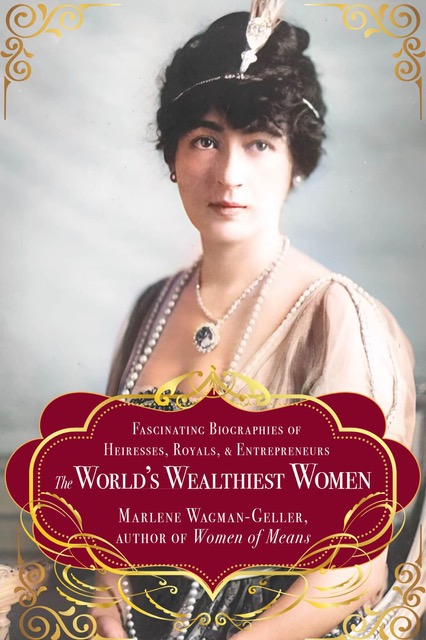
To pre-order my newest book, The World's Wealthiest Women: Fascinating Biographies of Heiresses, Royals, Entrepreneurs, and Entertainers, please click one of the links below.
- Amazon.com: amazon.com
- IndiePubs: indiepubs.com
- Bookshop: bookshop.org
- Amazon.co.uk
- Amazon.ca
- B&N: b&n.com
- Chapters Indigo (CA): indigo.com
- Books That Save Lives