The Halitosis Heiress
“Nothing should be noticed.”–Bunny Mellon
The great American financial dynasties originated with railroads, (Vanderbilt), oil, (Rockefeller), steel, (Carnegie). But there was only one whose wealth was predicated on bad breath: Rachel (Bunny) Mellon.
Entering the Listerine “Stink lab” in New Jersey is equivalent to stepping into a human mouth–one with terrible breath. The purpose of the “stink lab” is for the manufacturer of mouthwash to test varieties of its product. The company produces Listerine Zero, a non-alcoholic brand for distribution in Muslim countries where spirits are prohibited; Green Tea Listerine targets the Asian market; Listerine Naturals courts Americans who desire a holistic formula.
In 1879, Dr. Joseph Lawrence created an antiseptic for use in surgical procedures. Two years later, Dr. Lawrence sold the formula to Jordan Wheat Lambert, who founded the St. Louis based Lambert Pharmaceutical Co. To promote his product. Jordan travelled to London to meet Dr. Joseph Lister who had first used the treatment when performing operations. As fewer patients died, Queen Victoria rewarded him with a knighthood. Jordan received permission from the newly minted Sir Lister to license his name, which resulted in the brand Listerine. With his newfound prestige and wealth, Jordan was among the local leaders who visited the White House to persuade President Grover Cleveland to come to St. Louis for the 1888 Democratic Convention. As an adult, his fifth child, Gerald Barnes Lambert, came up with catchy ads such as the now cliched expression, “Always a bridesmaid but never a bride,” that associated the bridesmaid’s single status to her failure to gargle. Another slogan–alongside a married couple–held the caption, “till breath do us part.” In 1928, Gerald took his company public and presciently sold shares for $25 million–in contemporary currency $340 million–before the Stock Market Crash.
In tribute to the Lambert’s donation of land for the St. Louis Airport and their financing Charles Lindbergh’s historic flight, the pilot christened his plane, The Spirit of St. Louis. The liquid golden goose made Gerald’s daughter, Rachel a woman of means. A nanny called her Bunny, a lifelong nickname even though she grew to a height of five foot nine. Her father served as the president of the Gillette Safety Razor Company and managed the family pharmaceutical firm. In the 1920s, after coining the term ‘halitosis,’ sales skyrocketed. In 2000, Pfizer purchased the pharmaceutical firm for $110 billion.
The Lamberts’ main residence was the Princeton, New Jersey, fifty-two-room Albemarle estate that held a ballroom and a large staff. With the advent of automobiles and airplanes, the family purchased the latest models. Bunny and her sister Lily attended Miss Fine’s private school whose former students had included the daughters of Presidents Woodrow Wilson and Grover Cleveland.
Mary Lennox, the protagonist of Frances Hodgson’s 1911 novel, The Secret Garden, shared similarities with Bunny Lambert. The fictional heroine was born in British-India to wealthy, emotionally cold parents. After moving to England, Mary found her purpose in gardening. Bunny felt overshadowed by her brother, Gerald Jr., (nicknamed Sonny), the cherished only son, and by her Lily, praised as the beautiful daughter. When Bunny was eleven, her maternal grandfather, Arthur Lowe, gifted her a children’s wildflower guide that whetted her love of nature. As a child, her first garden epiphany had occurred upon spying a clump of garden phlox of which she later said, “Like a magic carpet it has carried me through life’s experiences.”
After graduating from high school at Foxcroft, Bunny wanted to attend college to study stage design. Gerald vetoed the notion, insisting her vocation lay with marriage and motherhood. As compensation, her father took her on a trip to the Bahamas on his yacht, once the property of Cornelius Vanderbilt.
In October 1929–the date and the month that coincided with the stock market crash, the Lamberts threw Bunny a coming out ball at Albemarle. She was a regular on the debutante parties such as the one for Woolworth heiress, Barbara Hutton, held at the Ritz-Carlton. The cost for roses was $50,000, a staggering amount as Depression-era families survived on fifty cents a day. One of Bunny’s beaus was Stacy Barcroft Lloyd, Jr., scion of a banking and brewing fortune. They shared mutual interests in sailing, horseback riding, golf and both hailed from upper class Episcopalian and Republican backgrounds. At age twenty-two, the couple married at Trinity Episcopalian Church in Princeton. Bunny’s maid of honor was Leila Delano, whose cousin, Franklin Delano Roosevelt, had just won the presidential election. One of Bunny’s cherished gifts from Stacy was a horseshoe-shaped gold and sapphire pinkie ring. In 1939, Bunny and Stacy attended a Christmas dinner at the White House hosted by President Roosevelt and First Lady Eleanor. The evening’s entertainment was the newly released film Gone with the Wind. .jpg)
Following the Pearl Harbor bombing, Stacy informed his wife that he was to be stationed in England for his role in the Office of Strategic Services, the predecessor of the CIA, that led her to blurt out, “You can’t, we just got new lampshades.” When Bunny wrote of the birth of their baby, Eliza Winn, Stacy replied in a letter addressed to his “Dearest Hun Bun.” What helped ease Stacy’s homesickness was his Virginia neighbor and friend, Paul Mellon, was also serving in the same OSS unit, and they shared a London lodging. During his service, Stacy interviewed foreign news correspondent, the writer Ernest Hemingway. Trouble loomed in the Lloyd marriage when Bunny heard rumors her husband was seeing Rose Greville. However, she chalked them up to rumor. Upon his return to the States, Lloyd had a joyful reunion with Bunny, Eliza, and son, Stacy Bancroft Lloyd III, (nicknamed Tuffy). He gave Bunny a gift of a gold compact with her initials spelled out in rubies.
At age thirty-six, Bunny took stock of her life: she was the mother of two with a rocky marriage. As an exit route, she set her sights on the recently widowed Paul Mellon, father of two, who was assuaging his grief with the time-honored crutches of drinking, smoking, and womanizing. Bunny set out to ensnare the fifth richest man in America who had an estimated fortune of $400-$700 million–$3.3 billion to 5.9 billion in contemporary currency. Although reeling from the double betrayal of Paul and Bunny, when his former brother-in-law, Sonny, died on a United Airlines crash, Lloyd attended the Princeton funeral.
The Mellons travelled on their DC-3 plane that included sleeping quarters and a décor of French paintings. They spent time in Manhattan in a townhouse on the upper East Side; on trips to Paris, they stayed in a penthouse in the Hotel de Crillon. Although Paul and his father Andrew did not see eye-to-eye, they shared a love of art. Upon his death, Andrew only willed his son an 1882 John Singer Sargent portrait of Miss Beatrice Townshead holding a terrier, (Paul’s favorite breed). The remainder of the canvasses went to the National Gallery. During European sojourns, they searched for paintings. She favored canvasses with scenes of flowers and fruit, and they purchased Vincent van Gogh landscapes: Flower Beds in Holland and Green Wheat Fields, Auvers. Other masterpieces: a Renoir featuring flowers in a vase, a Cézanne with three green pears, and a Manet of a melon on a wooden, paint-spattered table, a Picasso of a woman in a garden. In Switzerland, Paul, interested in psychotherapy, introduced her to Carl Jung. While on a walk the famed therapist told her, “You’re the wise one. Keep picking flowers.” Bunny preferred psychics over psychologists.
When not picking flowers or working in her magnificent gardens, Bunny made the best-dressed list, knocking off her sister-in-law, Ailsa Mellon Bruce. Her designer handbags had 18-karat gold zippers; interiors had the intertwined initials B.M. She accessorized with a diamond bracelet and a necklace made of emeralds. Her blue pendant diamonds, when put up for auction, were expected to sell for between $10 million to $15 million. Her preferred jeweler was Fulco di Verdura, a Sicilian duke whose Manhattan store enjoyed the patronage of Wallis Simpson, the Duchess of Windsor. Mrs. Simpson’s love of nature inspired creations such as a sapphire-and-emerald flower with a canary diamond center. The duke collaborated with Salvador Dali for his surrealistic line. Katharine Hepburn wore his pieces in the film The Philadelphia Story. In 1950, Paul commissioned a brooch for his wife that consisted of a gold tree, embellished with twenty-six ruby apples with diamond leaves.
The Mellons’ main residence was the nineteenth century, 5,000-acre Virginia farmhouse, Oak Springs, where they had a retinue of two hundred employees that consisted of horse trainers, gardeners, and chauffeurs. On the walls hung museum-worthy paintings such as the Rothko whose estimated value was $150 million. A bronze statue of Paul’s Kentucky Derby winner, Sea Hero, stands on its grounds. They turned another residence, Brick House, into a repository of treasures which held their collection of first editions, including hand-painted manuscripts by the British poet and artist William Blake. Bunny purchased a 1486 volume by Parisian miniaturist Antoine Vérard and a Thomas Jefferson letter where he wrote of his garden. Other floral works bore the names of Pablo Picasso and Andy Warhol. A four-volume set, “Birds of America,” bore on its spine the name: John James Audubon. Sotheby’s sold a similar set for $11.5 million. On her privately owned island, Oyster Harbors, in Cape Cod, nine gardeners tended the vegetable garden. Paul’s joke with the gardeners was, “Is this one of my $1,000 tomatoes?”
Passionate philanthropists, Paul’s Bollinger Foundation, underwritten with $20 million, distributed poetry awards. In a controversial move, the foundation awarded the 1949 prize to Ezra Pound, indicted for treason for his pro-Mussolini propaganda broadcasts and who was in a psychiatric hospital. The same year, Bunny turned her attention to the $2.5 million restoration of an 1895 Virginia Trinity Episcopal Church. Her architect renovated the structure to resemble a medieval Norman French church. The stained-glass windows originated in Holland from glass fragments salvaged from European bombed churches and greenhouses; its ancient door came from France. The blue stones that lined the walls were from boulders in the nearby Blue Ridge Mountains. Bunny mentioned to the rector, “I’m a different sort of Christian. I don’t really come to pray. I come in to talk with God because he’s a dear, dear friend of mine.”
A generous friend, Bunny sent her pilot around the country to deliver fresh flowers and vegetables from her Virginia farm. She scoured the beach at her Cape Cod estate for the perfect clamshell in which to encase a gift of pearl earrings, (she frowned upon Tiffany’s blue boxes which she considered “déclassé.”)
In the mid 1950s fault lines appeared in the Mellon marriage. Bunny believed that Paul had rekindled his affair with the British Valerie Churchill Longman with whom he had cheated on his first wife when stationed in England. Although Bunny likely never went beyond emotional adultery, she shared she was not sitting home knitting while hubby had affairs. Despite marital roadblocks, they stayed together.
When Queen Elizabeth II and Prince Philip planned their first official trip to the States, the Queen, an avid horsewoman, decided to visit the Mellons’ prized horses, followed by tea at their estate. London’s Daily Herald pointed out that the royals were sidestepping protocol by visited the home of a divorcee. The paper added, “Dozens of America’s top hostesses would give their minks and jewels to change places with Mrs. Mellon.” Bunny shrugged off the media frenzy, “We are tremendously honored and thrilled that the Queen and Prince Phillip should visit us. But why in the world are so many people interested in knowing about us? We live a plain ordinary sort of country life down here.” Three decades later, she entertained royals Charles and Diana.
An abiding friendship was with First Lady Jacqueline Kennedy. After visiting Oak Spring, Jacqueline told Bunny, “Jack is going to ask you something tonight and you better godddam say yes.” The request: The president wanted Bunny’s assistance in sprucing up the White House Rose Garden. The reason the grounds required beautification was because President Dwight D. Eisenhower had cut down the roses and turned the area into a putting green. Bunny’s green thumb also left its mark in the Kennedys’ summer home on Martha’s Vineyard, and the John F. Kennedy Presidential Library and Museum overlooking Boston Harbor. Bunny presided over the floral arrangements for President Kennedy’s funeral bier.
Tragedy arrived in 2000 when a truck hit Eliza Winn as she crossed a Manhattan Street. She suffered a brain injury that left her a paraplegic, unable to speak. She received round-the-clock care at Oak Springs where she passed away after eight years. Six years after the loss of her daughter, Paul died at age ninety-one. His widow auctioned off many of her possessions in Sotheby’s sale of the century. So great were her treasures that the catalogue for the estate filled four-volumes. The auction garnered $218 million that Bunny donated to a horticultural research center located on her Virginia farm.
Traditionally, well-bred ladies’ names only appeared in the headlines on three occasions: their birth, marriage, and death notices. Although fiercely private, Bunny was often media fodder. After John Edward’s presidential bid ended through a sex-and-money-scandal, news leaked that the 101-year-old widow had forked over $3 million in “Bunny money.” Another $725,000 went to the candidate’s personal bank account that he used to keep his mistress, Rielle Hunter, and their baby, a secret from his terminally ill wife. Of her contribution, Bunny stated, “Well, I suppose it’s my own damn fault. He was so attractive. And you know I’m weak on good looks.” After the trial, Bunny remarked to her friend who had introduced her to John, “Didn’t we have fun?”
When Bunny passed away at age 103, her beloved Oak Spring Farms was put on the market for $70 million. Bunny’s internment was in the Mellon family plot on the grounds of the Trinity Episcopal Church. Among the famous who paid their final respects were Bette Midler and former senator John Edwards. Her grandson, Stacy Lloyd IV, said his “Granbunny” had taught him how to appreciate nature’s beauty. Jackie once teased her, ‘Bunny, you think all your ducks are swans.” A tenor sang “Shenandoah;” Bette Midler performed “The Rose.”
In the closing scene of Citizen Kane, media mogul Charles Foster Kane’s dying word is “Rosebud-” the name of his cherished childhood sled found item amongst his priceless collections. Tucked amongst Bunny’s treasures were two objects her staff had been told not to touch–an old bottle of Listerine with a rusty cap, and a children’s book Flower Guide: Wild Flowers East of the Rockies. The scent of the roses in the White House garden offers no hint they came from the hand of the Halitosis Heiress

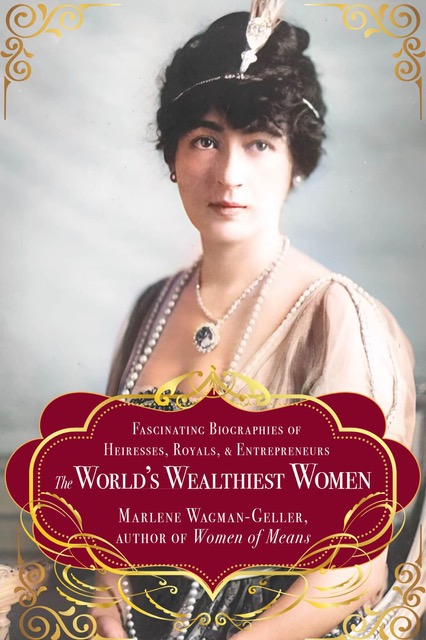
To pre-order my newest book, The World's Wealthiest Women: Fascinating Biographies of Heiresses, Royals, Entrepreneurs, and Entertainers, please click one of the links below.
- Amazon.com: amazon.com
- IndiePubs: indiepubs.com
- Bookshop: bookshop.org
- Amazon.co.uk
- Amazon.ca
- B&N: b&n.com
- Chapters Indigo (CA): indigo.com
- Books That Save Lives