Much is Expected
“ We must give of that which is divine within us, the love which is ready for all sacrifice, even unto life itself.” ~Anne Morgan
“The proverb, “Birds of a feather flock together” applied to the Gilded Age aristocracy whose daughters’ Holy Grail was Holy Matrimony-to a husband whose fortune was on par with her family’s. An exception to the rule was Anne Tracy Morgan who cared about causes and cared not a whit about coronets.
Anne’s father, J. Pierpont Morgan, (J.P.) the King Midas of the Gilded Age, was a one-man Federal Reserve whose wealth was so vast he once bailed out the United States’ Treasury from its crippling debts incurred during the American Civil War. The Robber Baron created U.S. Steel, the first billion-dollar corporation, established General Electric, and founded the bank that still bears his name. Known as the Napoleon of Wall Street, John’s Machiavellian bent is apparent in his quote, “A man generally has two reasons for doing things-one that sounds good and a real one.” Morgan is immortalized as Monopoly’s mustachioed, top-hatted, cane-carrying Rich Uncle Pennybags-official name: Milburn Pennybags.
Despite Morgan’s bulbous nose, a result of rhinophyma, his fortune ensured he had no trouble attracting the ladies. His first wife, Amelia, the love of his life, passed away from tuberculosis four months after their wedding. His second marriage, to Frances, resulted in children: J.P. Junior, Juliet, Louisa, and Anne.
The youngest of the Morgan siblings, Anne was born three years before Mark Twain published his satirical novel, The Gilded Age, an era in which her father was a dramatis persona. She spent her childhood in her family’s country estate, Cragston, situated on 700 acres in Highland Falls, in Hudson, New York. Her education consisted of governesses, private schools, and travels to London and Egypt. When in Manhattan, the Morgans lived in their mansion on Madison Avenue, the first house to be entirely electrified as Morgan had funded inventor Thomas Edison. From the walls of the estate hung Old Masters bearing the signature Rembrandt. At a dinner, family friend Elizabeth Drexel Lehr, (the wife of Henry Lehr, nicknamed King Lehr-the power behind the throne of the Gilded Age) recounted J.P. asked Anne what she wanted to be when she grew up. The little girl replied, “Something better than a rich fool.” Not long after Anne’s birth, her parents’ marriage unraveled that led to her father ‘s desire not to be in the same continent as his wife. J.P. was often on his yacht, Corsair, or in his mansion at 14 Prince’s Gate in London, or in the company of his current mistress.
The teenaged Anne attended the extravagant balls and costume parties held in the Fifth Avenue mansions of the Astors and the Vanderbilts. For the over-the-top Bradley Martin Ball, Anne dressed as Pocahontas for which she wore a headdress of fathers that made her appear taller than her 5-foot 8-inch height. For other masquerade balls, she came as Queen Elizabeth and even as the Marquis de Lafayette. A 1890s photograph shows the three Morgan sisters, elegantly attired. However, Anne later shunned these galas, as Anne-unlike her sisters- was not a husband hunter. Juliet Pierpont Morgan married William Pierson Hamilton, the great grandson of Founding Father Alexander Hamilton. After her wedding where 1,000 guests gathered for a reception in the Morgan mansion, the couple moved to a 40-acre, 52-room estate-Table Rock in the Hudson Valley. Louisa Pierpont Morgan Satterlee Manhattan’s marital home displayed the Gainsborough portrait of the Duchess of Devonshire, a gift from her father. While Julia and Louisa tended to their husbands, children, and lavish homes, Anne accompanied her father on the Corsair, dressed in Worth attire from Paris. Her role was oftentimes as a beard that deflected from innuendo a Morgan mistress was on board. In 1902, one month after Anne and her father had received Kaiser Wilhelm II on board their yacht, father and daughter attended the coronation of Edward VII in Westminster Abbey. Her annual $20,000 allowance ($550,000 today) insured Anne autonomy.
In 1902, at age twenty-nine, Anne, along with three friends, inaugurated New York City’s Colony Club-the first female private establishment for upper echelon ladies. The purpose was to provide the same social amenities that men had long enjoyed with the Metropolitan, the Raquet and Tennis, and Union Clubs. The founders enrolled 500 members and bought the land on Madison Avenue five blocks south of the Morgan mansion. Eminent architect Stanford White designed the building; Elsie de Wolfe served as its interior decorator, the first woman to hold the position. The Colony Club made headlines, and while J.P. initially disapproved of women having a “room of their own” he joined its advisory board.
The Colony Club changed Anne’s life as it led to her meeting member Elisabeth (Bessie) Marbury -the first woman international literary and theatrical agent whose clients included Oscar Wilde, J. M. Barrie, and George Bernard Shaw. Anne often stayed with Bessie and Elsie in their Irving Place townhouse. The triumpherate hosted cocktail parties, far more colorful than the staid variety hosted by the Mrs. Astor. Guests (sans spouses) were Stanford White, Jack Astor, and Willie K. Vanderbilt, as well as a bohemian assortment of actors and artists. The home is currently the residence of the U.N. Secretary-General. In 1921, Anne purchased her own residence at 3 Sutton Place that had a rooftop garden. Part of the draw of the address was its proximity to Anne Vanderbilt who lived at 1 Sutton Place. Other neighbors were Elisabeth Marbury and Elsie de Wolfe at 13 Sutton Place. Currently, Anne’s former home serves as the residence of the United Nations Secretary-General.
Bessie and Elise purchased Villa Trianon in Versailles, once the playground of Marie Antoinette they shared with Anne. The three American socialites became known as the “Versailles Triumvirate.” Edith Wharton, and Marcel Proust visited. To celebrate the remodeling of Trianon, the ladies threw a grand gala whose guest of honor was Constantine, the Crown Prince of Greece. Another attendee was Paul Ernest Boniface de Castellane, the former husband of Anna Gould, daughter of financial mogul Jay Gould. De Castellane pursued Anne in the hope of marrying a second heiress, but she was not interested. Anne and Bessie were spectators at the Hunaudieres Racecourse at Le Mans where Wilbur Wright showcased his “flying machine,” and watched Sarah Bernhardt perform on the Parisienne stage.
While other heiresses made advantageous marriages, Anne gave herself over to social reform in Manhattan’s garment industry. She visited Jane Addam’s Hull House in Chicago, and during the International Ladies Garment Workers Union Strike, marched on a picket line alongside Alva Vanderbilt Belmont. The press dubbed the trio “the mink brigade.” Factory owners found it harder to hire thugs to rough up Jewish and Italian immigrant women when J.P. Morgan’s daughter was present. When the police arrested picketers, Anne provided bail. The activist founded the American Women’s Association where working women could convene, and whose gym came with a swimming pool. A 1926 photograph for the American Woman’s Association event at Madison Square Gardens showcased the Morgan heiress with Douglas Fairbanks and Mary Pickford. The Renaissance heiress served as the Treasurer of the Society for the Prevention of Useless Giving (SPUG) that railed against commercialization of Christmas.
After her father’s 1913 passing, Anne inherited $3 million ($72 million today) and earmarked her fortune for the betterment of others. The following year, with the outbreak of World War I, while expatriates fled Europe, Anne transformed Villa Trianon to a veterans’ hospital. Not content with merely fulfilling her noblesse oblige, Anne determined to do more. In 1916, she became aware of Scottish physician Anne Murray Dike who was helping the war effort in rural France. With the assistance of Phillippe Pétain, France’s commander in chief of its army, the two Annes set up a volunteer headquarters in Chateau Blérancourt, forty miles from the Front. The history of the chateau originated in the days of Henry IV when the Duc de Gesvres modelled it after the Palis du Luxembourg in Paris. During the American Revolution, Lafayette recruited a volunteer army from the village of Blérancort to fight for the Revolution.
Anne Dike served as president, Anne Morgan served as vice president of the American Committee for Devastated France, CARD ( Comité Américain pour les Régions Dévastées de France) that aided rural villages suffering from the devastation wrought by who they called Boches-the German army. The heiress told the New York Times, “We do not want sightseers who would like to go for half a year to view Frances’ battlefields.” The organization’s 350 American predominantly female volunteers used the chateau as their headquarters from which they organized mobile hospital clinics, distributed food and books, and established orphanages. The relief workers found living quarters for 50,000 displaced villagers and provided rehabilitation for those wounded in the war. As few French women had licenses, the volunteers (including Gertrude Stein and Alice B. Toklas), serves as drivers. Deeply committed in their relationships, the president and vice president had to endure separation when Anne M. Travelled to the States to raise money for their organization. A juxtaposition of socialite Anne wearing a white fox fur (that consisted of the animal’s face and leg) beside the one where she is dressed in a Card uniform illustrates her metamorphosis from Fifth Avenue heiress to World War I volunteer. For their work on behalf of France, both Annes received the Croix de Guerre, and the Legion of Honor-the latter ceremony took place at Blérancourt. .jpg)
In 1929, Anne Dike passed away at the home she shared with Anne Morgan at 43 Rue de Courcelles in Paris. Her interment was in the cemetery at Blérancourt, located in the village she had worked tirelessly to restore. A year later, Anne purchased the Chateau Blérancourt and turned it into a museum dedicated to the alliance between America and France that later became the Musée franco-américain du château de Blérancourt. Among the museum’s artifacts is a World War I Red Cross ambulance, and a wall commemorating the American who enlisted in the Escadrille Lafayette. Anne Morgan, and Anne Vanderbilt attended the gala luncheon to celebrate the museum’s inauguration.
Not falling for the1938 headline “Peace For Our Time-” (the headline alluded to British Prime Minister Nevelle Chamberlain’s appeasement of Hitler,) Anne grew increasingly anxious over the rise of Nazism and the expansion of Germany’s military. The following year, she sailed to Europe shortly before Hitler’s invasion of Poland. With the eruption of World War II, Anne converted her Sutton Place home into the headquarters for the American Friends of France (AFF) (the name of the new organization.) While in the States for a fundraiser Anne spoke of “the women bearing babies in the roughest kind of shelters. Some of these mothers were themselves born under similar circumstances twenty -five years ago.” Anne Morgan was once more in Blérancourt when the Luftwaffe dropped bombs that led to the evacuation of the chateau. Anne narrowly evaded capture as she led her ambulance drivers who were helping the war-stricken refugees. Under continual bombardment, Anne and her volunteers set up shelters in Paris.
In 1941, exhausted from the two World Wars, Anne returned to New York. In response to the flock of journalists, Anne only said, “For God’s sake, send food.” She late shared with a reporter from The New York Times about the desperate situation, “I have been in occupied France and to get home I had to come through Spain and Portugal, and the food situation in Spain is also very acute. I want everyone in Europe to get food but the Germans.”
For the next few months, Anne worked to raise money through benefits, concerts, and lectures. One fundraiser, held at a French restaurant, served a pot-au-feu-a French peasant stew. Six hundred people gathered to honor Anne at a dinner sponsored by the American Woman’s Association. Anne O’Hare McCormick of the New York Times stated, “This dinner is a tribute not so much to Miss Morgan alone but to human courage which she typifies.”
Two months after Germany’s defeat, Anne sailed for her spiritual homeland; she remained for three months helping war-ravaged France. Upon he r return, Anne compiled a cookbook whose proceeds would go to rebuilding towns devastated by the D-Day invasion. Pearl S. Buck, Salvador Dali, and Katheine Hepburn furnished recipes. When Anne crossed the ocean in 1947 on the Wisconsin, she brought along twenty cases of food, clothing, and Christmas toys. In France, Anne celebrated her seventy-fourth birthday with friends. A gift from France was the network she had founded bore the name: the Association Médico-Sociale Anne Morgan. Three years later, former First Lady Eleanor Roosevelt visited Blérancourt and shared her thoughts as she passed through its arched gate. "You can still imagine how grand the old château must have been rising beyond it. But you also are forced to wonder all over again, as you drive in, whether we human beings are bound to go on destroying each other and our possessions forever."
The same year, Anne, who had not lived in her Sutton Place home for three years, was in her Old Bedford Road, Mount Kiscoe estate in Westchester County, where she suffered a stroke. After recovering her health, Anne returned to France where she had another stroke and returned to the States accompanied by two nurses. In ill health, after decades of humanitarian work, Anne enjoyed a peaceful life. She enjoyed her garden’s delphiniums and took rides through the woodlands that surrounded her estate.
The Gilded Age heiress who had taken the road less travelled passed away in 1952 in her Westchester County home. In her will, she bequeathed ten percent of her estate to the mayor of Blérancourt for the upkeep of the chateau and its grounds. In tribute for her heroic efforts on behalf of their country, France installed a marble plaque in the Court of Honor of the Hotel Des Invalides near Napoleon Bonaparte’s tomb. Anne was the first woman and the first American to be so honored. The U.S. ambassador, James C. Dunn, was in attendance.
The funeral service at St. George’s Protestant Episcopal Church in Stuyvesant Square held 600 mourners including the French ambassador. Eight representatives of the Federation of French War Veterans formed an honor guard that accompanied Anne’s coffin to the door of the church.
During the memorial Service, The Rev. Edward O. Miller, recited several verses from the Old Testament’s the Book of Isaiah. He could have also shared the biblical admonition from the Book of Luke, colloquially expressed as, “To whom much has been given, much is expected.”

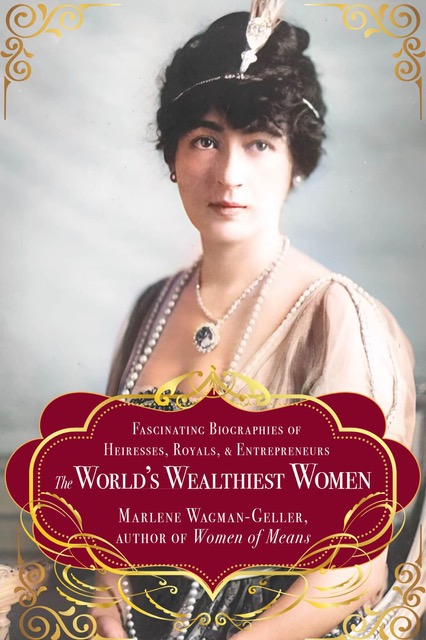
To pre-order my newest book, The World's Wealthiest Women: Fascinating Biographies of Heiresses, Royals, Entrepreneurs, and Entertainers, please click one of the links below.
- Amazon.com: amazon.com
- IndiePubs: indiepubs.com
- Bookshop: bookshop.org
- Amazon.co.uk
- Amazon.ca
- B&N: b&n.com
- Chapters Indigo (CA): indigo.com
- Books That Save Lives