The Sharpest of Thorns (1915)
When one conjures the image of European royalty, what comes to mind are the Habsburgs of Austria-Hungary, the Bourbons of France, the Windsors of England. Yet a small nation also boasted a crowned head, whose queen’s life could have sprung from a film noir.
Countess Geraldine hailed from aristocratic roots: her family could trace their decent back to the conquest of her native Hungary in 894 A.D. Her paternal grandfather served as the Grand Marshal of the Habsburg Court. She was one of three children of the impoverished Count Gyula (Julius) Apponyi de Nagy-Appony and Gladys Virginia Steuart, the daughter of the American council in Antwerp. Her mother was a descendant of the Mormon leader Brigham Young, and President Richard Nixon was her eighth cousin. The land rich, cash-strapped count owned an enormous country castle and a townhouse in Budapest, (in what was then part of the Austrian-Hungarian empire). The couple raised their three children-Geraldine, Virginia, and Gyula-on their ancestral estate, located on the perimeter of a vast forest at Nagy-Appony, a property that had been in the count’s family since 1280. With the collapse of the Austrian-Hungarian Empire, the Apponys embarked on a peripatetic odyssey: the Wienerwald in Austria and a family chateau in Czechoslovakia; they returned to their homeland in 1921. After her husband’s 1924 death, Gladys, along with her children, moved to Menton, in the south of France, to live near her widowed mother. With Gladys’ marriage to a French officer, she enrolled her daughters in the Sacred Heart School at Pressbaum, near Vienna, and the girls spent their vacations at Zebegny with their aunt, Countess Fanny Karolyi.
Because World War I had eroded the family’s finances, as a young woman Geraldine was grateful that her uncle, the director of the Hungarian National Museum in Budapest, found her a job as clerk in its gift shop selling postcards. Despite her straitened circumstances, Geraldine’s lineage and beauty made her a highly sought-after debutante. In 1935, she took part in a charity performance of La Bohème where the press displayed her photograph-taken at a ball- with the caption “The White Rose of Hungary.”
Albania, the birthplace of Anjezë Gonxhe Bojaxhiu, better known as Mother Teresa, was also home to Ahmet Bey Zogu, who had advanced from tribal chief to prime minister to president to Albania’s first royal, King Zog I. The newly minted crowned head, referred to as the Balkan Napoleon, had his share of trouble. He had barely escaped an assassination attempt in 1931 as he exited the Vienna Opera House. His mother kept watch over the royal kitchen to ensure her son’s food did not contain poison. Zog, anxious for an heir to ensure his dynasty, remembered the beauty of central European women from his years as a young officer in the imperial Austrian army, decided one would be his future consort. To this end, his six sisters left for Vienna and Budapest in search of a suitable bride. His favorite sister, Senije, felt she had found Zog’s perfect match and sent him Geraldine’s photo. The Muslim monarch was smitten with the beauty of the Roman Catholic countess.
An official from Albania, General Cyczy, visited the Appony family to invite Geraldine to visit the king. In response, her friend, Countess Katherine Teleki left for Tirana, the Albanian capital, to thank the king and to “have a good look around.” When the countess gave her approval, King Zog invited Geraldine to his palace where she took along a family friend, Baroness Ruling, as her chaperone. There she met the man, twenty years her senior, who had survived a score of assassination attempts, pulled all-nighters at the poker table, and smoked 150 cigarettes a day. Shortly after her arrival, she attended the king’s New Year’s Eve ball, along with 3,000 other guests. She entered the royal residence where she walked past walls covered with ancient costumes, crossed swords, and hundreds of candles. In the great hall, King Zog handed her a glass of champagne while a cannon boomed. Enthralled, he courted her with priceless gifts, and his vice-president presented her with a velvet pocketbook that contained $500,000; Geraldine promptly presented it to the National Albanian Charities. Geraldine claimed she had fallen for Zog and pronounced her suitor a man of “maturity and authority.” The next day she received one hundred red roses along with her breakfast tray. After ten days, when Geraldine accepted King Zog’s proposal, he gave her the title of Princess of Albania. Their courtship took place to the accompaniment of Leber waltzes and native folk music. The discordant element: Mussolini, hell-bent in annexing Albania in order to transform it into a fascist colony, did his best to undermine Geraldine, as he wanted an Italian on its throne. However, King Zog and his people would not be swayed in their steadfast devotion to Geraldine.
The couple married in 1938; with her coronation, Geraldine became Albania’s first queen and the only member of European royalty with American blood. The lavish ceremony took place in Tirana; Geraldine wore a white satin pearl and diamante wedding dress her fiancé had ordered from The House of Worth, in Paris, and her veil trailed from a diadem of orange blossoms. She had six bridesmaids and the wedding cake, which the bride sliced with her husband’s saber, was ten feet wide. Mussolini’s son-in-law, Count Galeazzo Ciano, served as a witness. Fifty thousand children in native costumes applauded, and even enemy clans shared wine. The gifts were over the top: a scarlet Mercedes from Hitler, (the only replica of his own car), four Lipizzaner horses from Admiral Horthy, the regent of Hungary, a bronze equestrian statue of a dragoon from King Victor Emmanuel III of Italy, and a rare cabinet from Franco. Mussolini, miffed at the king’s choice of consort, sent copper pots. At age twenty-two, Geraldine Margit Virginia Olga Maria Apponyi de Nagy-Appony became the second youngest queen in the world; only King Farouk of Egypt’s wife, Queen Farida, was younger. Queen Geraldine established the Albanian Red Cross and wrote that the scale of the mountain forests made those of Switzerland seem small. Nevertheless, a shadow hovered; The New York Herald Tribune observed that Queen Geraldine “seems to be marrying the Roman-Berlin axis as well as her king.” It concluded that she was “certainly marrying Mussolini’s foreign policy.” 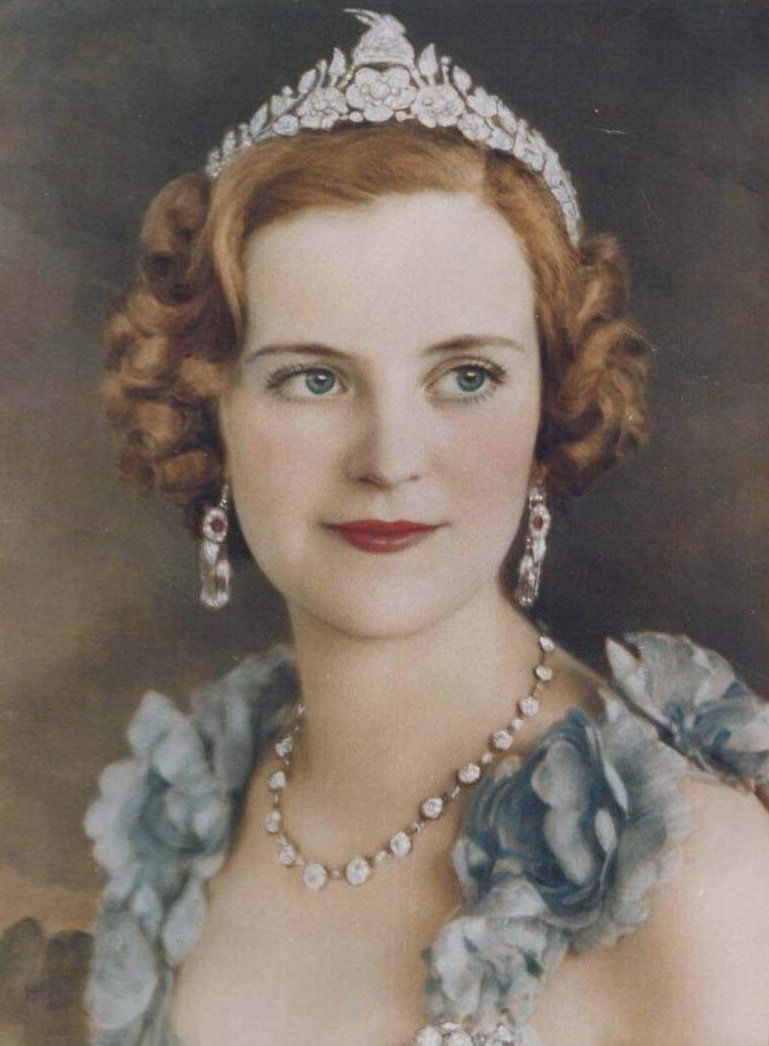
The roar of canons heralded the birth of their son, Prince Leka, but soon the air filled with a different form of artillery. The fairy tale came with an expiration date as a year later a 40,000 strong Italian army invaded, and King Victor Emmanuel III assumed the Albanian crown. Queen Geraldine, along with her two-day-old baby, fled by a car that travelled over torturous mountain roads to Florina, Greece. The king and 115 members of his court, as well as an arsenal of weapons, followed. Exile was made easier as Zog had also made off with Albania’s gold reserve. With the imminent invasion of Greece, the Albanian royals wandering began: Turkey, Romania, Poland, and Belgium, and France. Ian Fleming, author of James Bond, who served with British Naval Intelligence, spirited them out of Paris just before the arrival of the Nazis. He arranged their evacuation on a ship to England with the blessing of King George VII. King Zog rented an entire floor of The Ritz in London. Although Geraldine spoke flawless English-a polyglot versed in French, German, Hungarian, and Albanian- she was unhappy as her six sisters-in-law, who had also fled Albania, demanded too much of her husband’s attention. Their next destination was a villa in Alexandria where Geraldine spent her happiest years in the company of the exiled Queen Giovanna of Italy. With Nasser’s toppling of Farouk’s throne-Geraldine watched as he boarded his yacht- they departed for Cannes, France. Zog toyed with immigrating to the United States, and in 1951, he purchased a sixty-room mansion on a ninety-five-acre estate in Syosset, Long Island, though they never set foot in the estate. King Zog, after a decade of declining health, passed away in 1961.
The Albanian National Assembly in exile, in the Hotel Bristol in Paris, declared Leka their new crowned head; however, a referendum declined the return of the Zogu monarchy. Years later, France ended up expelling the six-foot eight-inch Leka due to his penchant for stockpiling weapons, and mother and son spent time in Spain where Geraldine became friends with the Queen of Bulgaria. Spain also refused sanctuary due to Leka’s vast collection of military grade weaponry, a ten-man guard, and his villa that doubled as an armed fortress. Mother and son accepted South Africa’s offer of diplomatic status and moved to the land where Apartheid held sway. The welcome mat disappeared after Leka’s arrest for filling his home with landmines and over 14,000 rounds of ammunition.
At the invitation of the Albanian parliament, eleven years after the collapse of its communist regime, Geraldine spent her final months in her adopted country after an abscence of sixty-two years. She reclaimed the magnificent family home behind the Hotel Bogner in Tirana from the Greek government that had been using it as their ambassador’s residence. She shared the estate with Leka, Queen Susan, Leka’s Austrian born wife, and their son, Crown Prince Leka II, who was to name his own daughter after her grandmother. Geraldine passed away at age eighty-seven from a heart attack while undergoing treatment for lung cancer. Life for the White Rose of Hungary came with the beauty of the flower, along with the sharpest of thorns.

To pre-order my newest book, The World's Wealthiest Women: Fascinating Biographies of Heiresses, Royals, Entrepreneurs, and Entertainers, please click one of the links below.
- Amazon.com: amazon.com
- IndiePubs: indiepubs.com
- Bookshop: bookshop.org
- Amazon.co.uk
- Amazon.ca
- B&N: b&n.com
- Chapters Indigo (CA): indigo.com
- Books That Save Lives