Art is Long
“I might perhaps write quite pretty fairy tales if I were only near the abodes of
fairies and elves.”—Theodate Pope
Located in London’s St. Paul’s Cathedral is the tomb of the famed British architect Sir Christopher Wren, which bears his epitaph, “Si monumentum requiris circumspice,” which translates to: “If you would seek my monument, look around.” In another time and place stands a different type of monument, the not-so-humble home: Hill-Stead.
Historically, women have had a hard time breaking through the glass ceiling of architecture. While Julia Morgan—architect of Hearst’s Castle, succeeded in “the gentleman’s profession” on the West Coast, Theodate Pope did likewise in the East.
The genesis of Hill-Stead began with Alfred Atmore Pope, the son of Maine Quakers, and his childhood sweetheart, Ada Brooks. With his many-splendored bank account earned from malleable iron, the Midwestern millionaire built a mansion on Cleveland’s Euclid Avenue, known as Millionaire’s Row. Their only child, Effie Brooks (Theodate), was born in 1867. At age nineteen, Theodate confided to her diary her dream of “owning a fine country home in the east and a dairy farm.” In the same year, feeling “Effie” lacked dignity, she assumed her paternal grandmother’s name, Theodate, Greek for “gift of God.” She attended Miss Mittleberger’s School for Girls, whose fellow alumnae were the daughters of Presidents James Garfield and Rutherford Hayes.
During a family trip east to check out finishing schools, Ada was in favor of Miss Porter’s School for Girls that Sarah Porter, the daughter of the town’s Congressional Minister, had founded in 1843 in Farmington, Connecticut. Theodate was in accord as her favorite cousin was a student. Enchanted by the New England village, Theodate declared it “one of the prettiest places I ever was in.”
In midlife, Alfred developed a passion for French modernist paintings and through them developed friendships with artists Mary Cassatt, and James Whistler. Alfred also made the acquaintance of Claude Monet during an impromptu visit to the artist’s home in Giverny, France. In 1888, the Popes embarked on a grand tour of Europe that lasted over ten months. On the return voyage to Cleveland, Alfred transported three Monets: Grainstacks, White Frost Effect, and Grainstacks in Bright Sunlight.
To alleviate their daughter’s depression—she was miserable with life as a debutante—upon the family’s return from Europe, her parents leased her a cottage in Farmington, two blocks from Miss Porter’s School. Although an unmarried woman living on her own was scandalous, Theodate thrived in her newfound freedom in her adopted hometown. She restored the eighteenth-century saltbox house and furnished it with antiques. During this period, she became enamored with the Colonial Revival Movement that would set the stage for Hill-Stead.
Theodate had become interested in pursuing a career as an architect following a conversation she had with her father during their European Grand Tour. Of the few women architects of the time, most had no formal training- as was the case with Theodate. Preparation for her chosen profession only consisted of private lessons from Princeton University Professor Allan Marquand. The art history notebooks from her lessons are in Hill-Stead’s archives. 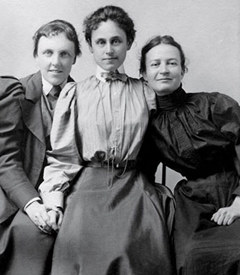
Upon completion of her studies, her parents supported Theodate’s desire to design a family home in Farmington. Initially, Alfred hired the firm McKim, Mead & White, the leading architects of the Gilded Age. In an audacious move, Theodate made it clear that their help would only be an auxiliary. In a letter, she wrote, “It will be a Pope house instead of a McKim, Mead & White.” Hill-Stead was a massive undertaking for a first project. After visiting George Washington’s Mount Vernon estate, Theodate determined to include a portico similar to the one on the Potomac River side of his mansion. Consequently, Hill-Stead has six white-pillared columns. In 1916, Theodate attained her license in New York State; in 1933, she obtained another in Connecticut.
While plans were underway, in 1899, the family stayed at their apartment in the Windsor Hotel in Manhattan. On March 17th, Ada and Theodate had made plans to visit Mrs. Louisine Havemeyer, owner of an art-adorned mansion. Due to a headache, Theodate wanted to forego the excursion; however, at her mother’s assistance, she went on the excursion. Had she not left the Windsor, she likely would have been a casualty of the fire that destroyed the building. When Alfred returned from his luncheon appointment at Delmonico’s restaurant and saw the flames, he arranged for a man with a ladder to rescue three Monet paintings from his suite. The canvasses were at the hotel as Alfred had planned to sell them at Durand-Ruel’s New York gallery. The night before the fire, Ada had convinced him not to go through with the sale. Two of the salvaged Monets, one of the Grainstacks and Fishing Boats at Sea, are on view at Hill-Stead.
In 1915 Theodate had another rendezvous with death. Along with her maid, Emily Robinson, and fellow spiritualist, Edwin Friend, Theodate booked a passage on the RMS Lusitania, as she wanted to visit the British Society for Psychical Research. When a German submarine torpedoed the Lusitania off the Irish Coast, twelve hundred people lost their lives, including Emily and Edwin. Crew from the rescue ship, The Julia [AU: what’s this?] discovered Theodate, unconscious, floating with her knee hooked over an oar that saved her from drowning. The sailors placed her in its makeshift morgue until Belle Naish, a fellow passenger, convinced them she was still breathing. Upon recovery, Theodate sent Ada a one-word telegram: SAVED. The nightmare shadowed her for the rest of her life.
Hill-Stead—the name derives from farmstead on a hill—represented the manifestation of Theodate’s dream. In 1901, in her first summer at her once-upon-a-time home, she described it as “a large simple home.” The adjective “large” is a given: it has thirty-six rooms for family use and servant’s quarters; the house and connected carriage barn total thirty-three-thousand square feet. The adjective “simple” is subjective. How simple could the house be if it held paintings whose counterparts hang in the halls of museums and the homes of royalty and oligarchs?
Two years after surviving the Lusitania torpedoing, at age forty-nine, Theodate married John Wallace Riddle, a career diplomat who had been an ambassador to Russia. She had met him ten years earlier through her Hill-Stead neighbor, Anne Roosevelt Cowles, President Theodore Roosevelt’s sister. The couple travelled extensively, including a 1919 trip to China, Japan, and Korea. Due to his height, she called him “Totem”; he referred to her as “dearest of geniuses.” John was supportive of her architectural aspirations, such as her commission to work on the Theodore Roosevelt Birthplace National Historic Site in Manhattan.
In 1946 Theodate, whose parents and husband had predeceased her, passed away at Hill-Stead. Her fifty-page will directed her home to operate as a museum. A clause stipulated that nothing could be added to the collection house, nothing could be removed or moved.
Hill-Stead Museum
Touring Hill-Stead with its stunning backdrop of the Litchfield Hills is to experience a house encased in amber where the first half of the twentieth century yet dwells. Henry James alluded to the estate in The American Scene, where he wrote, “A great new house on the hill apparently conceived—and with great felicity—on the lines of a magnificent Mount Vernon.”
In addition to the Claude Monet paintings, the two Grainstacks, Fishing Boats at Sea, and View of Cap d’Antibes, other treasures are Edgar Degas’ Dancers in Pink, Jockeys and the Tub, Mary Cassatt’s Sara Handing a Toy to the Baby, James McNeil Whistler’s, The Blue Wave, Biarritz, and Symphony in Violet and Blue, Édouard Monet’s The Guitar Player, and Toreadors. Paintings by the Impressionists’ contemporaries Eugène Carrière, and Pierre Puvis de Chavannes also grace the walls. Visitors can also gaze upon bronzes by Antoine Louis Barye, Italian ceramics, Chinese porcelains, eighteen etchings by Whistler, and a sixth century BCE Corinthian ceremonial head vessel called a pyxis.
In Hill-Stead’s magnificent sunken garden is a sundial whose base bears the Latin inscription, “Ars Longa Vita Brevis” which means “Art Is Long Life Is Brief”.

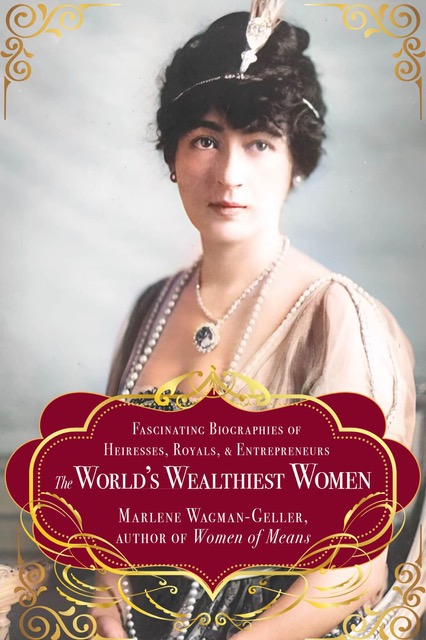
To pre-order my newest book, The World's Wealthiest Women: Fascinating Biographies of Heiresses, Royals, Entrepreneurs, and Entertainers, please click one of the links below.
- Amazon.com: amazon.com
- IndiePubs: indiepubs.com
- Bookshop: bookshop.org
- Amazon.co.uk
- Amazon.ca
- B&N: b&n.com
- Chapters Indigo (CA): indigo.com
- Books That Save Lives