Grace Metalious: Joan of Arc
"What day is it when you wake up and realize that what you have is not what you want at all?" ~Grace Metalious
Books have the power to alter the course of history. Harriet Beecher Stowe’s novel, Uncle Tom’s Cabin, that depicted the horrors of slavery, helped ignite the American Civil War. Lore holds that when Harriet visited the White House, President Abraham Lincoln greeted her by asking, “So you’re the little woman who started this great war?”
The book that impacted my life was Grace Metalious’s 1956 novel, Peyton Place. In 2008, I was in my local Barnes and Noble searching for a novel-my emotional support system. As Gwenyth Paltrow was starring in a screen adaptation of Peyton Place, I decided that would be my next read.
I was fascinating by the story that took place in a quaint 1950s New England town. On the surface, Peyton appeared very Christian, very conservative. (This was in keeping with the era when television sitcom couples slept in twin beds.) However, under the serene surface lay a hotbed of alcoholism, adultery, and illegitimacy. All sorts of slimy things crawled out from the coastal rocks.
After I had finished the riveting novel, in an act of serendipity, I chanced upon its dedication page that bore the words: “To George-for all the reasons he knows so well.” My inner yenta was intrigued, “Who was George? What were the reasons he knew so well?” I researched the answers, and Grace’s story rivalled that of Peyton Place.
Grace was a stay-at-home 1950s mother of three; George was the principal of an elementary school in Gilmanton, New Hampshire. A strain on their marriage was Grace refused to conform to the image of a principal’s wife. She had no desire to trade her customary garb of a man’s lumber shirt, jeans, and running shoes for stockings, twin sweater sets, and pearls. Once, to accommodate a guest, Grace tried to clean the table. What she took to be a Brillo pad turned out to be a dead mouse. When George came home from work, his children appeared to be auditioning for a role in The Lord of the Flies. Dinner consisted of frozen French Fries as they did not require washing. A sign in their home could have read: Mrs. Cleaver doesn’t live here. Grace was the 1950s desperate housewife. The more the women of the town gave her the side-eye, the more she took refuge on her Remington typewriter.
When Grace received a phone call from a publisher she was elated: the writer would never be poor, or happy, again. Peyton Place proved a publishing sensation and journalists descended on Gilmanton. The press dubbed her “The Pandora in blue jeans.” The author became an overnight sensation-and a local pariah. The townspeople were incensed as they felt the novel was a magnifying glass that exposed their darkest secrets. In response to the backlash, Grace added fuel to the fire, “You get angrier about the truth than you do about lies.” When John Michael Hayes, the screenwriter for the book’s adaptation, asked if the novel were autobiographical, Grace poured her drink on his head.
Although the book delivered fame and fortune, like Pandora’s Box, it also unleashed unsavory things. Due to the notoriety, George lost his job, and mothers refused to let their children play with the Metalious children. In 1956, Grace checked into Dorothy Parker turf-the Algonquin Hotel-where she signed a $250,00 deal with Twentieth Fox. She checked into the Plaza where she rented a floor, bought a Cadillac, and vacationed in the Caribbean. While she had dubbed her home with George” It’ll Do,” she purchased a country home from a retired Chicago gangster. .jpg)
George moved- on his own- to Stowe, Massachusetts, where he obtained a teaching position. In 1958, the couple divorced. Without the steadying influence of her ex-husband, unable to handle celebrity status, Grace turned to alcohol. She reflected, “I looked into the empty bottle and saw myself.” Another escape route were affairs and a second marriage to a disc jockey. In 1960, Grace and George remarried. The second time proved equally problematic.
In 1964, at age forty, Ms. Metalious, never having achieved a state of grace, died from cirrhosis of the liver brought on by consuming a fifth of liquor every day for five years. In her last conversation with her British lover, she told him, “Be careful of what you want. You may get it.” The only man who ever loved the Pandora in blue jeans was the one to whom she had dedicated Peyton Place.
Enthralled at the story behind the story, I became a Dedication Detective. Oscar Wilde, in his meditation, “De Profundis,” dedication bore the words, “Dear Boisie.” Boisie was the nickname for his lover, Lord Alfred Douglas, the Judas who had led to Oscar’s incarceration in Reading Gaol. Ernest Hemingway dedicated For Whom the Bell Tolls to his wife, Martha Graham. When Martha put the moratorium on their marriage, the man scorned rued his earlier tribute. In Atlas Shrugged, Ayn Rand’s dedication-a study in chutzpah- read, “To Frank O’Connor and Nathaniel Branden.” Frank was Ayn’s husband, Nathaniel, her lover. When the latter dumped the Russian writer for a younger woman, Ayn’s fury was a terrible thing to behold. Future editions expunged her former lover’s name.
What precedes the opening line of a novel is oftentimes as fascinating as the story itself. In the dedication page, writers enter the confessional. Because of the one in Peyton Place, Penguin/Perigee published my book Once Again to Zelda: The Stories Behind Literature’s Most Intriguing Dedications. The title is an allusion to F. Scott Fitzgerald’s dedication in the Great Gatsby: “ONCE AGAIN TO ZELDA.” Zelda, his wife, impacted his life, sometimes for the better, sometimes for the worst.
My first book also impacted my life as it led to my career as an author as thirteen titles followed. My books have shown me that dreams do not just have to be for sleeping. I will forever be grateful to Peyton Place for launching my second act. The author wielded her pen against social hypocrisy though it led to her martyrdom. Grace Metalious was the 1950s Joan of Arc.

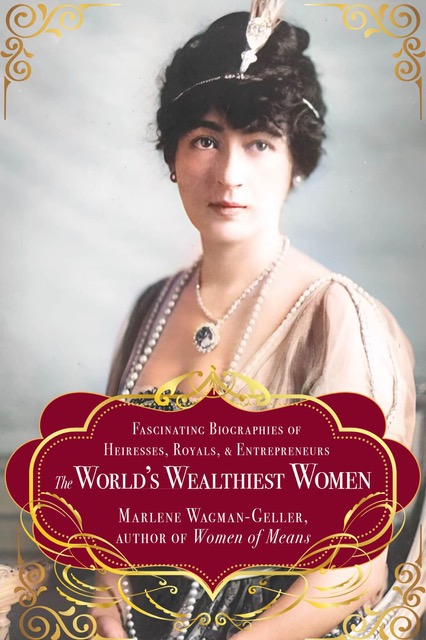
To pre-order my newest book, The World's Wealthiest Women: Fascinating Biographies of Heiresses, Royals, Entrepreneurs, and Entertainers, please click one of the links below.
- Amazon.com: amazon.com
- IndiePubs: indiepubs.com
- Bookshop: bookshop.org
- Amazon.co.uk
- Amazon.ca
- B&N: b&n.com
- Chapters Indigo (CA): indigo.com
- Books That Save Lives