Susan B. Anthony and Elizabeth Cady Stanton: Sister Suffragists
“The one thought I wish to express is how little my friend and I could accomplish alone…I never could have done the work I have if I had not had that woman at my right hand.” ~Susan B. Anthony
"I forged the thunderbolts and Susan
fired them." ~Elizabeth Cady Stanton on Susan B. Anthony
One of the great gifts of life are friendships-the individuals who half our sorrows, serve as emotional lifejackets. However, the one between Susan B. Anthony and Elizabeth Cady Stanton birthed a revolution that altered the tide of American history.
The auspicious meeting between the two thirty-something women occurred on the evening of May 12th, 1851. Three of the major movers and shakers of the nineteenth century had attended an anti-slavery meeting in Seneca Falls, New York. Elizabeth, who had cheered the event, was hosting a dinner for her speakers. While walking home, she ran into her friend, Amelia Bloomer, who introduced her to the woman standing beside her on a street corner. In her memoir, Eighty Years and More, Elizabeth recalled of the moment she met her partner in “crime,” “There she stood with her good, earnest face and genial smile, dressed in gray delaine, hat and all the same color, relieved with pale blue ribbons, the perfection of neatness and sobriety. I liked her thoroughly, and why I did not at once invite her home with me to dinner, I do not know.”
Visitors to the historic spot can view Ted Aub’s 1998 bronze statue, “When Anthony Met Stanton.” The sculptor’s commission coincided with the 150th anniversary of the 1848 Women’s Rights Convention. The monument overlooks the Seneca River, located down the street from the former Bloomer and Stanton home.
Despite commonalities, the duo hailed from divergent backgrounds. Susan Brownwell Anthony’s family were Quakers (co-called as members were said to quake in the presence of the Lord). She was the second oldest of the seven children of Daniel and Lucy who raised their daughter with the same opportunities they provided their sons. When the Anthonys moved to Rochester, New York, their parlor was a gathering place for abolitionists such as formerly enslaved Frederick Douglas. When she campaigned as a member of the American Anti-Slavery Society, mobs pelted her with rotten eggs and burned her image in the streets of Syracuse. Susan also assisted freedom seekers traveling on the Underground Railroad. A newspaper labelled her a “perfidious fanatic.”
One of eleven children, Elizabeth’s parents were Margaret and Daniel Cady, a New York Supreme Court Judge. Devout Calvinists, they raised their eleven children with gender defined roles. When a woman visited the Cady home in Johnstown, New York, seeking legal advice after male relatives had taken possession of a house she had purchased with her own money, the ten-year-old Elizabth overheard her father respond that under the law nothing could be done. The child was so enraged that she wanted to take scissors to Judge Cady’s books to cut out all the “laws that made women cry.” After losing all his six sons, Judge Cady told Elizabeth, “Oh, my daughter, I wish you were a boy.”
Elizabeth followed the traditional road of marriage; her husband was attorney and abolitionist Henry Brewster Stanton. Nevertheless, she put a feminist spin on her wedding ceremony by omitting the vow to “obey.” While taking her husband’s surname, she also kept her maiden one. The groom’s friend, Angela Gimké, felt Henry was not equipped to handle his firebrand wife.
When asked what her favorite thing was in her London honeymoon, Elizabeth responded: Lucretia Mott. In 1840, the twenty-four-year-old bride was in England for the World Anti-Slavery Convention. After the men forced women to sit in the gallery, and refused them the right to speak, the newlywed, along with the two-decade Old Quaker Lucretia Mott, disconsolately wandered the streets of London. In the ensuing years, Elizabeth cultivated a bevy of female friends in her home, a gift from her father, along the New Erie Canal, in Seneca Falls. Gal pals included Amelia Bloomer, and Martha Coffin Wright provided a respite from Elizabeth’s seven children. Of motherhood she explained, “I may burst my boiler screaming to boys to come out of the cherry trees and to stop throwing stones.” Susan, who did not possess a non-serious bone, remarked of her friend’s pregnancies, was to ask how, “for a moment’s pleasure to herself or her husband, she should thus increase the load of cares under which she already groans?” The mother of six, Elizabeth was pregnant when Susan made the comment. In the same vein, Susan’s comment to suffragist Antoinette Brown Blackwell, “Now, Nette, not another baby, is my peremptory command.”
A committed “spinster,” Susan had no desire to enter holy matrimony as she felt the institutional comprised unholy aspects. Her refusal to marry flew in the face of the zeitgeist that all any woman needed was “a wickerwork cradle and a dimple-cheeked baby.” Taking New England soberness to the extreme, the first time she set foot on a beach was at age sixty-seven. A decade later, she experienced her first football game which led to her pronouncement, “It’s ridiculous.” 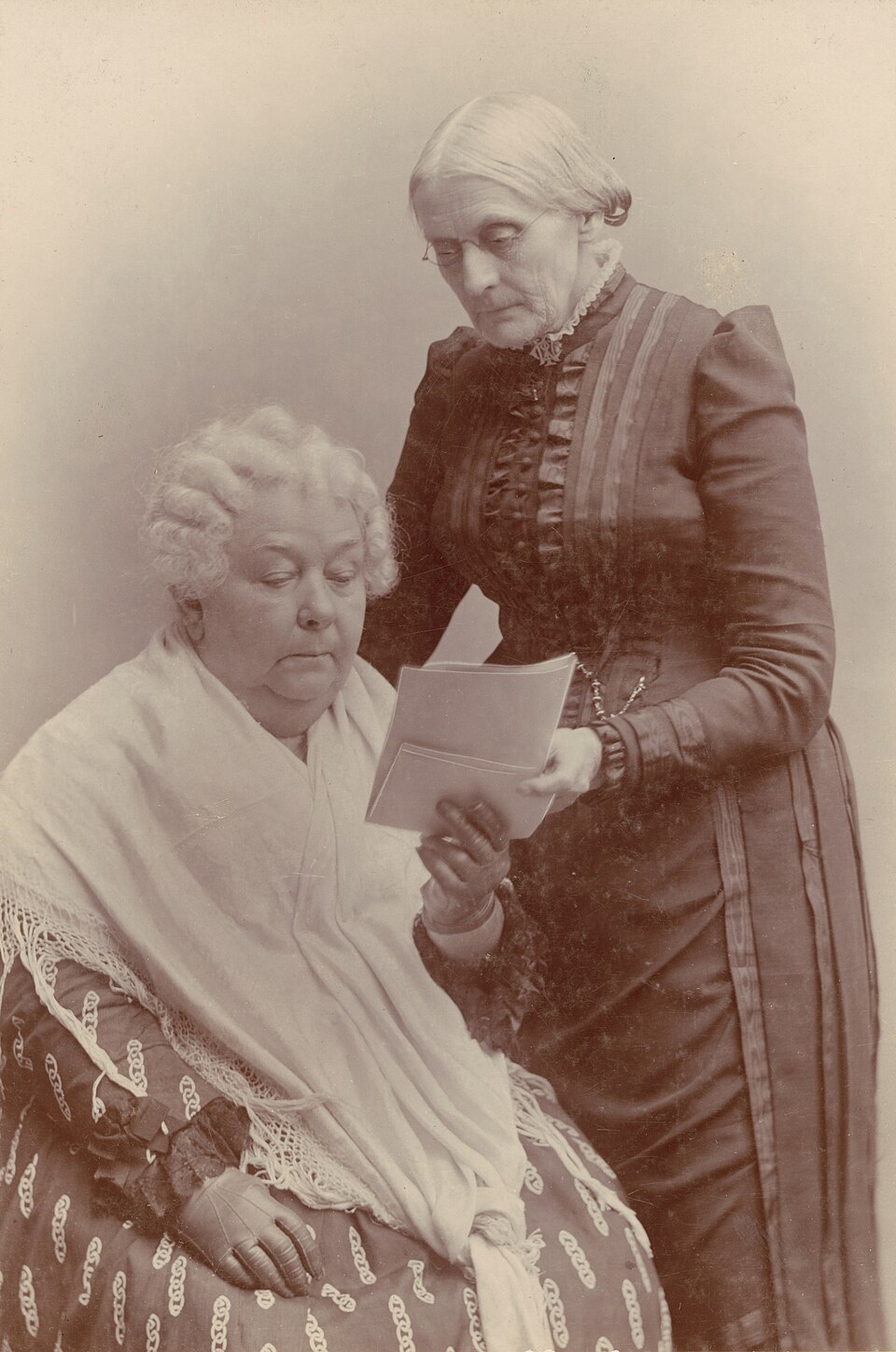
Susan and Elizabeth formed a partnership in fighting for their mutual causes: Temperance, abolition, and women’s rights. The relationship was pure gold as Elizabeth, anchored to domestic duties, wrote the brilliant speeches that Susan delivered across the country. The National Susan B. Anthony Museum & House in Rochester displays a vitrine that holds the alligator purse that she carried throughout her travels; to stress female financial autonomy she stated that “Women need a purse of their own.” The purse inspired the jump rope rhyme, “Call for the doctor! Call for the nurse! Call for the lady with the alligator purse!” Susan’s motto, “Organize, agitate, educate must be our war cry.”
The friend’s appearance was also a study in contrast: Susan wore slicked- back hair with a straight part and plain black dresses. Elizabeth styled her hair with ringlets and favored elaborate dresses. However, at one point in her life Elizabeth had traded finery for feminism. On the evening when she first met Susan, like Amelia, Elizabeth wore bloomers-so named after Amelia’s surname. The garb consisted of harem-styled pants under a tunic, that provided a freeing alternative to thirty pounds of padded petticoats and whalebone corsets. Eventually, as the garb elicited derision, she was willing to forego comfort as it distracted from pressing issues.
The nineteenth century Thelma and Louise, although they cared about temperance and slavery, focused on slaying the hydra heads of injustice against “the fairer sex.” The focus of their campaigns was coeducation, birth control, divorce, and equal wages. To decimate their message, the friends produced a newspaper, The Revolution. Under the masthead was the Revolution’s mission statement: Justice, Not Favors: Men Their Rights and Nothing More — Women Her Rights and Nothing Less. The New York Sunday Times responded to the publication by stating that Elizabeth should tend to her “domestic duties” and Susan needed “a good husband and a pretty baby.” Years later, the tireless crusaders collaborated on the History of Women Suffrage which consisted of six volumes. In the Preface they wrote, “We hope the contribution we have made may enable some other hand in the future to write a more complete history of the most momentous reform that has yet been launched on the world-the first organized protest against the injustice which has brooded over the character and destiny of one-half the human race.”
However, their Holy Grail was the vote. Lucretia Mott, feeling that demanding universal suffrage was taking matters too far, had chided Elzabeth, “Why, Lizzie, thee will make us look ridiculous.” “Lizzie” cared not a white for appearing ridiculous and shouldered ahead. Alongside Susan, she founded the National Women’s Suffrage Association that ultimately segued to the League of Women Voters. Henry Stanton remarked to his wife, “You stir up Susan, and she stirs up the world.”
Susan’s greatest stirring of the pot occurred on election day, 1872, when Susan, along with her sisters Guelma, Mary, Hannah and other suffragists, entered the polling station. Susan cast her vote for Republican candidate Ulysses S. Grant due to his pro-women stance. The following morning, The New York Times covered the historic moment under the heading “Minor Topics” and referred to the women as “a little band of nine ladies.”
Susan was in her parlor when Deputy U.S. Marshall E. J. Keeney placed her under arrest. She suggested her put her in handcuffs, an offer he declined. At her preliminary hearing, Judge Ward Hunt set bail at five hundred dollars, an amount she would not pay as incarceration would focus attention on her cause. To her chagrin, her attorney supplied the money as he could not countenance a lady languishing behind bars. The judge would not allow her to take the stand in her own defense; he explained women were not competent to testify. In regard to the court’s order to pay a hundred-dollar fine, Susan refused to comply, “Resistance to tyranny is obedience to God.”
Eight years later, Elizabeth was sitting at her desk writing an essay on the fact women were excluded from participating in their own government. At that juncture, a “wagon and horses all decked with flags and evergreens” drew up to her Tenafly, New Jersey home. The driver was seeking male Republican voters. As the six male members of her home were not present, and as she paid New Jersey taxes, Elizabeth determined to cast her vote though doing so was illegal. Susan accompanied who as her friend was “always ready to make an escapade on the ballot-box.” The polling booth official refused to give Elizabeth a ballot, explaining there was no precedent for a woman voting. In response, Elizabeth, who had researched history, stated, “On the sacred soil of New Jersey, where we now stand, women voted thirty-one years, from 1776 to 1807.” His answer was he knew nothing about the matter as he had never read the state constitution. Another official stated that voting was a male prerogative to which she replied, “I am here as a United States citizen to vote for United States officers. It is not the duty of a town inspector to decide on my liberties.” When “no outstretched hand was ready to receive” her ballot, she left it on the ballot box where a bible covered the opening of the ballot box. Her parting words were, “I leave my ballot here. With you rests the responsibility of refusing to count it.” She sent a report of the incident to the newspaper, “Let us as American citizens rise above the personal injustice we suffer, above the dust and smoke, the frauds and corruptions of politics, and remember the great experiment of government we are now making based on human equality.”
The affection never dimmed on the friendship between the two tireless advocates. In a letter Elizabeth wrote, “Whenever I saw that stately Quaker girl coming across my lawn, I knew that some happy convocation of the sons of Adam was to be set by the ears, by one of our appeals or resolutions.” And in missive from California Susan penned her tribute, “Oh how I have longed for you at my side to put into your matchless sentences the words that wait the saying—none of the young women are good—clear, crisp writers. . . . the two of us together being an invincible team—I feel every day—like Sampson shorn of his locks—without you.”
Despite near blindness, nearing her eight-seventh birthday, Elizabeth dictated a letter to President Theodore Roosevelt, “Abraham Lincoln immortalized himself by the emancipation of four million Sothern slaves. Speaking for my suffrage coadjutors, we now desire that you, Mr. President…immortalize yourself by bringing about our complete emancipation from the slavery of the past.” Elizabeth passed away from heart failure before she signed her name. The activist’s final resting place in the Woodlawn Cemetery in the Bronx, New York.
An inconsolable Susan stated, I am too crushed to speak.” At age eighty, after suffering a stroke, doctors had cautioned her that it was time to slow down but she determined it would be better to “die in the harness.” In 1906, Susan delivered her final speech in Washington, D. C. where she exhorted, “With women such as these consecrating their lives, failure is impossible.” Two weeks later, Elizabeth passed away from double pneumonia. Her internment was in Mount Hope Cemetery, Rochester, New York.
In 1920, the Nineteenth Amendment passed-due to the impassioned advocacy of the sister suffragettes.

To pre-order my newest book, The World's Wealthiest Women: Fascinating Biographies of Heiresses, Royals, Entrepreneurs, and Entertainers, please click one of the links below.
- Amazon.com: amazon.com
- IndiePubs: indiepubs.com
- Bookshop: bookshop.org
- Amazon.co.uk
- Amazon.ca
- B&N: b&n.com
- Chapters Indigo (CA): indigo.com
- Books That Save Lives