PERK
Chapter Perk
Frances Perkins, 1880-1965
121 Washington Place
“Being a woman has only bothered me in climbing trees.” ~Frances Perkins
[Insert: Francis Perkins.jpeg
Credit: Wikimedia Commons,
An archival photograph showcases President Franklin D. Roosevelt seated at his desk in the Oval Office signing the Social Security bill. Behind him stand ten men-eleven if one considers the portrait of George Washington staring from the wall-and one woman. Frances Perkin’s remarkable road led from Greenwich Village to the White House.
The story began in Beacon Hill, Boston, Massachusetts, the birthplace of Fannie (later Frances) Coralie Perkins, the daughter of Frederick and Susan Perkins, members of the Plymouth Congregational Church. In 1882, the family-that grew to include Ethel- relocated to Worcester, Massachusetts, where her father owned a stationery store that remains in operation. He had not attended college; however, he was a voracious reader who immersed himself in law and classical poetry. When his daughter was eight, he gave her Greek lessons. Her mother gave her another type of lesson during a shopping trip. Susan bypassed the hats festooned with ribbons, flowers, and feathers, and purchased a tricorn styled one that resembled headgear worn by Revolutionary War soldiers. Susan explained, “You should always wear a hat something like this. You have a very broad face…Never let yourself get a hat that is narrower than your cheekbones, because it makes you look ridiculous.” While wearing a party dress, Fred shared “the dress was ladylike though it did not make you look pretty.” The North Star of Frances’s youth was her beloved paternal grandmother, Cynthia Otis Perkins, of whom she described, “An extremely wise woman-worldly wise, as well as spiritually wise. I am extraordinarily the product of my grandmother.” Cynthia was a descendent of colonial statesman James Otis who coined the phrase, “Taxation without representation is tyranny.” Another illustrious ancestor was Cynthia’s cousin General Oliver Otis Howard who had lost his right arm in the battle of Fair Oaks in Virginia. He was the founder of Howard University in Washington and fought for black rights. In the summer, the Perkins visited The Brick House, Cynthia’s eighteenth-century Maine home in Newcastle situated by the Damariscotta River.
Frances attended Worchester Classical High School, a private college-prep college whose male students went on to ivy league universities. With her father’s approval, Frances enrolled in Mt. Holyoke, the all-women’s sixty-one-year-old college. In the era, only three percent of women went on to post-secondary education). During her senior year, a course in economic history required a visit to the mills along the Connecticut River in neighboring Holyoke. She was appalled there was no worker’s compensation, no minimum wage, no limit on the number of hours laborers had to work. The tour, along with hearing Florence Kelley-an activist dedicated to abolishing sweatshops and child labor-led to Frances’s aspiration to become a social worker.
Wanting to make a difference, an impossibility in staid Worchester, and aware that “a prophet has no honor in his own country-” Frances accepted a position at Ferry Hall, an elite school for females in Lake Forest, Illinois. In a break from her past, she abandoned the name Fannie-with its association of a woman’s posterior-to Frances. She also left the Congregational Church and became an Episcopalian. On the weekends she volunteered in Jane Addam’s Hull House where she met William MacKenzie King-the future Canadian prime minister, jazz musician Benny Goodman, attorney Clarence Darrow, and architect Frank Lloyd Wright. The man who made the most impression was Upton Sinclair whose muckraking novel, The Jungle, exposed the abuses of Chicago’s meatpacking industry. On a European vacation, Frances visited Blenheim Palace, the palatial home of the Duke of Marlborough and his American wife, Consuelo.
In 1907, Frances became the general secretary of the Philadelphia Research and Protective Association-dedicated to saving immigrant and Southern black women from prostitution. Frances studied at the University of Pennsylvania’s Wharton School. Two years later, she relocated to New York City to pursue a master’s degree at Columbia. The antithesis of conservative Worcester- Francis found her village in Greenwich Village. Frances reveled in the environment of libertines and lesbians, painters and poets. She wrote that the ideals of the environment made it “a beacon of American possibility in the new age.” She resided in Greenwich House on 26 Jones Street, founded by social reformer Mary Kingsbury Simkhovitch. She later moved to 104 Waverly Place. In her new neighborhoods she learned about communism, spoke on street corners on the Suffragette Movement, and smoked cigarettes to demonstrate women’s right to the habit. Acting did not pan out as she “was not pretty enough.” She tried her hand at writing and submitted one of her efforts to novelist Theodore Dreiser, author of An American Tragedy. When he did not respond favorably, Frances turned her effort elsewhere. In her pursuit of social justice for Manhattan’s poor, she courted the Gilded Age greats: the Astors, and the Vanderbilts. She edited Sinclair Lewis’s manuscript, Our Mr. Wrenn that helped him win the Nobel and Pulitzer Prizes. Sinclair stood on the sidewalk in front of Frances’s home and, through her open window, called out his marriage proposal.
In 1910, Frances met Paul Caldwell who she wed three years later. The couple resided in 121 Washington Place; a plaque affixed to the building praises her accomplishments. The crack in the marriage was Paul’s affair; she planned to leave him when she discovered she was pregnant. After a miscarriage and a still born birth, the couple had Susanna Perkins Wilson. Their marriage unraveled due to Paul’s manic depression, alcoholism, and unemployment. Susanna later suffered the same mental affliction and maintained a tenuous relationship with her mother.
At age thirty-one, Frances left her apartment on Waverly Place for a Saturday afternoon tea with Margaret Morgan Norrie, a New York aristocrat descended from two different signers of the Declaration of Independence. Famed architect Stanford White had designed Margaret’s luxurious townhouse at 26 North Washington Square. Guests were startled when they heard screams and sirens. After the butler announced that a fire had erupted at the other end of the square, Frances raced to the scene. She was an eyewitness to the Triangle Shirtwaist factory fire that claimed the lives of 146 Italian and Jewish women. The victims had been unable to escape as their employers had locked the doors to prevent theft and outdoor breaks. Watching the American tragedy unfold, Francis later remarked “It was the day the New Deal was born.”
Theodore Roosevelt selected Frances as the executive secretary of the Citizen’s Committee on Safety. The 1918 election was the first in which the women of New York could cast their votes. With the election of Al Smith, he assigned Frances to a seat on the New York State Industrial Commission, the first female to hold the position. Her annual salary of $8,000 made her the highest paid woman to hold public office.
Although reluctant to leave Greenwich Village for Washington, D. C., Frances relocated to the capital when President -Elect Franklin D. Roosevelt turned to her for assistance in salvaging the country from the Great Depression. Of her decision to accept the appointment she stated, “I came to Washington to work for God, FDR, and the millions of forgotten, plain, common working men.” Partially due to his forward-thinking wife Eleanor, Roosevelt did not view Frances’s gender as an impediment. Frances became the first woman to serve in a presidential cabinet.
Not everyone looked favorably on the woman who shattered the 1933 political glass ceiling. The leader of a seamen’s union grumbled, “I guess us sailors, as well as bricklayers and miners, better get a powder puff and lipstick to march in the inaugural parade.” John L. Lewis, head of the United Mine Workers, called her “woozy in the head.” Herbert Hoover’s appointee was aghast that a woman was assuming his position. He refused to invite her into his office. After her swearing-in ceremony at the White House, his secretary kept Frances waiting with the words, “I’ll see if he’s free.” Hoover’s man underestimated the woman with her trademark tricorn hat who wore dowdy dresses. She based her fashion choice on her belief that men responded better to a powerful female is she reminded him of his mother. Harold Ickes, the only other Cabinet member who stayed with Roosevelt to the end, grossed that she talked too much. In 1939, the House Un-American Activities Committee began impeachment proceedings against her for her failing to deport Australian-born labor leader Harry Bridges, an alleged communist. The House of Representative member Martin Dies ranked her on his list of dangerous individuals, just behind Joseph Stalin and Adolf Hitler. In her years in office, she was the target of witch-hunts.
Antagonism stemmed from another source. The Oakland Tribune scoffed, “She is really Mrs. Paul Wilson but she uses her maiden name in public life.” In 1933, married female federal employees had to use their husband’s name on their paychecks. At this juncture, Paul was living in a mental institution, and Frances was living with the widowed Mary Harriman Rumsey in a well-appointed house in Georgetown. Mary was the daughter of the wealthy and socially prominent railroad tycoon E. H. Harriman. He had founded the Junior League that later segued to the magazine Newsweek. In 1934, Mary was involved in a horseback riding accident; she died from her injuries, with Frances at her bedside. At a future date, Frances moved into the Washington, D. C., home of New York congresswoman Caroline O’Day.
In her new position, Frances instituted reforms: mandatory fire escapes, unemployment benefits, worker’s compensation, minimum wage, (25 cents an hour-$4.65 in contemporary currency,) a forty-hour workweek, ban on child labor, and universal health care. While the Civil Conservation Corps had been Roosevelt’s idea-it hired men to work on conservation projects in rural areas- Frances pushed it through Congress. Frances stated a lawmaker had praised her vision but then added, “he’d hate to be married to me.” After Kristallnacht, Frances fought to extend the visitor visas of German-Jewish refugees.
Madame Secretary was the guiding light behind the creation of social security. In 1934, she faced a Christmas deadline to institute the plan that led to Social Security. Frances invited her fellow all-male lawmakers to her Georgetown home and placed a sizeable bottle of Scotch on the table. She announced that no one would be leaving until the blueprint had materialized. The trailblazer was on the cover of the 1933 issue of Time magazine. In a 1944 Collier’s magazine article, it referred to President Roosevelt’s landmark New Deal as “not so much the Roosevelt New Deal as the Perkins New Deal.”
At the time of President Roosevelt’s death, Madame Secretary had been the longest-serving labor secretary. Following the president’s passing, Frances resigned. She remarked of her appointment, “has not made it necessary to have a woman in the Cabinet, but it has made it possible.” Frances gave her successor a kinder welcome than she had received twelve years before. However, the new Secretary did not reciprocate her overtures as he wanted to distance himself from the controversial Frances.
Until her death at age eighty-five, the fire that had burned since the tragedy of the Triangle Shirt Waist tragedy never went out. Her final resting place is in Glidden Cemetery in Newcastle, Maine. In tribute to the trailblazer, in 1980, President Jimmy Carter renamed the Labor Department’s Washington headquarters the Frances Perkins Building. Five years later, Frances was one of the Equality Forum’s icons for LGBT History Month. The home she shared with Representative Caroline O’Day in a national historic landmark. In 2014, her Maine homestead became a national historic monument. For all she gave America, a fitting epitaph for Frances would be the nickname her classmates gave her at Mr. Holyoke College, “Perk.” 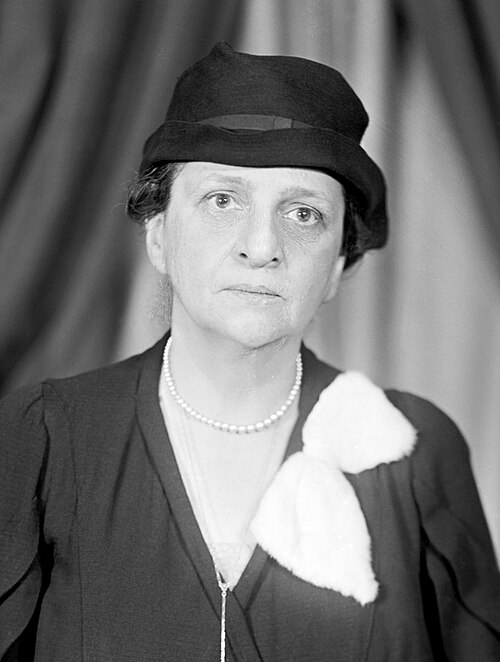
The story began in Beacon Hill, Boston, Massachusetts, the birthplace of Fannie (later Frances) Coralie Perkins, the daughter of Frederick and Susan Perkins, members of the Plymouth Congregational Church. In 1882, the family-that grew to include Ethel- relocated to Worcester, Massachusetts, where her father owned a stationery store that remains in operation. He had not attended college; however, he was a voracious reader who immersed himself in law and classical poetry. When his daughter was eight, he gave her Greek lessons. Her mother gave her another type of lesson during a shopping trip. Susan bypassed the hats festooned with ribbons, flowers, and feathers, and purchased a tricorn styled one that resembled headgear worn by Revolutionary War soldiers. Susan explained, “You should always wear a hat something like this. You have a very broad face…Never let yourself get a hat that is narrower than your cheekbones, because it makes you look ridiculous.” While wearing a party dress, Fred shared “the dress was ladylike though it did not make you look pretty.” The North Star of Frances’s youth was her beloved paternal grandmother, Cynthia Otis Perkins, of whom she described, “An extremely wise woman-worldly wise, as well as spiritually wise. I am extraordinarily the product of my grandmother.” Cynthia was a descendent of colonial statesman James Otis who coined the phrase, “Taxation without representation is tyranny.” Another illustrious ancestor was Cynthia’s cousin General Oliver Otis Howard who had lost his right arm in the battle of Fair Oaks in Virginia. He was the founder of Howard University in Washington and fought for black rights. In the summer, the Perkins visited The Brick House, Cynthia’s eighteenth-century Maine home in Newcastle situated by the Damariscotta River.
Frances attended Worchester Classical High School, a private college-prep college whose male students went on to ivy league universities. With her father’s approval, Frances enrolled in Mt. Holyoke, the all-women’s sixty-one-year-old college. In the era, only three percent of women went on to post-secondary education). During her senior year, a course in economic history required a visit to the mills along the Connecticut River in neighboring Holyoke. She was appalled there was no worker’s compensation, no minimum wage, no limit on the number of hours laborers had to work. The tour, along with hearing Florence Kelley-an activist dedicated to abolishing sweatshops and child labor-led to Frances’s aspiration to become a social worker.
Wanting to make a difference, an impossibility in staid Worchester, and aware that “a prophet has no honor in his own country-” Frances accepted a position at Ferry Hall, an elite school for females in Lake Forest, Illinois. In a break from her past, she abandoned the name Fannie-with its association of a woman’s posterior-to Frances. She also left the Congregational Church and became an Episcopalian. On the weekends she volunteered in Jane Addam’s Hull House where she met William MacKenzie King-the future Canadian prime minister, jazz musician Benny Goodman, attorney Clarence Darrow, and architect Frank Lloyd Wright. The man who made the most impression was Upton Sinclair whose muckraking novel, The Jungle, exposed the abuses of Chicago’s meatpacking industry. On a European vacation, Frances visited Blenheim Palace, the palatial home of the Duke of Marlborough and his American wife, Consuelo.
In 1907, Frances became the general secretary of the Philadelphia Research and Protective Association-dedicated to saving immigrant and Southern black women from prostitution. Frances studied at the University of Pennsylvania’s Wharton School. Two years later, she relocated to New York City to pursue a master’s degree at Columbia. The antithesis of conservative Worcester- Francis found her village in Greenwich Village. Frances reveled in the environment of libertines and lesbians, painters and poets. She wrote that the ideals of the environment made it “a beacon of American possibility in the new age.” She resided in Greenwich House on 26 Jones Street, founded by social reformer Mary Kingsbury Simkhovitch. She later moved to 104 Waverly Place. In her new neighborhoods she learned about communism, spoke on street corners on the Suffragette Movement, and smoked cigarettes to demonstrate women’s right to the habit. Acting did not pan out as she “was not pretty enough.” She tried her hand at writing and submitted one of her efforts to novelist Theodore Dreiser, author of An American Tragedy. When he did not respond favorably, Frances turned her effort elsewhere. In her pursuit of social justice for Manhattan’s poor, she courted the Gilded Age greats: the Astors, and the Vanderbilts. She edited Sinclair Lewis’s manuscript, Our Mr. Wrenn that helped him win the Nobel and Pulitzer Prizes. Sinclair stood on the sidewalk in front of Frances’s home and, through her open window, called out his marriage proposal.
In 1910, Frances met Paul Caldwell who she wed three years later. The couple resided in 121 Washington Place; a plaque affixed to the building praises her accomplishments. The crack in the marriage was Paul’s affair; she planned to leave him when she discovered she was pregnant. After a miscarriage and a still born birth, the couple had Susanna Perkins Wilson. Their marriage unraveled due to Paul’s manic depression, alcoholism, and unemployment. Susanna later suffered the same mental affliction and maintained a tenuous relationship with her mother.
At age thirty-one, Frances left her apartment on Waverly Place for a Saturday afternoon tea with Margaret Morgan Norrie, a New York aristocrat descended from two different signers of the Declaration of Independence. Famed architect Stanford White had designed Margaret’s luxurious townhouse at 26 North Washington Square. Guests were startled when they heard screams and sirens. After the butler announced that a fire had erupted at the other end of the square, Frances raced to the scene. She was an eyewitness to the Triangle Shirtwaist factory fire that claimed the lives of 146 Italian and Jewish women. The victims had been unable to escape as their employers had locked the doors to prevent theft and outdoor breaks. Watching the American tragedy unfold, Francis later remarked “It was the day the New Deal was born.”
Theodore Roosevelt selected Frances as the executive secretary of the Citizen’s Committee on Safety. The 1918 election was the first in which the women of New York could cast their votes. With the election of Al Smith, he assigned Frances to a seat on the New York State Industrial Commission, the first female to hold the position. Her annual salary of $8,000 made her the highest paid woman to hold public office.
Although reluctant to leave Greenwich Village for Washington, D. C., Frances relocated to the capital when President -Elect Franklin D. Roosevelt turned to her for assistance in salvaging the country from the Great Depression. Of her decision to accept the appointment she stated, “I came to Washington to work for God, FDR, and the millions of forgotten, plain, common working men.” Partially due to his forward-thinking wife Eleanor, Roosevelt did not view Frances’s gender as an impediment. Frances became the first woman to serve in a presidential cabinet.
Not everyone looked favorably on the woman who shattered the 1933 political glass ceiling. The leader of a seamen’s union grumbled, “I guess us sailors, as well as bricklayers and miners, better get a powder puff and lipstick to march in the inaugural parade.” John L. Lewis, head of the United Mine Workers, called her “woozy in the head.” Herbert Hoover’s appointee was aghast that a woman was assuming his position. He refused to invite her into his office. After her swearing-in ceremony at the White House, his secretary kept Frances waiting with the words, “I’ll see if he’s free.” Hoover’s man underestimated the woman with her trademark tricorn hat who wore dowdy dresses. She based her fashion choice on her belief that men responded better to a powerful female is she reminded him of his mother. Harold Ickes, the only other Cabinet member who stayed with Roosevelt to the end, grossed that she talked too much. In 1939, the House Un-American Activities Committee began impeachment proceedings against her for her failing to deport Australian-born labor leader Harry Bridges, an alleged communist. The House of Representative member Martin Dies ranked her on his list of dangerous individuals, just behind Joseph Stalin and Adolf Hitler. In her years in office, she was the target of witch-hunts.
Antagonism stemmed from another source. The Oakland Tribune scoffed, “She is really Mrs. Paul Wilson but she uses her maiden name in public life.” In 1933, married female federal employees had to use their husband’s name on their paychecks. At this juncture, Paul was living in a mental institution, and Frances was living with the widowed Mary Harriman Rumsey in a well-appointed house in Georgetown. Mary was the daughter of the wealthy and socially prominent railroad tycoon E. H. Harriman. He had founded the Junior League that later segued to the magazine Newsweek. In 1934, Mary was involved in a horseback riding accident; she died from her injuries, with Frances at her bedside. At a future date, Frances moved into the Washington, D. C., home of New York congresswoman Caroline O’Day.
In her new position, Frances instituted reforms: mandatory fire escapes, unemployment benefits, worker’s compensation, minimum wage, (25 cents an hour-$4.65 in contemporary currency,) a forty-hour workweek, ban on child labor, and universal health care. While the Civil Conservation Corps had been Roosevelt’s idea-it hired men to work on conservation projects in rural areas- Frances pushed it through Congress. Frances stated a lawmaker had praised her vision but then added, “he’d hate to be married to me.” After Kristallnacht, Frances fought to extend the visitor visas of German-Jewish refugees.
Madame Secretary was the guiding light behind the creation of social security. In 1934, she faced a Christmas deadline to institute the plan that led to Social Security. Frances invited her fellow all-male lawmakers to her Georgetown home and placed a sizeable bottle of Scotch on the table. She announced that no one would be leaving until the blueprint had materialized. The trailblazer was on the cover of the 1933 issue of Time magazine. In a 1944 Collier’s magazine article, it referred to President Roosevelt’s landmark New Deal as “not so much the Roosevelt New Deal as the Perkins New Deal.”
At the time of President Roosevelt’s death, Madame Secretary had been the longest-serving labor secretary. Following the president’s passing, Frances resigned. She remarked of her appointment, “has not made it necessary to have a woman in the Cabinet, but it has made it possible.” Frances gave her successor a kinder welcome than she had received twelve years before. However, the new Secretary did not reciprocate her overtures as he wanted to distance himself from the controversial Frances.
Until her death at age eighty-five, the fire that had burned since the tragedy of the Triangle Shirt Waist tragedy never went out. Her final resting place is in Glidden Cemetery in Newcastle, Maine. In tribute to the trailblazer, in 1980, President Jimmy Carter renamed the Labor Department’s Washington headquarters the Frances Perkins Building. Five years later, Frances was one of the Equality Forum’s icons for LGBT History Month. The home she shared with Representative Caroline O’Day in a national historic landmark. In 2014, her Maine homestead became a national historic monument. For all she gave America, a fitting epitaph for Frances would be the nickname her classmates gave her at Mr. Holyoke College, “Perk.”

To pre-order my newest book, The World's Wealthiest Women: Fascinating Biographies of Heiresses, Royals, Entrepreneurs, and Entertainers, please click one of the links below.
- Amazon.com: amazon.com
- IndiePubs: indiepubs.com
- Bookshop: bookshop.org
- Amazon.co.uk
- Amazon.ca
- B&N: b&n.com
- Chapters Indigo (CA): indigo.com
- Books That Save Lives