The Worse Gorings
Spain, the culture that invented the word machismo, has for centuries considered
bullfighting an altar of testosterone. Hence, when Cristina Sanchez became Europe’s first mujer torero (matador), it was the equivalent of waving a red flag at a male citadel. 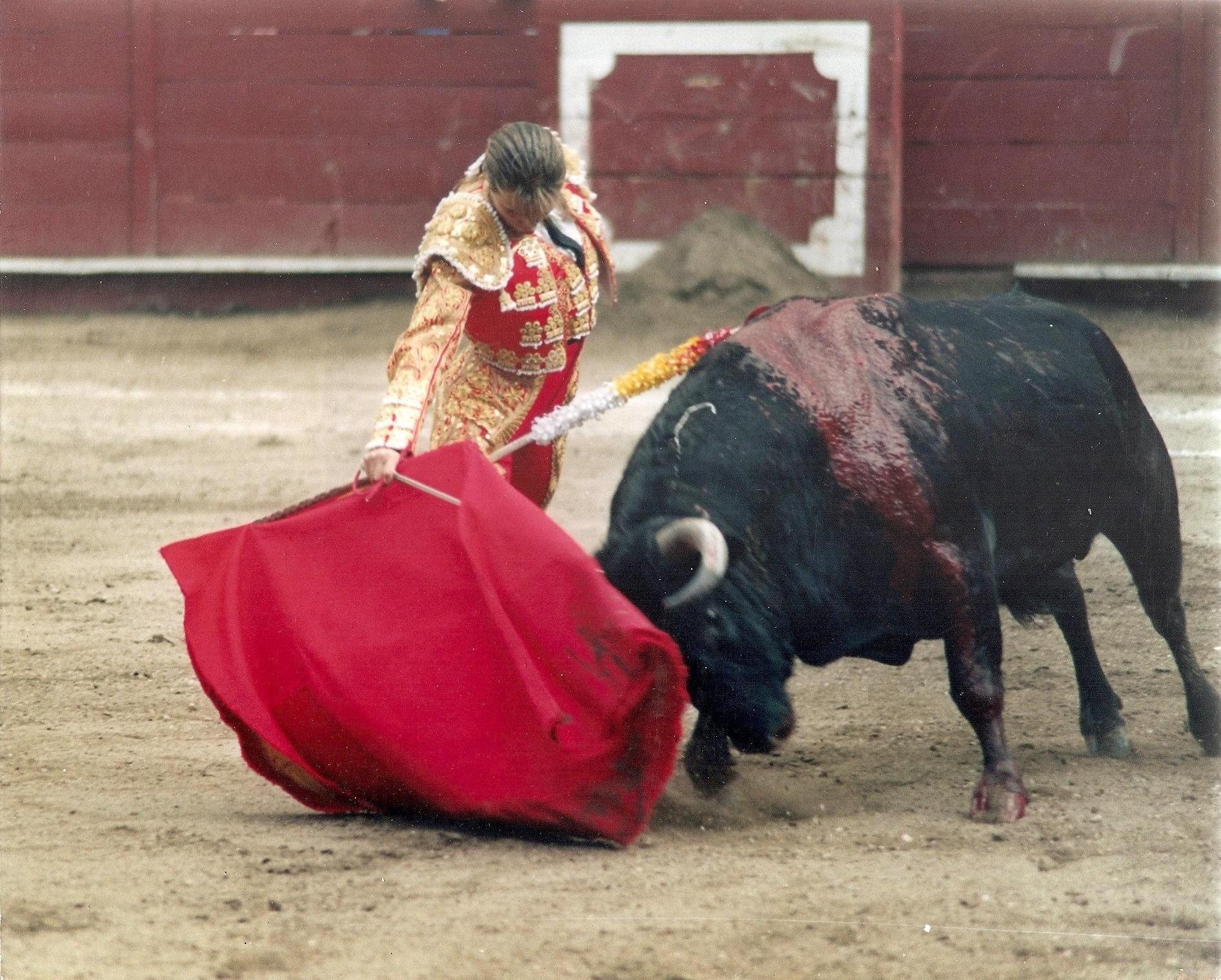
The Latin controversy surrounding the ethics of bullfighting is as heated as the American one surrounding abortion. At one end of the spectrum was Ernest Hemingway who wrote, “There are only three sports: bullfighting, motor racing, and mountaineering; all the rest are merely games.” Picasso and Orson Welles were equally smitten. At the other end are those who feel the sport the contemporary gladiator game. In either contingency, it is hard to wrap one’s mind around why a lone matador, armed only with a red cloth and sword, would pit himself against half a ton of infuriated animal equipped with horns for the merriment of the masses.
Cristina Sanchez, who made waves both in and out of the arena, was born in 1972 in working-class Parla, the second of four sisters. Her mother, Maria Carmen, worked in a leather factory; her father, Antonio Sanchez, was an undistinguished matador who became a banderillero-the man who rushes on foot toward the bull to thrust barbs in its neck, an action that facilitates the kill. Before his demotion, Cristina watched her papa perform, and even after witnessing several gorings was not swayed from following in his footsteps. Antonio tried to dissuade his headstrong daughter, “I told her you have to know that bullfighting is very difficult-sometimes impossible-for a man, so for a woman it will be more difficult.” But Cristina had the poison-a Spanish expression for obsession.
Senor Sanchez did not embellish the difficulty of becoming a matador. For every 10,000 who aspire to the calling, only one is successful. Thus, the likelihood of meeting a matador is as improbable as meeting a Nobel Prize winner or an Academy Award recipient. An episode of Seinfeld alluded to this rarity when Elaine claimed to have dated Eduardo Carochio. Jerry, waving a red hand towel asked, “I wonder where on the upper west side a single girl might meet a matador? Perhaps Zabars? Or Ray’s Pizza!”
At age fourteen, Cristina took trips to the Plaza de Torres to join the student matadors who practiced with her father. Many thought her audacity was “bull” and cries broke out, “Look! Look! A girl is bullfighting!” The shouts alerted Antonio who lectured her about her unfeminine pursuit. What he did not tell her was, “Dos, mio, she is not bad.”
The sixteen-year-old Cristina bowed to family and societal pressure and found a job at a hairdressing salon; in the evenings, she cried. While Prufrock measured his life out in coffee spoons, Cristina felt her life was slipping away in a bouillabaisse of hairspray, conditioners, and mousse. Her escape was an allergy to the chemicals, and her family arranged for her to work as a clerk in her uncle’s fire-extinguisher factory. In her after-hours, alone in her kitchen, she moved the dish towel as if it were a cape. Soon she was ditching her job and joining aspiring matadors at practice; her embarrassed papa assured everyone her obsession would pass.
Cristina wore Antonio down, and he took her to the plaza at Torrelaguna where she killed her first bull. She decorated her bedroom walls with pictures of bulls, matadors, and cutouts from matchboxes that demonstrated the traditional poses of a torero. Fired with enthusiasm, Cristina enrolled in Madrid’s elite La Escuela de Tauromaquia de Madrid which she attended seven days a week. She graduated in 1992 third in her class, one of five women among one hundred men. The star pupil collected accolades over the next few years as a novillera, an apprentice bullfighter. During her successful run, Sanchez slew approximately 240 bulls. She said of her passion, “Every problem in your life goes away in front of a bull. Because the problem, the bull, is bigger than all other problems. Of course, I have fear, but it is the fear that I will fail the responsibility I have taken on in front of all these people-not the fear of the bull. Death becomes unimportant when I am in front of him. I feel so good; it doesn’t matter if he kills me.” Her gender contributed to her visibility, but recognition also arrived for her flourishes that seduced the animal to come ever closer. Cristina earned a trophy case of more than 200 bull ears and one tail.
The beauty who faced the beast in the arena declared bullfighting was her drug, and like a drug, her career was fraught with peril. In a bullring in the tiny town of Loeches, Cristina had her “baptism of blood” when a 700-pound bull knocked her down with the force of a runaway car. The animal tossed her in the air with its 24-inch horns, stamped on her, tossed her again, and then gored her through the stomach. Antonio, who accompanied her in the medical van transporting her to the hospital, cried, “Look at you, bruised like a Christ! Do you finally understand how impossible this is?” He admonished himself for not having taken the bull by the horns when she was young and confiscated her $1,000 sword and her $2,000 traje de luces (suit of lights) and ended the madness. Post recovery, Sanchez could not wait to get back into action, “To be in front of the bull is a feeling so great that it can’t be described. Outside the ring I am a normal, shy girl. But in the ring I am transformed. I’m not a girl anymore. I am a bull-fighter.”
In 1993, at age 21, in the historic city of Toledo, Sanchez made history by becoming the first woman to fight and kill six bulls in succession in a single corrida. Because of her prowess, the crowd carried her on their shoulders amid thunderous applause. In her resplendent attire, her hair wound in a pigtail, she had knelt defiantly in front of one bull, threw aside the muleta, and ran her finger along the horn of another. Away from the blood-drenched sand Cristina transformed into a down-to-earth-woman in T-shirt, tight jeans, and Dr. Scholl sandals. Paris Match photographed her in a Christian Dior gown and asked her if she wasn’t afraid of scaring off suitors. She responded to such questions by clarifying the only boyfriends she had time for were los toros.
Sanchez also had a ready response when asked about the morality of her profession. She became extremely distressed (though not as distressed as the hundreds of bulls she dispatched to the great meadow in the sky) when detractors called her a bloody executioner. She claimed, “I regard bullfighting as an art form. In Spain it is part of our culture, our heritage, like flamenco.” She adds the fight carries sexual innuendo, “The matador must penetrate the animal, until you become one being. For me, it is the moment of supreme happiness. I am content.” Bullfighting does, for some, serve as an aphrodisiac. By the time Luis Dominguin died at the age of 70, he had bedded a reported 4,000 females (his death was, unsurprisingly, due to heart failure.) Of his bevy of beauties was a torrid affair with Ava Gardner, and when he later married Italian actress Lucia Bose, his rejected lover, Mexican film star Miroslova Stern, committed suicide.
While Don Quixote jostled at windmills, Sanchez jousted at the alternativa-the august ceremony where a bullfighter first kills a full-grown bull in public and is formally recognized as a matador-in her case, a matadora. In a ceremony in Nimes, France, Sanchez became the first woman in Europe to storm the macho world of bullfighting at the master level. At the close of the historic event, veteran bullfighter Curro Romero handed her his sword and cape with the words, “I am old, Cristina, and have acted in several alternativas, but no other has moved me as much as this one.”
Her new status was an incredible accomplishment for a woman in a country where female bullfighting was seen as far-fetched as being a female pope. A 1908 law had banned “the weaker sex” from the ring on the grounds of “decency and public morality.” The restriction ended when Spain became a republic in the 1930s but was reinstituted by the Fascist dictator Francisco Franco in 1940, though he did allow females to participate as rejoneadores-those who perform from the safety of a horse. The ban was ultimately laid to rest by the Spanish Supreme Court, but the court of public opinion lagged behind. Sanchez’s achievement was also a victory for Spanish feminism; after all, if a woman could become a full-fledged matador, there was no wall they could not scale. Her win was all the more wondrous as, at the time, the country’s feminist movement was only twenty years old. Until Franco’s death in 1975, a woman could not open her own bank account or travel without her husband’s permission. Legally, she was a man’s property. In 1976, 2,000 women demonstrated for the first time, and as they marched along Goya Street, they did so to shouts of “Putas!” (whores!) After her crowning achievement, Sanchez had seventy engagements in Spain, France, Mexico, and South America with a paycheck of $1.6 million for one season. Not too shabby for a former hairdresser from working-class Parla.
What proved sharper than a bull’s horn was the entrenched machismo of her native land. Her countrymen regarded a female bullfighter as a contradiction in terms. Jesulin de Ubrique, a strutting superstar matador, refused to appear on the same bill as Sanchez. Historian Muriel Feiner explained, “To appear inferior to a woman would have been tantamount to a loss of manhood. No one would risk it.” The ladies who dared had not only to face an enraged bull but also jeers from the audience. As Cristina performed in the Las Ventas Plaza in Madrid, comments and sniggers flowed from the stands, “Cristina, where are your balls?” “A woman and a frying pan belong in the kitchen!”
In 1999, Spain’s only full-fledged female matador revealed that after a decade, she was hanging up her cape. She attributed her departure to her colleagues’ machismo. Her swan song was in Madrid’s Las Ventas bullring, dubbed “the cathedral of bullfighting.” She stated of her last ole, “I’ve never traded on the fact that I am a woman; I’ve never used it to get ahead, but I’ve certainly suffered because of it. Bulls are associated with courage and virility and some men cannot forgive a woman for being able to hold her own in that environment. I realized prejudice had won when I wasn’t accepted in any of the top festivals this year and I refuse to accept a life trailing around second-rate rings fighting dud bulls.” At a farewell press conference, fans greeted her with applause and shouts of torero!
Senorita Sanchez’s bulges may have been ill-distributed for a bullfighter-as a journalist once remarked-but she had cojones, and in Spain, having balls is what counts. Unfortunately, due to years of systematic sexism, Cristina well understood the bullfighter’s adage, “Mas cornadas da la vida-” which means “Life inflicts the worst gorings.”

To pre-order my newest book, The World's Wealthiest Women: Fascinating Biographies of Heiresses, Royals, Entrepreneurs, and Entertainers, please click one of the links below.
- Amazon.com: amazon.com
- IndiePubs: indiepubs.com
- Bookshop: bookshop.org
- Amazon.co.uk
- Amazon.ca
- B&N: b&n.com
- Chapters Indigo (CA): indigo.com
- Books That Save Lives