What is the Question?
The years between the two world wars can be viewed as the French Renaissance, as the greatest creative minds of the century congregated in Paris. The luminaries indulged in a meeting of minds in a famous salon dominated by Gertrude Stein and the woman she considered her wife, Alice B. Toklas.
Gertrude Stein was born in Pennsylvania into a wealthy Jewish family. After a European sojourn the Steins relocated to Oakland, California, about which Gertrude wrote, “There is no there there.” Her closest confidante was her brother Leo, and when he went to Harvard, she followed him to Boston. However, as the school would not admit women, she attended Radcliffe. The pivotal event of her university years was being tutored by the psychologist William James, whose influence would later emerge in her subsequent novels’ stream-of-consciousness style.
Later Gertrude transferred to John Hopkins; there, although intellectually stimulated, she felt emotionally bereft. Her notebooks of this period reveal a troubled and depressed young woman unable to envision herself fitting into the prescribed roles as wife and mother. Her “red deeps,” as she termed her inner turmoil, were exacerbated when she fell in love with May Bookstaver, who, involved with another woman, did not reciprocate Gertrude’s feelings. Distraught, Gertrude dropped out of medical school and once more followed Leo, this time to Europe.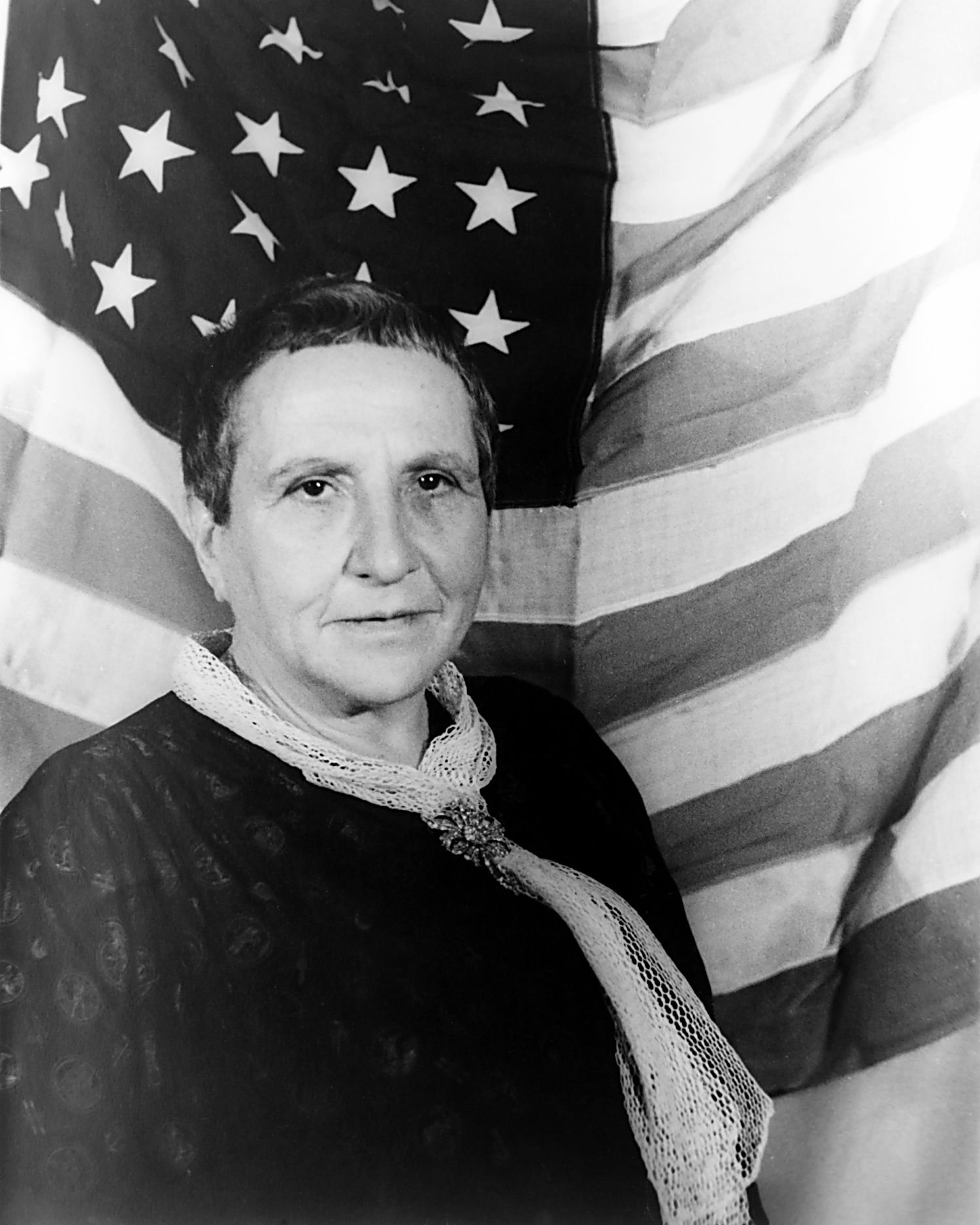
Gertrude’s destiny, Alice Babette, was born in San Francisco in 1877, the only daughter of middle-class Jewish parents, Ferdinand and Emma (Levinsky) Toklas. After Alice’s mother passed away (a few weeks before Alice’s twentieth birthday), her life had evolved into the role of housekeeper for her father and brother.
In 1906 Michael Stein (Gertrude’s eldest brother) and his wife, Sarah, paid a visit to his friend Alice when they arrived in San Francisco to check on the earthquake’s damage to their properties. They brought along with them three Matisse paintings and tales of Parisian life. When Michael extended an invitation to visit him in France, Alice accepted, to escape the drudgery of her current life and in the hope that the trip would provide an exciting interlude.
The first time Gertrude met Alice was on Alice’s first day in Paris on September 8, at the home of Michael and Sarah Stein. When she was introduced to Gertrude, she said a bell went off in her head, a sound signifying that she was in the proximity of a genius. Gertrude had been quite fond of declaring herself a genius long before Alice heard bells, and that became the first thing they agreed upon. A similar note resounded in her heart; she wrote of that initial meeting, “She was a golden brown presence, burned by the Tuscan sun and with a golden glint in her warm brown hair. She was dressed in a warm brown corduroy suit. She wore a large round coral brooch and when she talked, very little, or laughed, a good deal, I thought her voice came from this brooch. It was unlike anyone else’s voice—deep, full, velvety, like a great contralto’s, like two voices.”
The two women were quick to fall in love, and their attraction to each other was immediate. In her memoir Alice wrote, “It was Gertrude Stein who held my complete attention, as she did for all the many years I knew her.”
Although both were horizontally challenged (Gertrude was five feet one, while Alice was four feet eleven), they adopted very different styles. Gertrude, rotund, wore her hair in a Roman emperor cut and favored severe, mannish outfits. Alice knitted for her the shapeless garments and heavy woolen stockings she felt most comfortable in. Alice, who was extremely slight, favored couture outfits (though she wore them badly) and gypsy earrings and chain-smoked Pall Malls. Gertrude’s term of endearment was “Pussy,” while Alice called her “Baby.”
Gertrude expressed her love in words. Alice, an early riser, often woke to notes that Gertrude, who wrote late at night, left on her pillow. These were often signed “Y. D.” (“Your Darling”). The couple was inseparable; if Ms. Stein appeared at a café, by her side would be Ms. Toklas. The high-profile women also liked to stroll the streets of Paris and browse flea markets, walking their enormous white poodle, Basket, who, upon his passing, was replaced by Basket II.
In 1908, on a hillside outside Paris, Gertrude proposed to Alice and presented her with a ring. Stein wrote of the day, “It happened very simply that they were married. They were naturally married.”
When Alice B. Toklas first hitched her heart to Gertrude’s star, little did she imagine that by doing so she was destined to become half of one of the most famous lesbian couples of the twentieth century. Alice and Gertrude’s Left Bank apartment became the living room for all the great artists living in Paris between the two world wars. Their salon’s walls showcased the avant-garde painters of the day: Picasso, Matisse, Toulouse-Lautrec, Cezanne. These stars orbited Stein, the grande dame of her salon, and Pablo Picasso painted Stein’s portrait, which currently hangs in the Metropolitan Museum of Art. When Toklas commented on it, he responded, “Yes. Everybody says that she does not look like it but that does not make any difference, she will.” Not to slight Ms. Toklas, he rewarded her with a needlepoint pattern, which she used to make tapestries for two Louis XVI chairs.
The writer closest to Stein was Ernest Hemingway, who had arrived on her doorstep armed with a letter of introduction from Sherwood Anderson. Gertrude and Alice became the godmothers of his first child, John. His parents’ nickname for him was Bumby; the two ladies called him Goddy, as they were his godparents. (John became the father of actresses Margot and Mariel.) It was about Hemingway that Stein coined her famous expression: “You are all a lost generation.” Toklas, fanatically possessive when it came to Gertrude, banned Hemingway from their home when she felt he was getting to close to Stein. Perhaps in retaliation, in his memoir A Moveable Feast, he recounted an argument between the two hostesses: “I heard (Miss Toklas), speaking to Miss Stein as I have never heard one person speak to another, never, anywhere, ever.”
Toklas, in a similar jealous vein, in reference to Gertrude’s youthful crush on May Bookstaver, forced the author to replace every instance of the word may with can in Stein’s 1932 epic poem “Stanzas in Meditation.”
The conversation during Gertrude and Alice’s Saturday night soirees always revolved around art. While Gertrude entertained the men, Alice gossiped with their wives and girlfriends. She also provided fragrant, colorless liquors that she made herself from plums and raspberries. While Gertrude shone in the drawing room, Alice excelled in the kitchen, as she was one of the finest chefs in Paris. Later she wrote a cookbook of her famous recipes, which included her specialty: brownies with a dash of hash. (Some believe that the term toke when referring to marijuana is derived from the surname Toklas.) However, Alice’s main task was to ensure that nothing disturbed the flow of Gertrude’s genius. Thornton Wilder called Alice “the dragon protecting the treasure.” Without Alice, Gertrude would not have been Gertrude.
When the Nazis goose-stepped into Paris, Gertrude and Alice’s friends encouraged them to return to America; Stein refused by explaining, “America is my country, but Paris is my hometown.” As lesbians and Jews, they managed to escape by moving to Bilignin, their country retreat in the south of France, where they were aided by a collaborator. After liberation, Stein wrote to Toklas, “I love you so much more / every war more and more and more and / more.”
In 1946, Stein began to experience stomach pain and was diagnosed with cancer. When the end was near she was taken to a hospital in Neuilly-sur-Seine. On vigil was Alice, already grieving the remaining empty years. However, like Rick and Ilsa, they would always have Paris.
As Gertrude died, Alice listened to her “deep, full, velvety, contralto’s voice for the last time,” ask, “What is the answer?” Alice did not reply. Gertrude then said her last words to her first love, “Then what is the question?”
Postscript
~Gertrude Stein was buried in the Pere-Lachaise Cemetery in Paris.
~Not long before Alice died in 1967, she converted from Judaism to Catholicism. She had askedher priest, in reference to her new religion, “Will this allow me to see Gertrude when I die?” Toklas was interred in the adjoining grave to Stein’s.

To pre-order my newest book, The World's Wealthiest Women: Fascinating Biographies of Heiresses, Royals, Entrepreneurs, and Entertainers, please click one of the links below.
- Amazon.com: amazon.com
- IndiePubs: indiepubs.com
- Bookshop: bookshop.org
- Amazon.co.uk
- Amazon.ca
- B&N: b&n.com
- Chapters Indigo (CA): indigo.com
- Books That Save Lives