Chutzpah
““There are no ugly women, only lazy ones.” –Helena Rubinstein
Women CEOs are no longer an oxymoron. Sheryl Sandberg helped expand Google and Facebook into the titans of the Internet. In contrast, when Helena Rubinstein established her brand built on lipstick and lotion, female head honchos were as rare as sunburn on the cosmetic czar’s porcelain complexion.
By coating eyelashes with mascara, painting lips, drawing on brows, cosmetic devotees are paying homage to a mogul who died over half a century ago. Chaja, (later anglicized to Helena), was the eldest of eight girls born in Podgórze, Poland. The Rubinsteins later moved to Kraków, the Jewish Quarter of Kazimierz., a suburb immortalized due to Steven Spielberg’s movie Schindler’s List. Her father, Hertzel, preferred studying the Torah than eking out a living as a kerosene dealer. Her mother, Gitel, insisted her daughters, devoid of dowries, used her cream concoction, as their looks were their marital lifelines. .jpg)
As the eldest, Helena was expected to be the first to take a husband and to obey a paternal demand. Refusing to endure a loveless marriage, she left home with her mother’s parting gift: twelve jars of cold cream that were to prove her variation of Aladdin’s lamp. Helena moved first to her aunt’s house in Krakow, and then to another who lived in Austria. In Vienna, her relatives initiated her into the intricacies of their fur business. At age twenty-four, Helena, armed with a parasol and her jars, landed in Coleraine in western Victoria where she lived with her uncle, Louis Silberfeld, in the sheep-farming outback. She shed the name Chaja for Helena–likely an allusion to the ancient world’s femme fatale who, according to playwright Christopher Marlowe, had “launched a thousand ships.” When asked about her past, Helena painted a portrait of her childhood “country estate, her monied past, her medical studies at the University of Krakow.”
For two years, Helena worked for Louis as a housekeeper and clerk in his store without remuneration. To better her chances, she enrolled in English classes, where she asked her teacher “What does “bugger” mean? My uncle calls me that.” As soon as she had achieved basic proficiency in English, (her adopted language always held a strong Yiddish accent), she left behind the economic exploitation.
Helena moved from one poorly paid job to another such as her stint as a waitress at Melbourne’s Café Dore. Her dream was to start a business, an endeavor that would prove a Sisyphus struggle, as she would have to come up with the funds as well and overcome prejudice regarding a self-employed woman. Her fate seemed as grim as the one she would have endured had she remained in Krakow.
Females of the Outback, whose faces bore the ravages of the broiling Australian sun, constantly complimented Helena on her milky complexion. The financial bloodhound, rather than pointing out that Poland did not have hot weather that took its toll, attributed her blessing to her mother’s cold cream. She dropped hints her jars held an old family recipe that contained secret ingredients sourced from herbs found only in the Carpathian Mountains. She cooked up vats of the product she named Crème Valaze, (“gift from heaven” in Hungarian.) and incorporated her “the secret ingredient” into the cream- lanolin,–oil produced by sheep–and in the Outback there were thousands of them.
The girl from the shtetl, who an acquaintance described as having the figure of an icebox, was on the road to becoming the high priestess of beauty as well as an entrepreneurial heavyweight. Helena brought cosmetics, formerly only a product associated with prostitutes and actresses, into the vanity tables of millions. Interested in the scientific aspect of beauty, Helena paid to study with Marcellin Berthelot, the brilliant chemist who had invented disinfectant using bleach. To promote herself as more than a beautician, Helena posed in a white lab coat and billed herself as “The First Lady of Beauty and Science.”
There had been no time in the workaholic’s life for romance until Helena met Edward William Titus with whom she shared several commonalities. He had started life as Arthur Ameisen in Krakow; in Australia, as a respected journalist, due to anti-Semitism, he had anglicized his name. Edward became her marketing and publicity manager; the professional relationship soon surpassed the Platonic plane. For their 1908 wedding, Helena gifted Edward her greatest treasure: not her virginity, but rather equal shares in Helena Rubinstein Cosmetics. Edward always referred to his wife as Madame, a name that stuck. A rude awakening occurred when she descended the ornate staircase of her honeymoon hotel in Nice and observed her husband kiss the hand of a younger, red-haired woman. Bordering on the stout, and self-conscious over her height, her husband’s roving eye fueled Helena’s insecurity.
Desirous of other worlds to beautify, Helena sailed to Europe. In 1908, Helena established Maison de Beauté Valaze, on 24 Grafton Street in Mayfair, London. The salon, the former home of Robert Cecil, the Marquess of Salisbury who had served twice as Britain’s prime minister, bore the colors inspired by the Ballets Russes. When Prime Minister Herbert Asquith’s wife, Margot, left the salon in full regalia of lipstick, rouge, and powder, women from society doyennes to shop girls beat a path to Madame’s door.
With the storm clouds of war hovering, Helena left her European establishments in the hands of a trio of sisters she brought from Poland. In heavily accented English, she recalled first stepping foot in New York in 1914, “It vas a cold day. All the American vomen had purple noses and grey lips, and their faces vere chalk vhite from terrible powder. I recognized that the U.S. could be my life’s vork.” The following year, Madame opened a salon in Manhattan which she micromanaged wearing a tomato-colored dress and eight strands of pearls. Her assistant was her sister Manka, another sister summoned from Poland. Unlike others of her era who believed a woman’s vocation was motherhood, Helena felt at home in her entrepreneurial emporium. She explained, “Work has been my best beauty treatment! It keeps the wrinkles out of the mind and the spirit. It helps to keep a woman young. It certainly keeps a woman alive!” Helena became the archrival of fellow cosmetic queen–who she only referred to as “that voman” Elizabeth Arden. A force to be reckoned with during board meetings, to deflect attention from her petite stature, she sat on a cushion to appear taller.
After the war, Helena and her family returned to Paris where she bankrolled her husband in establishing the Black Manikin bookstore in Montparnasse that rivaled Sylvia Plath’s Shakespeare and Company. He also founded the Black Manikin Press that published D. H. Lawrence, Gertrude Stein, Ernest Hemingway, Aldous Huxley, and Samuel Beckett. Salon member, Jean Cocteau, christened Madame “The Byzantine Empress of Beauty.” A less flattering description was when he described her as “an old Polish frog…with a huge casket of jewels.” Helena rubbed shoulders with Colette, Pierre-Auguste Renoir, Amedeo Modigliani, Ernest Hemingway, and James Joyce. The press also led to Titus’s affair with writer Anaïs Nin. While Madame’s wealth brought her entry into rarified circles, her background made her a fish out of the proverbial water. Hoping to furnish verisimilitude for his work-in-progress novel, Marcel Proust asked Helena whether demimondaines lined their eyes with kohl. She recalled Proust smelt of mothballs, wore a full-length, fur-lined coat, and dismissed him as “nebbish-looking.” She further remarked in her trademark brusque fashion, “But then, how could I have known he was going to be so famous?” Her long-suffering assistant, Patrick O’Higgins, recalled her remark, “How was I to know those writers were worth a sou? I never had a moment to read their books. To me, they were meshuga-and I always had to pay for their meals!”
At age thirty-seven, Helena had son Roy, followed three years later by Horace. She worked almost up to her delivery date and did not curtail her twelve-hour workdays. At the apogee of her career, she had established her brand in more than thirty countries, owned fourteen factories, and had a staff of 32,000.
Despite their transition from penniless Polish immigrants, as well as their sons, the Titus marriage held serious crack lines. He was a man of letters; she was at a loss in a highbrow milieu. While Edward collected a who’s who of the 1920s intelligentsia, Madame collected possessions: homes, jewelry, art, and clothes. Although Helena blamed their 1938 divorce on serial adultery, she admitted she was also culpable when she confessed, “My heart has always been divided between the people I loved and my ambition.” Armed with a substantial settlement, Edward discreetly departed Manhattan for Paris. While Dr. Faustus had sold his soul for knowledge, Helena had sold hers for wealth, power, and acclaim.
In 1928, the makeup mogul sold the American branch of her company to the Lehman Brothers for $7.3 million, ($84 million in contemporary currency). The following year the Depression, coupled with mismanagement, lowered the price of the company’s stock from sixty to three dollars. Regretting she had sold her birthright, Helena regained control of her company, a move that netted a $5.8 million profit.
The cosmetic colossus made up in jewels what she lacked in inches. She mixed pieces from her collection of eye-popping gems–including antique pieces once owned by Catherine the Great–with dime store baubles. Madame kept her legendary collection of gems in a filing cabinet: “A” for amethysts, “D” for diamonds, “E” for emeralds…. She draped herself in haute couture from designers Balenciaga, Chanel, and Schiaparelli. Paradoxically, Helena padded around her twenty-six-room Manhattan penthouse turning off lights, was upset if a maid broke a teacup, indulged in Bloomingdale’s basement sales.
Another of Madame’s passions was art, and she obtained pieces from Christian Dior, a youthful antiques dealer. Her residences in Manhattan, Connecticut, Paris, the French Riviera, and London held priceless paintings. A room in her Park Avenue triplex displayed seven Renoirs, a still life by Frida Kahlo who Helena had met on a trip to Mexico, and a drawing by Andy Warhol. The cosmetic queen gifted the pop artist a ruby and silver ring inlaid with the initials “H.R.” With the tenacity of a pit-bull in getting what she wanted, Helena showed up at Pablo Picasso’s home on the Riviera, announcing she would not leave until he painted her portrait. Picasso drew a series of pencil sketches he referred to as “a few police notes.” Twenty-seven portraits of Madame portrayed her as a Polish princess, dripping with jewels.
Unsurprisingly, the woman who had shared her childhood home with eight sisters, followed by her stint as the poor relative in her uncle’s home, took great pride in her palatial homes. Her consultant was Salvador Dali; interior designer David Hicks decorated her British duplex with violet walls and magenta chairs. Her Manhattan suite displayed a green carpet designed by Miro, twenty Victorian carved chairs with seats swathed in purple and magenta velvet, Oriental pearl-inlaid coffee tables, gold Turkish floor lamps, and six-foot tall blue vases. Caring more about her taste than what was in vogue, life-sized Easter Island sculptures and African masks stood in proximity to venerable pieces of art. Magazines featured her residences that served as fashion shoots such as in a 1935 Vogue photograph taken at her New York home in which actress Merle Oberon posed by a Fang reliquary head. For an outdoor party in her property on the Cote d’Azur, she hung her Chagalls, Monets, Renoirs, and Modiglianis from the trees.
Although wed to work, at a 1938 party, hosted by the Comtesse de Polignac, Helena met her second husband. In her sixties, Helena wed the forty-three-year-old impoverished Russian émigré Prince Artchil Gourielli-Tchkonia. She married for love as well as for a title–though the royal title might not have borne too much scrutiny. Being referred to as princess proved the ultimate coup for the girl from the Krakow Ghetto. A bonus for having her name preceded by “princess” was it conferred bragging rights, something she lorded over the recently divorced Elizabeth Arden. Artchil said of his wife, “Besides Helena, every other woman is uninteresting-” not to mention poor. Artchil passed away in 1955; three years later, her son Horace died in a car crash. Helena found solace in work, explaining she had squeezed 300 years of work into a single lifetime, “I did it not for money but because I love work. I will never retire.””
As holding the reigns of an international corporation, Helena was unlikely to have indulged in that “nebbish” Marcel Prout’s “remembrance of things past.” As much as Helena tried to draw a curtain over her biography, every time she spoke, her Yiddish accent revealed her roots. Despite her Orthodox upbringing, Helena did not attend synagogue. However, she helped spirit several Polish Jews out of Europe and gave them jobs in her salons. Helena also demonstrated solidarity to Judaism by keeping the name Rubinstein in an era rife with anti Semitism. Her decision kept her flagship storefront regulated to 5th Avenue side streets. The diminutive dragoness also used her money to fight discrimination. When she attempted to upgrade from one posh Park Avenue apartment to one with a bigger balcony, the owner refused, as he did not rent to Jews. Helena directed her accountant to buy the entire building.
In 1964, thieves, posing as florists delivering roses, broke into her Park Avenue apartment and surprised the ninety-two-year-old as she lay in bed. Due to a pile of papers strewn on her sheets, the intruders did not notice her purse that held the keys to her safe that contained $1,000,000 in jewelry. Surreptitiously, she extracted her key and dropped it into her cleavage. When the thieves discovered the purse, they found a HR powder compact, and five twenty-dollar bills. The purse had held a pair of diamond earrings valued at $40,000 that slipped out as the thieves dumped out its contents. After tying Helena to a chair, they fled with $100.00. When her butler freed her, she instructed him to put the roses in the icebox. After paying for the roses, they had only netted $60.00. Not longer after the horror of the home invasion, Helena departed for Paris, Tangier, and Normandy.
When she passed away at age ninety-four from a stroke, Helena left her empire to her son as well as several charitable organizations. Charles Revson, the founder of Revlon, who she only referred to “as that nail man,” took over her Park Avenue triplex. Her art, real estate, haute couture, and jewelry fell under the hammer of auction houses. The cosmetic empire eventually came under the ownership of L’Oréal that had originated with Eugène Schueller, who had been in league with the Nazis in Occupied France.
Before her 1955 passing, Helena had showed her secretary a paper. She explained, “This is a piece of history. The famous magic formula for my original cream.” The paper, yellow with age, held the words: “vegetable oil, mineral oil, wax.” The over-riding question hovers: how did she transition from Caja, to Helena, to Madame, to princess? The answer: Chaja had chutzpah.

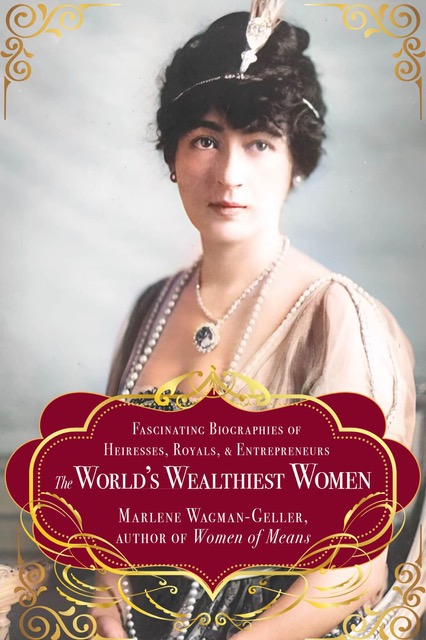
To pre-order my newest book, The World's Wealthiest Women: Fascinating Biographies of Heiresses, Royals, Entrepreneurs, and Entertainers, please click one of the links below.
- Amazon.com: amazon.com
- IndiePubs: indiepubs.com
- Bookshop: bookshop.org
- Amazon.co.uk
- Amazon.ca
- B&N: b&n.com
- Chapters Indigo (CA): indigo.com
- Books That Save Lives