Marilyn Monroe and Ella Fitzgerald: Can't We Be Friends?
"Well, my very favorite person, and I love her as a person as well as a singer, I think she's the greatest, and that's Ella Fitzgerald.” ~Marilyn Monroe on Ella Fitzgerald
“She was an unusual woman – a little ahead of her times. And she didn't know it.” ~Ella Fitzgerald on Marilyn Monroe
The friendship between Marilyn Monroe, the Blond Bombshell, and Ella Jane Fitzgerald, the First Lady of Song, seemed the pairing of strange bedfellows. The entertainers forged their union in the 1950s in an era when racism ruled the American roost. Miscegenation laws in several states made it illegal for whites to wed “colored persons.” Yet the meeting of minds superseded skin color, triumphed societal approbation.
The genesis of the Marilyn-Ella union began in 1953 when the film star was preparing for her film, Gentlemen Prefer Blondes. The movie featured her trademark song, “Diamonds are a Girl’s Best Friend.” One of the most revealing of its lyrics, “When those louses go back to their spouses/ Diamonds are a girl’s best friend.” Vocal coach Hal Schaefer advised Marilyn to “listen to the best female singer there is.” He gave her Ella Fitzgerald’s recording of Gershwin songs with the advice to listen to them 100 times to improve her vocal range. Ira Gershin, likewise an Ella aficionado, stated, “I never knew how good our songs were until I Eard Ella sing them.” Proof of Marilyn’s high regard of the jazz singer: Ella’s “Embraceable You” was the favorite love song of the actress and her second husband, Yankee Clipper, Jo DiMaggio.
Eager to hone her voice, Marilyn wrote Ella to request singing lessons. The jazz great turned her down by explaining, “I’m self-taught. I don’t know how to teach someone else to sing.” In 1954, Marilyn and her entourage attended the Tiffany Club in Los Angeles’ Wilshire district. The venue was the domain of mainly black jazz legends such as Charlie Parker, Louis Armstrong, Nat King Cole, Billie Holliday- and Ella Fitzgerald. 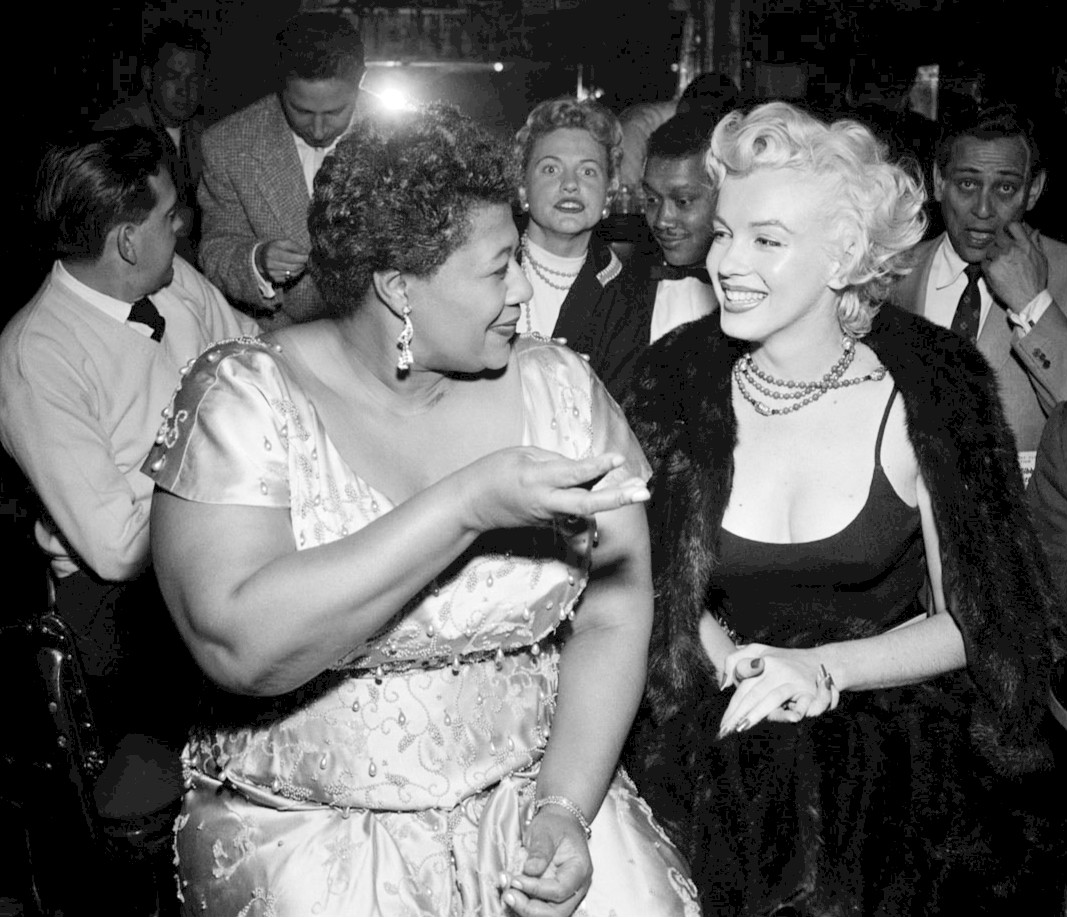
On the night when the two stars crossed paths for the first time, Marilyn was at an emotional low ebb. Six days before she had checked out of Cedars of Lebanon Hospital in East Hollywood (currently the site of the Church of Scientology) for treatment for her endometriosis. She had also separated from DiMaggio. Trouble in their marriage had erupted in New York City where she starred in the Seven-Year Itch. Producer Billy Wilde had positioned Marilyn above a subway grate, legs akimbo, where the rush of air raised her dress to reveal what lay beneath. (The white cocktail dress sold in 2011 for $4.6 million). Although filming took place at 2:00 a. m., from the sidewalk emanated a crescendo of catcalls. The scene was jolting to Joltin’ Joe who kept repeating, “What the hell.” While the scene was publicity gold for Ms. Monroe, it was all wrong for Mrs. DiMaggio. That evening, in their St. Regis Hotel room, a screaming match ensued. The marriage ended from a nine-month itch.
In addition to romantic woe, Marilyn was weary of playing roles that did not allow her to flex her dramatic muscle. Consequently, she announced she wanted the part of Grushenka in a film version of Fyodor Dostoyevsky’s The Brothers Karamazov. A reporter asked, “Do you even know how to spell Dostoevsky, Marilyn?” The retort, “Actually, have you read the book?” Marilyn had. Marilyn had met writers from Vladimir Nabokov to John Steinbeck, and her third husband was Death of a Salesman playwright Arthur Miller. Her home library held 400 books by authors that included Marcel Proust, William Blake, and Walt Whitman. Director Billy Wilder supported the star with his statement, “She would be a Grushenka to end all Grushenkas.” 20th Century Fox gave the role to German actress Maria Schell.
Ella was struggling with her own issues such as the indignities she suffered performing in the Jim Crow South. Another cross was her divorce from her second husband, jazz bassist, Ray Brown. In a bid to extend her repertoire to film, Ella was ecstatic to discover that Warner Brothers was considering her for the nightclub singer in Casablanca; the role went to Dooley Wilson.
To connect with her idol, Marilyn arranged a backstage introduction with the “Summertime” singer. The words of Rick Blaine to Louis in Casablanca applied to the meeting of the two legendary ladies, “This is the beginning of a beautiful friendship.” During their relationship, Ella shared with Marilyn what she had told her press agent, "I know I make a lot of money at the jazz clubs I play, but I sure wish I could play at one of those fancy places."
In her film, Some Like It Hot, Marilyn said, “I have this thing about saxophone players, especially tenor sax. All they have to do is play eight bars of ‘Come To Me, My Melancholy Baby,’ and my spine turns to custard. I get goose-pimply all over, and I come to ’em.”
Marilyn also had a thing about injustice, and her hatred of it was made manifest at the Sunset Strip nightclub, Mocambo. The club featured Mexican-themed décor that purportedly cost over $100,000 (1$1.6 million in contemporary currency). A glass-walled aviary housed parrots, macaws, and cockatoos. The hot spot was the watering hole for the stars in the Hollywood firmament: Clark Gable, Humphrey Bogart, Bob Hope, Howard Hughes, Lana Turner, Lauren Bacall, and Sophia Loren. However, owner Charles Morrison never extended an invitation to Ella. Lore holds that Morrison’s decision was due to race, but that was not the case: he had hired black Dorothy Dandridge and Eartha Kitt. His rationale was the heavy-set Ella was not the sex siren needed to draw crowds.
The fact the top-rated nightclubs overlooked her because of her girth was Ella’s Achilles Heel. She admitted that she had always wanted to be so beautiful she would “stop traffic. Insecure over her appearance, she had quit appearing in Harlem’s Apollo Theater because she lacked the self-confidence to compete with the statuesque, sinewy, light skinned showgirls.
Excluding one of the greatest jazz singers of the century did not sit well with Marilyn. She thought it was as wrong to judge Ella on her weight as it was for the public to judge her on her curves. In 1954, when a writer from Collier’s magazine visited Marilyn and Schaefer, the actress told the journalist, “I won’t be satisfied until people want to hear me sing without looking at me.” But she quickly added, “Of course, that doesn’t mean I want them to stop looking.”
In a ploy to change Morrison’s mind, Marilyn told him she would sit front and center row of the Mocambo for five consecutive nights if Ella performed. Moreover, she would bring along her high-profile friends. During Ella’s run, Marilyn made good on her promise; on opening night she brought along Frank Sinatra and Judy Garland. The shows sold out every evening; Morrison extended Ella’s contract for an additional week.
The Mocambo engagement super-charged Ella’s career but hurdles remained. While in Colorado to watch her friend perform, the Some Like it Hot actress became heated when her friend had to enter the nightclub through the back door. Marilyn said she would not be entering the club unless the racist policy ended-which it did.
Proof of the ladies’ superstar status: Andy Warhol created a portrait of the actress, one in a series of five inspired by Marily’s film, Niagara. The work was part of the “shot Marilyn portraits.” The name derived from a 1964 incident when Dorothy Podber shot at a stack of four Marilyn paintings. (The Christie canvass remained intact.) Although the canvass’s image was not as racy as the white sheath from The Seven-Year Itch, or as sultry as the one from Happy Birthday, Mr. President, it was the priciest. Christies sold the silk-screening for $195 million.
In 1970, Pablo Picasso sketched a portrait of Ella with notes pouring from her mouth, and with breasts exposed, on the blank page of an art catalog. He signed the drawing: “Pour Ella Fitzgerald / son ami Picasso / le 28.5.1970." The work sold for $20.000. In the same vein as Ella had turned down the opportunity to provide Marilyn with singing lessons, she was equally dismissive of Picasso. When the painter and the jazz singer were both in Juan-les-Pins France, in answer to a request to meet the Spanish painter, Ella wrote, “I’m busy. I’m darning my stockings, and I have some other things I’m sewing, so I can’t go.’” Picasso’s response, “That's great. Now I really want to meet her!” However, the girl who had spent time in her youth in a reformatory for truancy brushed off her fame, “I’m just a ballad singer.”
An impediment to the entertainers ‘friendship was Ella disproved of Marily’s addiction to prescription pills, alcohol, and laissez faire horizontal pursuits. The jazz singer’s escape was watching soap operas while on tour. Yet, Ella never forgot Marilyn had gone out on a limb to further her fame. In an interview in Ms. Magazine, Ella shared, “I owe Marilyn Monroe a real debt. After that, I never had to play a small jazz club again.”
The finale of Marilyn’s career lasted thirty-seconds. In 1962, Marilyn appeared at a Madison Square Garden Democratic fundraiser for a ten-day early forty-fifth birthday celebration for President Kennedy. She wore an Empress New Clothes sheath dress embossed with 2,500 hand-stitched crystals. (Ripley’s Believe It or Not Museum purchased the gown in 2016 for $4.8 million. Kim Kardashian wore it for an evening at the Met Gala). In front of an audience of 15,000-Jackie was not in attendance-Marilyn delivered a sultry rendition of “Happy Birthday, Mr. President.” Jazz pianist Hank Jones, her accompanist that night, told an interviewer for NPR that they rehearsed eight hours to prepare for the sixteen bars of music. After the rendition, President Kenndy came on stage to receive an oversized birthday cake. Of the sultry song, he remarked, “I can now retire from politics after having had “Happy Birthday” sung to me in such as sweet, wholesome way.”
Three months later Marilyn died in her Hollywood home, either from a drug overdose or homicide. While Ella would have been happy to perform at her friend’s funeral, she was not permitted to attend the internment. Joe DiMaggio oversaw the funeral arrangements. And he banned the Hollywood elite from the Westwood Village Funeral Chapel who “had only hurt Marilyn.: The statement was a truth Marilyn had understood, Hollywood a place where they’ll pay you $50,000 for a kiss and fifty cents for your soul.” The star’s final attire was a green Pucci dress. The organ music played a rendition of “Over the Rainbow” from The Wizard of Oz. Joe kissed Marilyn on the lips and repeated, “I love you.” On their wedding day, Marilyn had asked Joe when she died she wanted him to place flowers on her grave every week as William Powell had done for Jean Harlow. The grief-stricken baseball legend honored her request; he arranged for six fresh long-stemmed red roses delivered to her gravesite three times a week. The star’s remains are in crypt number 24 in the Corridor of Memories. The site is also the final resting place of Hugh Hefner who bought the tomb next to Marilyn’s for $75,000 so that he could spend eternity alongside Playboy’s first Playmate. Richard Pincher spent twenty-three years next to his idol until his widow sold the unit for $4.6 million on eBay to a bidder who used the initial O. S.
In her final years, Ella, suffering from diabetes had both her legs amputated below her knees. Her final concert was at New York’s Carnegie Hall. Ella passed away at age seventy-nine at her thirteen-room home in Beverly Hills, California. Singer Bing Crosby stated, "Man, woman, or child, Ella is the greatest." After a private service, Ella’s internment was in the Ingelwood Park Cemetery, in Ingelwood, California, in the Sanctuary of Bells on the second floor of the Sunset Mission Mausoleum, crypt 1963. Her memorial bears the words: BELOVED MOTHER AND GRANDMOTHER. MISS ELLA JANE FITZGERLAD. 1917-1996 :THE FIRST LADY OF SONG.”
Ella’s 1929 song encapsulates her relationship with Marilyn Monroe, Can’t We Be Friends?
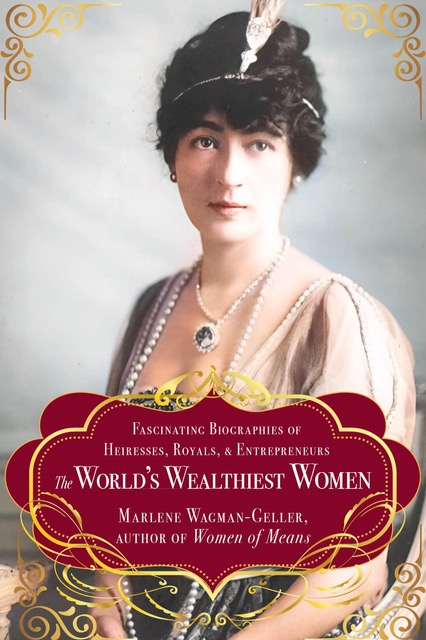
To pre-order my newest book, The World's Wealthiest Women: Fascinating Biographies of Heiresses, Royals, Entrepreneurs, and Entertainers, please click one of the links below.
- Amazon.com: amazon.com
- IndiePubs: indiepubs.com
- Bookshop: bookshop.org
- Amazon.co.uk
- Amazon.ca
- B&N: b&n.com
- Chapters Indigo (CA): indigo.com
- Books That Save Lives