Brave Enough to Try
"It takes a lot of money to look this cheap.” –Dolly Parton
In 1809, Canadian author Edmund Vance Cooke wrote a poem that described a squalid village in which Nance Lincoln had just given birth. A local groused of the newborn Abe, “Poor young’un born without a chance!” Another baby- “born without a chance-” Dolly Parton, made the transition from cabin to mansion. In her meteoric rise, she never lost her homespun roots or her humility.
The 1994 memoir, Dolly: My Life and Other Unfinished Business, opened with a self-mythologizing sentence, “Once upon a time and far, far away, back in the hollers at the foothills of the Great Smoky Mountains…” Dolly was the fourth of twelve children of mother, Avie Lee Owens, who was married at age fifteen to the seventeen-year-old Robert Lee Parton. The teenaged couple rented a ramshackle lodging in the Tennessee woods. To supplement his sharecropper wages, Robert brought home game that Avie Lee served as meals of rabbit, squirrel, groundhog, turtle, and bear. After the birth of their children, Willadeene, David, and Denver, the family relocated to a one-room cabin on the banks of the Little Pigeon River, East Tennessee, a home without electricity, without an indoor bathroom. Dolly reminisced they had “two rooms and a path and running water, if you were willing to run to get it.” For Dolly’s birth, Doc Thomas arrived on horseback; Robert paid him in cornmeal. To entertain her daughters, Avie Lee fashioned paper dolls that consisted of a corncob body to which Robert created a mouth with a fire poker. The toy became Dolly’s prize possession she christened Tiny Tassel Top.
An indelible childhood experience occurred when Alvie Lee sewed Dolly a winter coat made from scraps of discarded clothing. Dolly thought she looked like Joseph; her classmates thought she looked like white trash. Years later, Dolly composed The Coat of Many Colors, “Now I know we had no money/ But I was rich as I could be/In my coat of many colors/My momma made for me…”
When she was five, Avie Lee wrote down the lyrics to her daughter’s song “Life Doesn’t Mean that Much to Me.” Her grandfather Jake declared that Dolly “started singing as soon as she quit crying.” A natural-born performer, Dolly placed a tin can on a stick as a makeshift microphone. Standing on her porch, her audience was “whatever was in the front yard-human, animal, or dirt.”
The key to Dolly’s lavish looks began with her perception she was homely. She recalled, “I was an ugly little ol' young-un." I used to overhear people saying, 'Look at that little ugly tabbyheaded young-un. She don't even look like one of Robert and Avie Lee's kids.” To compensate for her perceived shortcomings, Dolly used purple pokeberries to darken her lips, burned matches to apply eyeliner, and mashed up honeysuckle for perfume. In her memoir, she wrote that she would only leave the house without her hair and makeup under gunpoint. She also sleeps with her makeup on in case of an earthquake. Growing up in a Pentecostal household, the sisters drew what they called “Jesus sandals” on their feet and pretended to be biblical characters. Dolly dearly coveted a pair of red high heels that arrived in a charity box. She recalled, “I loved high heels even before I knew I was gonna be short!” She never outgrew her youthful love of stilettoes: she wears them around her mansion; even her golf shoes have heels.
At age ten, her Uncle Bill arranged for her to perform on the Cas Walker Radio Show in Knoxville, Tennessee. Bill recalled, "She caused some clamor. She was an instant hit. The engineers came a-runnin' to find out who that young-un was, a-singin' so growed-up-like." Cas gave her airtime on his television show; as her family did not own a T.V., they were unable to tune in. Before one episode, Cas organized a publicity stunt where participants had to climb a greased, fifty-foot pole; the first to reach the top would receive $50.00. The enterprising Dolly immersed herself in water and then rolled in the sand. Her winnings led to the Partons’ first television. A lucky break arrived when she performed on the Grand Ole Opry. Johnny Cash introduced the ten-year-old who sang, “You Gotta Be My Baby.” The 4,000 spectators gave the singing-sensation three encores.
Determined to be the first in her family to graduate high school, Dolly returned home. Still self-conscious over her looks, Dolly donned heavy makeup, a look she modeled on the woman she referred to as the town tramp. While the town denigrated the “fallen woman,” Dolly felt the lady of the night was “the prettiest thing she had ever seen” with her peroxide blonde hair piled on the top of her head, red lips and fingernails, high heels, and tight shirt. She aspired to a “cheap and gawdy” look that she actualized when she donned the façade of a Backwoods Barbie. To add height to her five-foot frame, she teased her hair into a towering bouffant. When her ship arrived, Dolly took to buying hundreds of wigs teased into towering heights. A fan of stars Marilyn Monroe, Jayne Mansfield, and Mae West, she used her money to buy peroxide. The mean girls pronounced her “trashy.” The first glimpse Dolly had of the world beyond the mountains occurred in 1964 with the senior class of Sevier County High School’s field trip to New York City. The outing coincided with the Broadway musical hit Hello, Dolly! that led the Smoky Mountain girl to exclaim, “They must have been waitin’ for me!” Tired of the poverty, pettiness, and patriarchy, Dolly desired a life far afield from east Tennessee, “I used to see relatives marrying one ol' shitty guy after another and their teeth would rot out and I'd think, that is not what I'm a-gonna do with my life.”
Six years after her field trip, Dolly returned to New York City, but there was no warm greeting of “Hello, Dolly.” She reminisced, “We came here, and we stayed down on, what is it, Forty-second Street, where all the whores run? We went out walking, and we saw there were all these porno movies, and we were thinking, ‘Oh, my God, this don’t look like a good place’. And we were overdressed—lookin’ like I do now, we did look like trash, and so we looked the part.” When a man “started grabbing me in places I reserve for grabbers of my own choosing” she threatened that if he touched her one more time, she would shoot him. As she was carrying a gun, she could well have–in the words from her film 9 to 5–transformed him from a rooster to a hen.
On a Greyhound bus, Dolly left for Nashville and worked at a diner where she refilled the salt and pepper shakers in exchange for food. Other means came from eating off trays left in hotel hallways. On her first day in Nashville, Dolly was outside the Wishy-Washy Laundromat when a stranger remarked, “Y’all gonna get sunburnt out there, little lady.” Carl Thomas Dean and Dolly started dating; she was distraught when he joined the army for a two-year stint.
A year later, Dolly had her first recording with Monument Records whose executives told her, “Nobody’s ever going to take you serious as a songwriter or a singer if you look like that, because you look more like a hooker than you do a singer.” Not only did fans get used to her appearance, they expected Dolly would wear outfits that only Marilyn Monroe, Mae West, Barbie, and King Louis XIV could have pulled off. Her first album, Dumb Blonde, proved prescient, “Cause this dumb blonde ain’t nobody’s fool.” Dolly hitched her wagon to Porter Waggoner who hired her for his television show. By the early 1970s, Dolly had her hit single “Coat of Many Colors.”
Three years after leaving Tennessee–at least on a physical plane–Sevierville declared a Dolly Parton Day, and several thousand people participated in a parade in her honor. In 2010, the University of Tennessee bestowed an honorary doctorate on the state’s famous daughter. Dolly remarked, “Just think, I am Dr. Dolly. When people say something about 'double D,' they will be talking of something entirely different!"
With her soaring popularity, Dolly bought a Cadillac; a terrible driver, she crashed her car into the brick wall of the studio parking lot. With finances no longer an obstacle, Dean and Dolly wed in a 1966 secret ceremony in Ringgold, Georgia. Seven years later, Dolly penned her signature song “Jolene” on a woman who flirted with Carl. Comeuppance came to the flirtatious “Jolene” when Dolly ran into her after a span of years and “as she was as broad as a barn, I didn’t feel threatened anymore. That’s my revenge!” Dolly and Carl acquired Willow Lake Plantation, a twenty-three-room mansion, situated on sixty-five acres in Brentwood, Nashville, that holds a swimming pool, tennis court, and chapel. The estate provides ample space for Dolly’s sentimental treasures including Porter Waggoner’s dry-cleaning receipt with the scrawled the lyrics to her 1971 classic “Coat of Many Colors;” her first royalty check from a song for which she received $1.02. Her book Behind the Seams: My Life in Rhinestones details her voluminous closets that hold everything from her childhood coat of many colors to the disco-ball suit she wore to the Academy of Country Music Awards.
Childless, Dolly took in her five younger siblings who called her Aunt Granny; Carl was Peepaw. Due to Carl’s reclusive nature, rumors have always dogged their relationship. The couple has an open marriage, which Dolly pronounced, “It's very healthy for both of us." Dolly dresses to the nines even while in the privacy of her mansion. She quipped that when she sees Carl snoring in his La-Z-Boy chair, she asks herself, “Where is Jolene when I need her? Come on, you can have him now!” .jpg)
The decade older Porter served as Dolly’s father figure, and together they cranked out lucrative duets until Dolly succumbed to the seven-year itch. No longer willing to play the role of the dutiful lil’ lady, Dolly decided to branch out on her. As a parting gift to Porter Dolly composed, “I Will Always Love You.” The song soared to Number One on the country music charts. Elvis Presley approached her to record her song–along with the stipulation he would receive half the publishing rights. She turned down his offer; with the money she made on royalties, she could have bought Elvis’ home, Graceland, many times over. For the 1992 film, the Bodyguard, Whitney Houston crooned “I Will Always Love You,” in a soul-stirring rendition. Porter sued Dolly for breach of contract and won a $1 million award. Despite the stress of the lawsuit, Dolly felt she had made the right move.
The small-town girl moved to Los Angeles where she added to her country repertoire with pop music, including the duet with Kenny Rogers, “Islands in the Streams.” Dolly had her first million-selling record with “Here You Come Again.” In addition to winning a Grammy, Dolly appeared on The Tonight Show, Cher, Hollywood Squares, she had her own program, Dolly. In 1977, along with family members, she formed a band, the Gypsy Fever. Her tour bus, dubbed “The Coach of Many Colors,” exterior was a mixture of pink, purple, and silver; inside, it held hues of yellow, pink, and orange.
Hollywood beckoned in 1980 when Dolly shared the silver screen with heavy-hitters Jane Fonda and Lily Tomlin in the movie, 9 to 5, a revenge fantasy against a chauvinist male boss. Not only did she excel in her role, Dolly also wrote the theme song that made it to the number one slot on pop and country charts. Another breakout performance was in the film whose title described Dolly Parton herself: Steel Magnolias. Leaving Tennessee in her rear-view mirror, Dolly toured London, Sweden, Alaska, and Hawaii. In England, Dolly performed for Queen Elizabeth II. Dolly said that the queen wore “just as much jewelry as I did, though maybe she was a little tastier with it.”
In a world far away from the Tennessee woods, Dolly’s super star status opened the doors to rarified zip codes. In the 1970s she hung out at celebrity hot spot, Studio 54 whose owner, Steve Rubbell, threw a party in her honor where he filled his nightclub with hay bales, and a backdrop that showcased cows and a white horse. The guests wore country-western outfits; ironically, that evening, Dolly had arrived in a sparkly black chiffon. She partied with Andy Warhol who immortalized her in all her blonde glory on his canvass. During that time, Dolly met designers Calvin Klein and Diane von Furstenberg. When Dolly, clad in a red miniskirt and matching red jacket entered the Manhattan eatery, Le Madri, she became the focus of all eyes. Ivana Trump sent the singer a bottle of wine.
Dolly Parton’s appearance is an indelible part of her repertoire: gravity defying breasts, (often the butt of her jokes), wind-defying platinum wigs, and age-defying face. But although she occupies a hallowed niche in pop culture, and despite having written three memoirs, she remains elusive. How did a product of a poor, white, Southern Christian milieu turn into a media sensation mogul? How did she pull off the metamorphosis from rags to rhinestones? Deeply religious, Dolly sums up her success to her higher power. In “Songteller,” Dolly wrote, “A great line will just come to me, and I’ll go, ‘Hey, thank you, Lord. I know I didn’t think of that.’” She also credits her success of her work ethic: while most people work 9 to 5, Dolly works from 3:00 a.m. on, too busy to spend time on sleep. In Dolly-speak, “I may look like a show pony, but I’m a workhorse.”
Dolly wrote that her three passions are, “God, music and sex” but she has a fourth-money, a byproduct of her hard-scrabble youth. Indefatigable, Dolly oversees her $650 million fortune. The Wall Street Journal described her as “one of the most important women in the world for business and in industry.” Capitalizing on her fame and fortune, the singer founded Dolly Parton Enterprises; she has her own record, movie-production, and music-publishing companies, the latter of which brings in $150 million annually. She has investments in real estate, restaurants, radio stations, macadamia nuts, and bakeware in Williams Sonoma–for starters. The crown jewel in her multi-pronged empire is her Tennessee theme park, Dollywood, located on 700 acres in Pigeon Forge, that brings in an annual revenue of $30 million. There is a replica of mountain homestead and the Southern Gospel Hall of Fame. Nearby, is Dollywood’s Splash Mountain, the state’s largest water park.
For giving back so much to Pigeon Force, the region raised $60,000 for a life-size bronze Dolly Parton statue that stands in the courthouse square, an honor generally reserved for soldiers who fought in the Confederacy. The monument depicts a young, barefoot Dolly, in rolled-up jeans, sitting on a rock, holding a guitar. Of the honor, Dolly stated, “I’m prouder of that statue than almost anything in my life." In a nod to superheroes wear corsets as well as capes, Dolly has gifted more than 200 million books to children through her Imagination Library organization. During the pandemic, Dolly donated $1 million to a Covid-19 vaccine. With her astronomical fortune, Dolly can afford to buy any number of islands in the stream.
The rhinestone cowgirl stated her wish is to die in the middle of a song on a stage…at age 120. Funny, feisty, and fabulous, Jolene, ya never stood a chance.

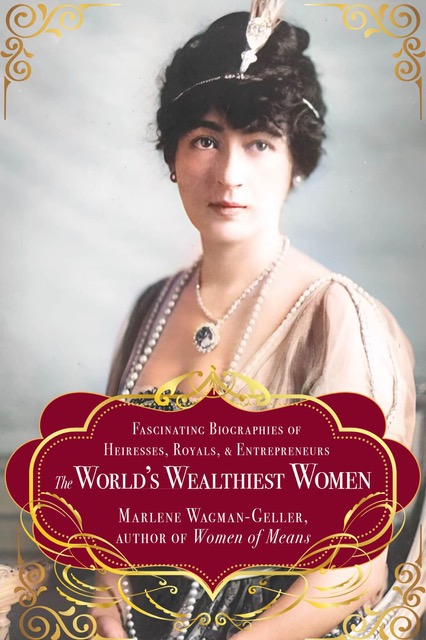
To pre-order my newest book, The World's Wealthiest Women: Fascinating Biographies of Heiresses, Royals, Entrepreneurs, and Entertainers, please click one of the links below.
- Amazon.com: amazon.com
- IndiePubs: indiepubs.com
- Bookshop: bookshop.org
- Amazon.co.uk
- Amazon.ca
- B&N: b&n.com
- Chapters Indigo (CA): indigo.com
- Books That Save Lives