Mama of Dada
Mama of Dada
Baroness Elsa von Freytag-Loringhoven, 1874-1927
14th Street Years in the Village: 1913-1923
“Sleep with everyone! Be embarrassing!” ~Baroness Elsa von Freytag-Loringhoven
In a Dr. Seuss’s poem, Marco, a small-town boy, imagines a fantastic parade; the verse concludes, “And that is a story that no one can beat/When I say that I saw it on Mulberry Street.” A literal fantastic parade took place on Greenwich Village streets by its most resident “royalty:” Baroness Elsa von Freytag-Loringhoven.
The belle of bohemia, despite her tile, she was not to the manor born. Elsa Hildegarde, the daughter of Adolf and Ida Plötz, grew up in the seaside resort of Swinemünde, part of the German Empire (present-day ÅšwinoujÅ›cie, Poland.) As with other artists, her childhood was a merry-go-round of unhappiness. Adolf, a non-benevolent patriarch, made life a rough ride for his spouse and children, Elsa and Charlotte. As much as Elsa feared her father is as much as she adored her mother. Ida shared with Elsa her passion for banal objects she crafted into found art. Afflicted with mental illness, Ida passed away from cancer.
After an altercation with her stepmother, the teenaged Elsa ran away to Berlin where her life entailed “a gal gotta do what a gal gotta do” existence. She found work as a scantily clad chorus girl and exchanged sex for gentlemen who paid the rent for her room in a boardinghouse. Moving on to Munich, she found her niche in the vanguard art world.
Elsa worked as a stage model, engaged in indiscriminate sex, both for money and to nourish her voracious carnal appetite. In her memoir, she later wrote, “Now I began to know what ‘life’ meant…every night another man!” The wages of carnality were contracting syphilis and gonorrhea. She favored men’s attire, and her androgenous appearance made her the magnet of curious eyes. A homing pigeon to art, Elsa studied her craft in the town of Dachau.
Elsa’s first marriage was to architect August Endell who she married at a small church dominated by a statue of the Virgin. The bride wore a white dress with bells sewn to the sleeves that tinkled as she walked down the aisle. As Elsa eschewed a corset as restrictive, her garment showcased her natural curves. Their union remained unconsummated due to August’s impotence, and consequently he understood his wife’s extramarital affairs. During their relationship, she met writer Felix Paul Greve, a friend of her husband. The trio traveled to Palermo, Sicily in 1903; three years later Elsa and August divorced. Although Feliz was gay, he and Elsa took their vows. A few years later, to evade relentless creditors, with his wife’s assistance, Felix faked his suicide and hightailed it to America. Elsa joined him and they settled on a farm in Sparta, Kentucky. She soon tired of her role as a farmer’s wife. Their union imploded when Felix headed for Canada where he changed his name to Frederick Philip Grove. Felix married, had children, and earned his livelihood through writing.
Miserable in the conservatism of the South, Elsa gravitated to Manhattan. Within a year, she wed the expatriate German Baron Leopold von Freytag-Loringhoven. His title was real, as was his gambling addiction. Three times did not prove the proverbial charm. With the outbreak of World War I, Leopold sailed to Europe to enlist in “the war to end all wars”. The Baron ended up in a French prison-of-war camp that might have contributed to his suicide. He did not leave monetary provisions for Elsa, though he did bequeath her an aristocratic title.
In New York City, destitute and alone, Elsa found work in a cigarette factory and served as a model and muse for Man Ray. The artist, like his model, had undergone a name change: the son of Russian immigrant Jews, he started life as Emmanuel Radnitzky. He was a creator of the Dada Movement-anti traditional art- that Elsa embraced. Not only did she become one of its proponents, she fell hard for fellow Dada bigwig Marcel Duchamp. In one of her performances, Elsa rubbed a newspaper article that centered on Duchamp’s painting, Nude Descending a Staircase, over her naked body. In accompaniment to her gesture, she recited her poem, “Marcel, Marcel, I love you like hell, Marcel.” He kept her at arm’s length. The woman scorned retaliated in her poem, “Graveyard Surrounding Nunnery,” in which she wrote, “I loved Marcel Dushit.” While Marcel was able to present himself in a conservative manner to attract wealthy patrons, the same did not hold true of his female counterpart. 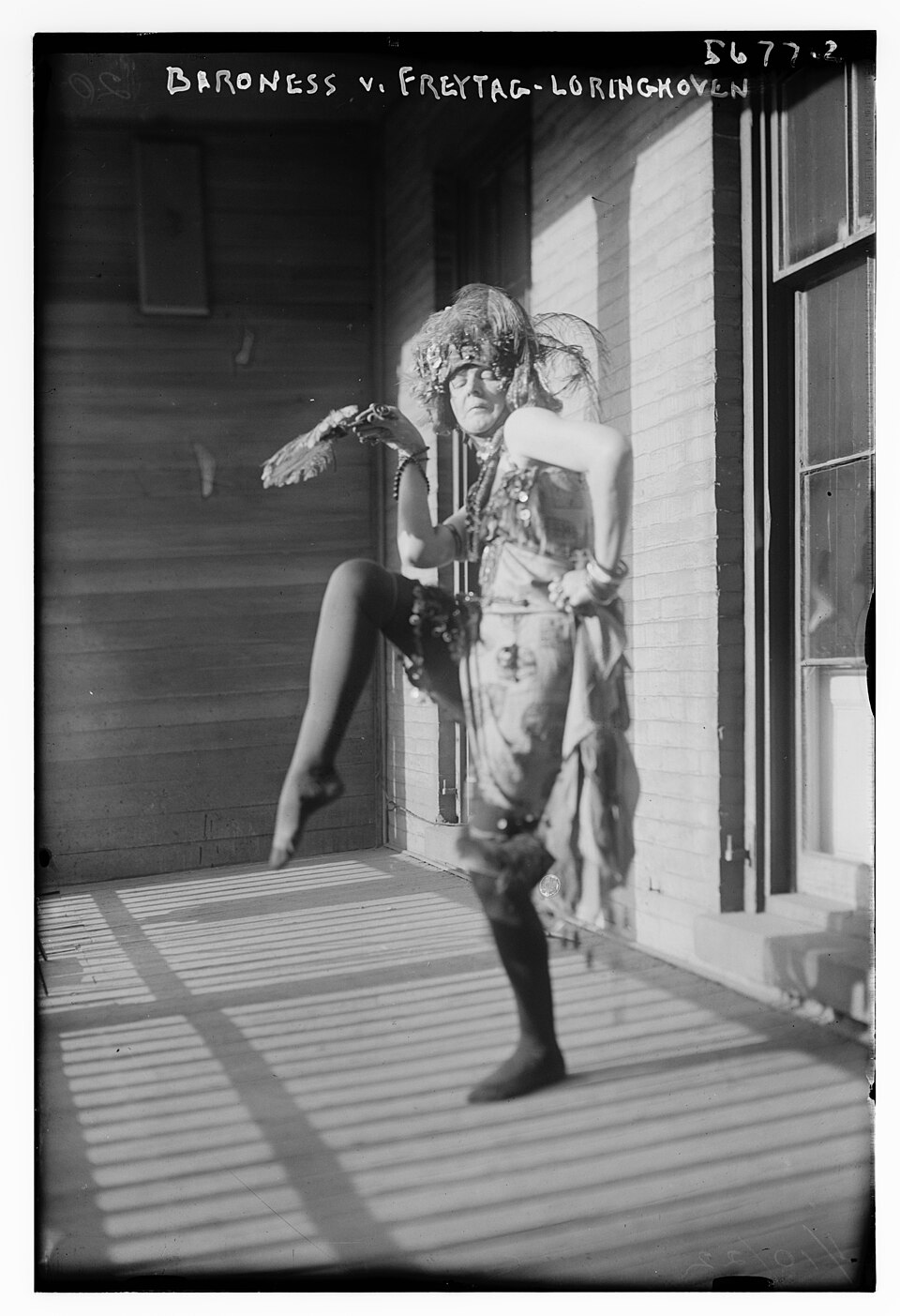
Although drawn to off-kilter women-Elsa was too off-kilter for his taste. She also went on the prowl for poet William Carlos Williams who was not charmed by her offer of gifting him syphilis that would “free his mind for serious art.” After she showed up at his home in Rutherford, New York, he punched her during a street confrontation. While the Dada male artists did not reciprocate her romantic overtures, she had an intermittent lesbian love affair with author and fellow Greenwich Village resident and eccentric, Djuna Barnes,
Smarting from romantic rejection from artists, she decided to become one herself, and rented a home-studio in Greenwich Village’s 14th Street. She painted portraits, sewed outlandish outfits, and created sculptures from found materials-thereby demonstrating that art could spring from the mundane. In a letter to artist Sarah Freedman McPherson, Elsa wrote, “Sarah, if you find a tin can on the street stand by it until a truck runs over it. Then bring it to me.” Her first creation was a heavily rusted metal ring she picked up from the sidewalk and named Enduring Ornament that predated Duchamp’s Bottle Rack. Her God sculpture consisted of a cast iron drain trap. A discarded metal spring, coupled with a curtain tassel, became her sculpture, Limbswish. Poet Ezra Pound admired her “principle of non- acquiescence;” they collaborated on several pieces.
The painter, George Biddle, wrote of his visit to Elsa’s 14th Street studio, “It was crowded and reeking with strange relics which she had purloined over a period of years from the New York gutters. Old bits of ironware, automobile tires, gilded vegetables, celluloid paintings, ash cans, every conceivable horror, which to her tortured yet highly sensitized perception, became objects of formal beauty.”
While she did not receive acknowledgement for her art, she was more successful with her poetry. Margaret Anderson and Jane Heap, editors of the periodical, The Little Review, published her experimental work that revolved around sex, death, and America. They placed Elsa’s poems alongside those by James Joyce’s Ulysses; the May, 1919 edition featured his work, “Scylla and Charybdis” and her poem, “King Adam.” The latter consisted of highly charged erotica. Although Jane admired Elsa’s poetry, she described the baroness of leading a life “unhampered by sanity.” During a visit to their publishing house, Elsa appeared wearing a dress she had made from the black crepe that had adorned a house of mourning. Margaret recalled, "She jerked off the crepe with one movement while explaining, 'It's better when I'm nude.’ We were just as glad that some of our more conservative friends didn't choose that moment to drop in."
Through her reputation as the most avant garde feminist of the era, the rootless duchess became a member of the artistic salon hosted by Walter and Louise Arensberg. In their charmed circle, Elsa circulated with Marcel Duchamp, Mann Ray, and Beatrice Wood. According to Irene Gammel, author of the 2003 biography, Elsa: Gender, Dada, and Everyday Modernity, theorized that Elsa had been the creative force behind Marcel Duchamp’s urinal from which he had created the ground-breaking piece “Fountain.” The urinal bore the name R. Mutt and first appeared at the 1917 Society of Independent Artists’ Salon in New York. In a 1917 letter to his sister, Duchamp recounted that “one of my female friends under a masculine pseudonym, Richard Mutt, sent in a porcelain urinal as a sculpture.”
At the dawn of the twentieth century, still in the throes of the Victorian mindset, women dressed in a conservative fashion. The paradigm, however, did not hold sway with the Village’s foreign-born consummate character. While walking several dogs, Elsa strolled the streets wearing a birdcage hat that held a bird. In lieu of jewelry, the baroness accessorized with a bra made of tomato cans, a profusion of shower-curtain bangles, and teacup earrings. She shaved her head and painted her scalp in various bright colors, affixed postage stamps to each cheek, affixed porcupine quills to her eyelashes. She became a walking poster for Dada as her body doubled as a surrealist canvass. Her manner of dress-or undress-often landed her behind bars. As some of her found object came from store shelves that she took without payment also ended with ending up on the wrong side of the law. Another stay behind bars occurred after the police arrested her for crashing a Daughters of Democracy fundraiser. During the protest she held aloft an oversized artistic rendition of a phallus as she recited a poem. The New York Times, covering the event, focused on the fact Elsa was a cross-dresser. The artist collaborated with Man Ray and Duchamp on a film entitled, The Baroness Shaves her Pubic Hair.” In contrast, photographs reveal a Rapunzel-like armpit bush.
As her art did not provide much in the way of income, and as she had a carefree attitude to money, her existence was one of abject poverty. Despite her straightened circumstances, she took stray animals into decrepit apartment. While as a young woman Elsa had radiated sexuality, by her mid-forties, due to her hard knock life she looked far older. Her eccentricities, coupled with her prickly personality, often led to alienation from other Village residents. Denizens of the liberal enclave did not appreciate her antisemitism. Although unabashedly bisexual and once wed to a homosexual, Elsa was paradoxically homophobic. Nevertheless, Djuna Barnes, and photographer Bernice Abbott remained in her corner. When age increased her curmudgeon manner, they oftentimes gave her a wide berth.
With the passing of the unkind years, the 14th street apartment became more squalid. In an atmosphere of filth and rank odor, Elsa continued to pen her Dadaesque poem and dress in a fashion that aligned with te movement’s unorthodox doctrine. In 1923, unable to afford her Village apartment, Elsa camped out in Upper Manhattan parks. In a bid to try her luck in Berlin’s flourishing Avante garde milieu, Elsa decamped for Europe. She arrived in Germany where she discovered her deceased father had disinherited his wayward daughter. Destitute, Elsa sold newspapers on the Kurfürstendamm. She wanted to try her luck in Paris but was unable to obtain a visa. Part of the reason was likely because she turned up for an immigration interview at the French Consulate in Berlin with a birthday cake, replete with lit candles- on her head. She thought the official would have been receptive to the fact her appearance indicated she was an artist and therefore would find a niche in Paris. Her plan did not bear fruit.
Eventually, in 1926, she was able to move to Paris but, despite her aristocratic name, she was unsuccessful in carving out a niche. Elsa’s improbable life ended when she died, (along with her pets,) in her Rue Barrault apartment. Her cause of death was from asphyxiation caused by the gas from her stove. The coroner was unable to determine whether her passing was accidental, planned, or homicide. Djuna Barnes claimed Elsa’s body and arranged an interment in an unmarked communal grave in Paris’s Père Lachaise cemetery. She would have been gratified that the cemetery helf the remains of fellow eccentric artist Sarah Bernhardt.
A few years later, in the Village, Djuna started to write-but never completed- the biography of Baroness Elsa von Freytag-Loringhoven. Struggling with penning the story of an improbable life, a friend told her to think of Elsa ''in as detached a way as you possibly can-not as a saint or a madwoman, but as a woman of genius, alone in the world, frantic.'' While many Village residents viewed Elsa as the local nutcase, she had made huge strides in unlocking the straitjacket that Victorian society had used to imprison women.
Elsa’s life can be seen through multiple prisms: artist, muse, eccentric. But an apt posthumous epitaph for Elsa would be: The Mama of Dada.

To pre-order my newest book, The World's Wealthiest Women: Fascinating Biographies of Heiresses, Royals, Entrepreneurs, and Entertainers, please click one of the links below.
- Amazon.com: amazon.com
- IndiePubs: indiepubs.com
- Bookshop: bookshop.org
- Amazon.co.uk
- Amazon.ca
- B&N: b&n.com
- Chapters Indigo (CA): indigo.com
- Books That Save Lives