QUEEN OF THE THIRD SEX
“Why do you object-what harm am I doing” Eve Adams’ response when questioned about her unorthodox sexuality. (1891-1943)
Joseph L. Mankiewicz’s 1950 film, All About Eve, revolved around the backstage, back-stabbing Eve Harrington. An Eve of a very different color was the grand dame of America’s first lesbian establishment.
A Greenwich Village story began in Milawa, Poland, a country under the rule of the Russian Empire. Chawa (rechristened Eve) was the eldest daughter of Jewish grocers, Mariem and Mordechai Zloczewer. She had sisters Fejga, Tauba, Szeina, and brother Jerachmiel. Eve distinguished herself in her shtetl for her fluency in Yiddish, Polish, and Russian- and for dressing in male attire. In her early years, Eve explained her clothing preference as more comfortable for running and climbing trees. When her fashion choice extended into her teens, her religious parents accepted their nonconformist child. In Milawa, Eve embarked on her first romantic relationship with a woman, an artist in her thirties. In a letter to a friend, she shared her alienation, “In all the world, a foreigner, and in the country I was born, a Jew.”
Although Eva dearly loved her family, her homeland offered a bleak future. Casting about for escape, she contacted her maternal uncle, Isidor Meegdall, an American immigrant, who sent his niece a second-class ticket. In 1912, Eve left for Antwerp, Belgium, where she boarded the Red Star Line’s Vaderland. Her travel papers listed her occupation as “Tailoress.” In her passport photograph, Eve wore a scarf- decorated with anchors-around her neck. After a nine-day voyage, the twenty-year-old arrived on Ellis Island with $23.00. The five foot two, 100-pound newcomer hoped America would prove to be the Golden Medina-a Yiddish phrase that translates to “the golden land.” Eastern European Jewish immigrants believed the new world offered opportunity and freedom to those who arrived on her shores.
In a nod to put her past behind her, Chawa Zloczewer adopted the English translation of her first name Eve, and in a nod to her androgyny, chose the biblical surname, Adams. Eve lived with her uncle and his family in Brooklyn until she found a job as a seamstress in New York City’s garment district. 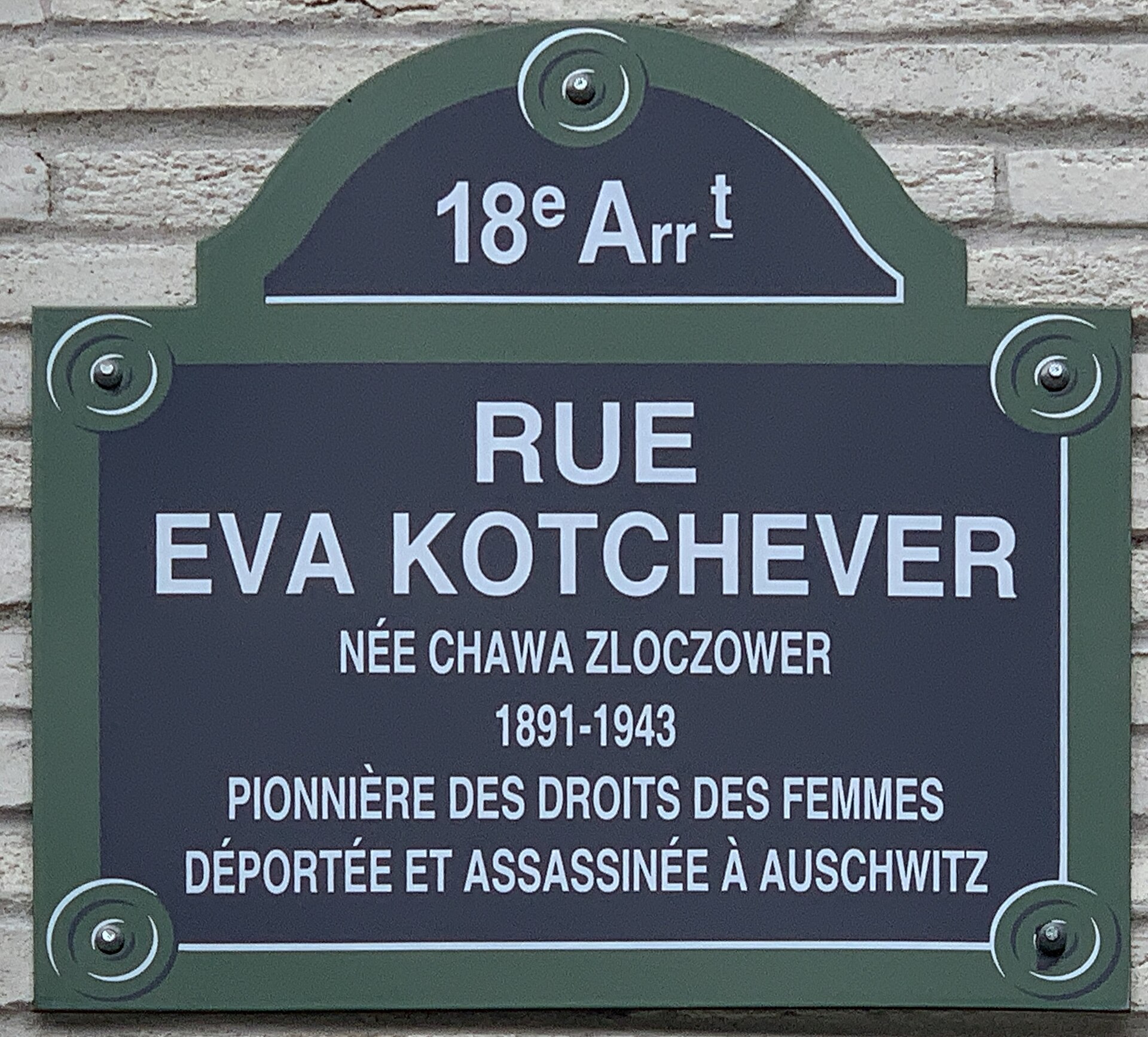
Preferring men’s clothes and women’s company, Eve refused to regulate her sexuality to a closet. Comfortable in the company of fellow nonconformists, Eve befriended Russian-Jewish anarchist-activist Emma Goldman. Emma gave her prodigy a position on her journal Mother Earth, one of whose offshoots was the Liberator, a “Journal of Revolutionary Progress.” To advertise her subscription services, Eve placed a drawing in the publication that showed her bobbed hair accompanied by the caption, “You will know her by her hair.” Whether as a nod to her leftist learnings or to stand out, she dyed her brown hair a distinctive red. One also knew Eve because she spoke her mind. After watching Isadora Duncan dance, Eve stated, “I could not forget her for a year.”
In 1919, Eve, in the company of other women, traveled throughout the United States pedaling her anarchist publications. The public disliked the peripatetic saleswomen of smut and referred to them as “hoboettes.” The company she kept, along with her unorthodox lifestyle, put Eve on the authorities’ radar. A Waterbury, Connecticut, police official contacted the Bureau of Investigations agent Warren G. Grimes in New Haven regarding a dangerous agitator. Accordingly, they searched Eve’s hotel room and confiscated items such as her radical publication. The fact their action violated the Fourth Amendment did not prove an impediment. Another item they considered contraband was a list of names, one of which was Margaret Anderson. Margaret and her romantic partner, Jane Heap, had published a glowing review of James Joyce’s censured book, Ulysses. The same year, twenty-four-year-old John Edgar Hoover, (future head of the F.B.I) started a file on ADAMS, Eve: alias Chawa Zlochever.
Two years later, Eve settled in Chicago where she opened the Grey Cottage in Townshead, the Illinois counterpart of New York City’s Greenwich Village. In an ad in the Liberator, Eve described her establishment as “Chicago’s Greenwich Village Tea Room. Eve Adams and Ruth Norlander in Charge.” Ruth was a painter, and her lover and muse was Eve-who posed in the nude. The New York Times described the tearoom as “a refuge for gay people.” The proprietors turned a blind eye to the alcohol smuggled into the premises by their patrons in defiance of Prohibition. At one point, police arrested Eve over the alcohol but released her on a $50.00 bond. In a letter Eve wrote ten years later when the two women were no longer in a relationship, “My beloved. I love you Ruth and the memories of our beautiful friendship and love keeps me young.”
In 1923, the thirty-two-year-old Eve returned to New York City. Aware of Emma Goldman’s deportation to Russia, Eve signed a government declaration of intention to become a United States’ citizen. She also became a denizen of Greenwich Village’s bohemia that included birth-control activist Margaret Sanger, playwright Eugene O’Neil, and author Henry Miller.
Eve donned an author’s hat with her 1925 book, Lesbian Love, published under the name Evelyn Addams. The book, one of the first of its genre in America, was a seventy-two-page collection of short stories and illustrations that explored the sexual awakenings and gender-defying nature of the habituates of Greenwich Village. She used made-up names to provide anonymity to those profiled. Eve wrote her book was “To show them the truth of their lives.” The book referenced The Flowery Tea Pot populated by same sex couples. Eve took the name for her fictional café- the Flower Pot- the Greenwich Village café operated by Dolly Judge. The book’s dedication page was “to my last love Rosalie O.N.” perhaps a veiled tribute to Ruth Olson Norlander. The author printed 150 copies earmarked for private circulation as the public considered the subject matter pornographic. She had remarked to a friend about her writing, “Why, my dear man, if I wanted to write my experiences of my wanderings and people and adventures which still continue with every blessed day, it would take me years to write and I could fill volumes, not chapters.”
The year 1925 also marked the opening of Eve’s Hangout, a tearoom situated in a basement of 129 McDougall Street. The small, dimly lit establishment was a lesbian literary salon located next door to the Provincetown Playhouse. Lore holds that the entrance of Eve’s Hangout displayed a sign: “Men Are Admitted But Not Welcome.”
The flapper-era hot spot was also a meeting place for writers. Eve loaned author Henry Miller money when his wealthy mistress grew weary of fronting his bills. At one of the tables Anais Nin-whose famous diaries included the tidbit she was a bigamist- and Emma Goldman who preached free love was protected under the First Amendment. The flapper-era watering hole had its detractors: Tour buses drove along the cobblestoned Village streets to watch the bohemians walking along the haunts of perversion.
In 1926, Margaret Leonard, dressed in a tweed suit, visited Eve’s Hangout. Margaret introduced herself to the salon’s hostess, and the following evening they took a taxi to Times Square to see a play. Afterwards, they went to a dinner dance establishment where they shared a waltz. Upon their return to the tearoom, Margaret requested a copy of Lesbian Love, and she received an autographed book.
What set Margaret apart from the other patrons: she was an undercover police officer, part of a government sting. The policewoman reported that while in the taxi Eve had kissed her “profusely” and had touched her breasts. Based on her accusations, four police officers raided the tearoom. A court charged Eve with disorderly conduct and possession of obscene material. Four policemen conducted a raid, and a court sentenced Eve to a year and a half incarceration.
Initially, Eve spent time in Greenwich Village’s Jefferson Market Prison until her transfer to the Women’s Penitentiary on Welfare Island, (now Roosevelt Island.) For a brief time, Eve crossed paths with Mae West who had received a ten-day jail term on a charge of corruption of morals stemming from her Broadway production entitled Sex. The bodacious blonde and the diminutive redhead received far different treatment. The warden and his wife invited her to dine with them each evening, and she left two days early due to “good behavior-” likely a first for Mae.
Eve served her full eighteen months; as Eve’s Hangout had closed, she was planning her next move. However, a judge passed her name to immigration authorities. During the proceedings, Eve beseeched the judge for leniency, “I love this country with my whole heart and soul, and I have made application for my final papers. I want to become a citizen. If I am deported, my life is ruined.” However, as America of the twenties was in the throes of xenophobia, homophobia, and anti-Semitic-since Eve was all three, in 1927 she was on a ship back to Poland.
In Milawa, Eve had a reunion with her family except for her brother, Jerachmiel, who had immigrated to Palestine. Life was grim, and in a letter to a friend she described her “everyday worry was for a piece of bread. I cannot steal and I am a stranger-Jew here.” What helped her endure was a Ten Cent Classics edition of Lord Tennyson’s poetry. Three years later, Eve left for Paris. Her passed listed her occupation as “writer-woman of letters.” At first, eve found her niche in 1920s bohemian Paris that reminded her of her glory days in Greenwich Village. She tried opening a tearoom, and, when that proved unsuccessful, she hawked banned books such as Henry Miller’s Tropic of Cancer. In 1933, Eve fell in love with Hella Olstein Soldner, a cabaret singer from Germany. Eve said of their meeting that it was fate, and in a letter described Hella as a “most beloved girl.” At this juncture, history lost track of Eve Adams. Lesbian Love also vanished as the only copy ever held by a library, the Sterling Library at Yale, disappeared from its shelf.
The postscript of Eve Adams occurred when Jerachmiel, just prior to his 1983, tasked Eran Azhavy, his eighteen-year-old grandson, “You must look for Chawa.” Jerachmiel knew his other sisters had perished in the Holocaust, and he hoped his remaining sibling had survived. During the war, he had sent letters to the Red Cross asking for information, but he had not received a response. Eran tracked down Hella’s brother who shared Eve’s fate.
In 1940, as German troops reached the outskirts of Paris, Eve and Hella fled to the south of France. The Nazis arrested them three years later in Nice and sent them to the Drancy internment camp in Paris. Later that month, Eve-Passenger 847 on Transport 63-along with 850 other Jews, left on a three-day cattle car to Auschwitz-a literal Tropic of Cancer. As lesbians and Jews, they would have worn both a pink triangle and a yellow Star of David. Of those on the transport, only thirty-one survived; Eve and Hella were not among their number.
A street in Paris’s 18th Arrondissement bears a commemorative plaque: RUE EVA KOTCHEVER NÉE CHAWA ZLOCZOWER 1891-1943 PIONNIÈRE DES DRIOTS FEMMES DÉPORTÉE ET ASSASSINÉE A AUSCHWITZ
The former premise of Eve’s Hangout is now an Italian restaurant, La Lanterna di Vittorio. Hover over her old haunt is the woman who old Greenwich Village knew as the Queen of the Third Sex

To pre-order my newest book, The World's Wealthiest Women: Fascinating Biographies of Heiresses, Royals, Entrepreneurs, and Entertainers, please click one of the links below.
- Amazon.com: amazon.com
- IndiePubs: indiepubs.com
- Bookshop: bookshop.org
- Amazon.co.uk
- Amazon.ca
- B&N: b&n.com
- Chapters Indigo (CA): indigo.com
- Books That Save Lives