As the Wind Blows (1910)
“Elsa has taken the place of a lover in my life.”~ Joy Adamson
e. e. cummings’s last stanza in his poem “maggie and milly and molly and may” stated, “For whatever we lose (like a you or a me) it’s always ourselves we find in the sea.” Joy Adamson found herself in the Kenyan savannah, in the company of her beloved lioness, Elsa.
The Russian novelist, Leon Tolstoy, wrote, “All happy families are alike; each unhappy family is unhappy in its own way.” The genesis of an unhappy family began in Troppau, Austria, then part of the Habsburg Empire, now Opava in the Czech Republic. The patriarch was civil servant Victor Gessner, and his decades younger wife, Taute, the parents of Friederike Victoria-later known as Joy. Her parents had desperately desired a son, and the birth of a second daughter proved a bitter pill. Not cut from a maternal cloth, Taute left child-rearing to the nanny. A father daughter bond was a shared love of animals, and they nurtured those found in the wilds surrounding their ancestral country home at Seifenmühle: fawns, birds, and fox cubs. A barefoot Joy rode a donkey that pulled a cart she filled with wild mushrooms. The eight-year-old Joy’s deepest affection was for her albino rabbit, Hasi.
The outbreak of World War increased the household tension. Pregnant with her third child, miserable in her marriage, the wartime shortages exacerbated Taute’s misery. One evening, when Gessner was on leave from his duties as a captain in the Russian Front, his wife announced she had made a special dinner. After finishing the stew, Taute announced Hasi had finally been of use. Another haunting incident occurred at age fifteen when Joy shot and killed a roebuck. Deeply remorseful, she vowed never again to hunt.
The Gessner’s three daughters-Traute, Joy, and Dorle, tutor was Vienna-born Hans Hofman who emphasized his surname only had one letter F-not two like the Jews whom he despised. Immune to the stigma of scandal, Taute ran off with Hans. Her devasted husband sent his two older daughters to live with their maternal grandmother, Oma, in Vienna, while he retained custody of Dorle.
In her adopted city, Joy visited a museum with frescoes that dated to Nebuchadnezzar, the king of Babylon. Joy was fascinated with a painting that displayed leopards and lions that sported elaborate collars. She wondered how the ancient civilization had tamed the wild creatures. Possessed of an artistic bent, Joy fashioned sculptures of animals; her first was of her dachshund, Plinkus who had been a present from Oma.
With a figure for which kings have tossed away scepters, men were mesmerized with the blonde beauty’s body. At the Gschnas masquerade ball, dressed as a harlequin, a man who had come as an Apache, made such an impression that an hour later they ran off to Italy for two weeks. He was Jewish, the son of a bank president, with whom Joy became pregnant. Succumbing to his wishes, Joy underwent a back-alley abortion that almost resulted in her death. Shortly afterwards, when he ended their relationship, Joy attempted suicide by taking an overdose of pills. Oma rushed her to the hospital.
On a ski vacation in the Alps, Joy met Viktor Isidor Ernst von Klarwill, the product of a Jewish mother and Catholic father, who she married in 1935. She was devastated when she suffered a miscarriage. To escape Vienna’s growing anti-Semitism, the couple decided to immigrate to Kenya. The plan was for Joy to set out first to house hunt. 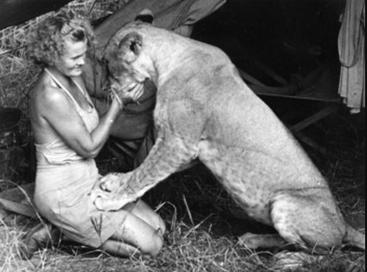
Aboard the ship to Africa, attracted to a fellow passenger, Joyce circled him as a lion would her prey. Dressed provocatively, she introduced herself as Friederike von Klarwill from Austria, and he introduced himself as Peter Bailey from Switzerland. They embarked on a shipboard romance, and after obtaining their divorces, in 1938, Joy and Peter took their vows. And had a safari honeymoon. Peter gave his wife his surname, and changed her first name as well, In Nairobi, Peter said as her Christian name was a mouthful, and that as she made him so happy, she should be called Joy.
A botanist, Peter introduced his wife to the beauty of African nature and encouraged her pursuit of painting. Her art brought recognition and an outlet for her tremendous energy. Her talent was such the Kenya National Museum put her works on display. As his wages as a game warden were meager, George was angered Joy funneled the money back into the country. However, as the storm clouds of World War II hovered, the British colonials looked askance at Joy who spoke with a heavy German accent. The famed anthropologist, Dr. Louis Leakey contacted the authorities regarding the Austrian. Police officers arrested Joy and detained her in a POW camp enclosed by barbed wire and armed sentries. Through Peter’s efforts, he obtained her release. He also gifted her a Cairn terrier puppy she named Pippin. Despite his kindness, Joy emasculated him for poor conjugal performances.
In 1942, while on a safari, Joy enjoyed the sunset in the Kenyan bush where she watched a group of dancing tribesmen. Knowing that the acclaimed game warden, George Adamson, would be joining the Christmas Eve party, Joy wore a slinky, silver evening dress. She was not disappointed when George came into view, his long blonde and beard blowing lion-like in the wind, sitting astride a camel at the head of a caravan. In the morning, shreds of a silver evening dress hung from the barbed wire surrounding her tent. When Peter surprised them, George sprang up and mumbled, “Sorry, old chap.” Before storming off, Peter replied, “You can have her.” A relieved Peter volunteered to pay for the divorce proceedings. Hoping that the Indian-born Brit would prove a better husband that her Austrian and Swiss ones, in 1944, the couple wed. They spent their honeymoon hiking the shores of Lake Rudolph, a crocodile enclave. George recalled, “Both of us werenearly killed by rhinos. But Joy discovered some lovely rock engravings. I captured several poachers and learned to call crocodiles. All in all, it was a good trip.”
With her third miscarriage, Joy slept with other men, and rarely with her husband. Joy did not live up to the promise of her name until serendipity stepped in. In 1956, George and his friend Ken came across a lion who suddenly went on the attack; Ken killed it in self-defense. attacked him and whose friend shot the animal in self-defense. Hearing a cry coming from the bush, they discovered three-week-old female cubs. The lioness had been defending her litter.
Upon his return to camp, Joy fell in love with the cubs and fed them watered-down milk through a rubber hose, and morsels of meat. The runt became her favorite who she named Elsa. Eventually three lions proved too dauting and the Admasons sent Elsa’s siblings -Lusitca and One, to the Rotterdam Zoo. Elsa ate from Joy’s hand, sucked her thumb, and shared George’s cot. They taught he to swim and took her on safaris where she enjoyed the view from the roof of their Land Rover.
At age two, the 300-pound Elsa met and roamed with a pride of lions, and Joy tearfully decided to release Elsa into the wild, something never accomplished. She taught Elsa to hunt and supply her own food. Joy was the first person to teach a lion to kill an antelope. In preparation for Elsa’s emancipation, Joy roamed with Elsa in the terrain she had been born. While Elsa thrived in her native environ, things proved problematic for her surrogate mother. On one occasion, a buffalo knocked her down and kicked her in the head. Releasing Elsa into the Meru National Park was wrenching. From a distance, the anxious den mother tracked Elsa, and worried when she nervously approached prey and the opposite sex. Elsa soon adapted and when pregnant, permitted her human parent’s to rub her extended belly. She often visited her old haunt with her three cubs born 108 days after her release-Gopa, Jespah, and Little Elsa-which she delivered 108 after her return to the wild- while her mate roared from the bush.
Austrian African Joy Adamson was a horse of a very different color; however, as with others, she turned to writing to exorcise her demons. After suffering three miscarriages, three disappointing marriages, and the release of Elsa, Joy began a book of her unique experiment. Her writer’s studio was by a river under a fig tree. She titled her Born Free, an allusion to The Acts of the Apostles, “With a great sum obtained I this freedom. And Paul said, ‘But I was born free.’” Joy took her manuscript and photographs to London where she was hell-bent to obtain a publisher.
Born Free became a publishing phenomenon-translated into twenty-five languages- and sold six million copies. Joy’s share of the royalties went to conservation causes, A movie followed, and David Attenborough paid a week’s visit in Kenya to film a production for BBC. Born Free did for big cats what Uncle Tom’s Cabin did for the abolitionist movement. Because of the emotional connection between humans and animal, the public perception altered: people could no longer dismiss lions as brutal predators to shoot on safari. Elsa became a symbol that animals had the right to be born-and live-free.
The celebrity embarked on a world tour while George worked with introducing his lion, Boy, into the wild. What cast a pall on her astounding success was a year later five-year-old Elsa died from tick fever where she had spent four years as a pampered pet. In tribute, Elsa’s grave held sone slabs.
Columbia Pictures adapted the plot into an Academy Award-winning 1966 film that starred Bill Travers and Virginia McKenna who founded the Born Free Foundation that promoted wildlife conservation. Because Joy proved intrusive that the director banned her from the set. Queen Elizabeth II attended the Royal Command performance in London; a photograph showcases the queen and Joy, wearing identical dresses, shaking hands. Joy founded the Elsa Wild Anima Appeal whose message was to “save the wild cats of Africa and the world by boycotting the trade of furs and other organic parts of the animal’s body sold as jewelry or trinkets.”
The adventurous Austrian had flirted many times with the Grim Reaper. In the El Lolo islands of Lake Turkana, Geoge shot a crocodile who had slithered into their tent. Wild African animals had charged and gored her; she had survived flash floods, blizzards, a Saharan sandstorm and a ninety-mile per hour gale as she navigated a flatbottom motorboat. But her arch nemesis of the two-fitted variety, provided her 1980 epilogue. She had gone for her customary evening stroll near Shaba, a remote camp where she had been studying leopards. When she did not return by 7:00 to listen to BBC radio, her assistant, Pieter Mawson investigated and discovered her body. He brought her body back to the preserve. The news spread she had died as the result of a lion mauling, something George refused to countenance. Skepticism as to her means of death increased: her tent bore signs of forced entry, and someone had cut her telephone line. The BBC carried news of Joy’s passing to a shocked public. An autopsy proved an assailant had murdered the sixty-nine-year-old patron of animals with a simi, a sharp pointed dagger.
In accordance with Joy’s wishes, the authorities transported her body to the Langata Crematorium; those in attendance were mainly journalists and George who watched the proceeding with tears streaming down his eyes. George scattered his wife’s remains over Elsa’s grave.
A month later, the police arrested Paul Nakware Ekai who confessed he had staged the scene to make it appear she had been the victim of a big cat mauling. His motive was Joy had not paid him for fourteen days’ work as a laborer, and, when he complained, she shot him in the left foot. He retaliated by ambushing her. He later swore the police had coerced his confession. Because he was eighteen, a judge spared him from execution by hanging. Twenty-two years later, in a prison interview, Paul said he was now rehabilitated, and that he sang in the choir at King’ong’ o prison and had converted to Catholicism. He explained, “I have sought God’s forgiveness. I pray every day. It is not easy, as Joy Adamason will haunt me until the day I die.” Nine years later, three men fired gunfire into George’s Land Rover, that resulted in his death along with his two Kenyan assistants. His murders were like poachers. Having had enough Joy in life, George left instructions that he be interred with Boy, his beloved lion. The lyric to Born Free captured the spirit of the irrepressible Joy, “As free as the wind blows…”

To pre-order my newest book, The World's Wealthiest Women: Fascinating Biographies of Heiresses, Royals, Entrepreneurs, and Entertainers, please click one of the links below.
- Amazon.com: amazon.com
- IndiePubs: indiepubs.com
- Bookshop: bookshop.org
- Amazon.co.uk
- Amazon.ca
- B&N: b&n.com
- Chapters Indigo (CA): indigo.com
- Books That Save Lives